


From now until the end of the year, Camden Chat writers will be revisiting some of the biggest moments and storylines of the disappointing 2025 Orioles season.
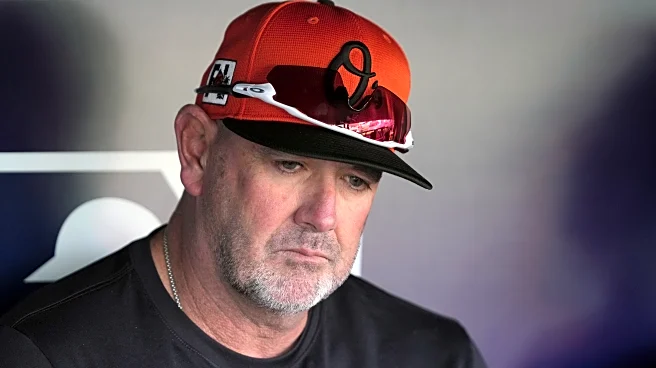
Few things illustrate that an MLB team’s season has not gone according to plan than firing the manager before Memorial Day even comes around. The 2025 Orioles found themselves in this company when a blown eighth inning lead turned into a loss that sent the team down to a 15-28 record on the season. After this game, manager Brandon Hyde was
relieved of his duties, replaced on an interim basis for the remainder of the season by then-third base coach Tony Mansolino.
It was not by accident that the Orioles had this record at this point in the season. The season was not going according to plan in so many ways, resulting in an offense that was in the bottom third of MLB teams, a defense and bullpen that were each among the five worst, and a starting rotation that counted among the bottom three by ERA.
To this day, I do not think these challenges were impacted in any meaningful way by anything that Hyde was or was not doing on a day-to-day basis. However, when a team comes in with the expectations it had and flops so hard, the manager may not be part of the problem, but he’s definitely not part of the solution. Hyde was out in the middle of his seventh season, having the team combine for a 421-492 record over his time at the helm. It is tough to say he deserved to stay. He has landed mostly on his feet, moving on after the season to a senior advisor job with the Rays.
For the offense in particular, the malaise carried over from the second half of last season. They hit even worse, as a team, in April and May of this year than they did in August and September of last year. That’s not to say that every Oriole was playing so poorly. Ryan O’Hearn was the team’s best hitter, with a .916 OPS at the time of Hyde’s firing. Fellow future Padre Ramón Laureano, the only successful offseason signing by the team, was also doing well. So were several other Orioles, including Cedric Mullins, who at this point had eight home runs in 41 games.
Much was going badly. Mike Elias’s biggest offseason addition, Tyler O’Neill, only played in 24 games by the time Hyde was fired, and after a hot first week or so, was heading towards flop territory. Weirdly-expensive backup catcher Gary Sánchez was batting .100 before hitting the IL at the end of April. Among incumbent Orioles, Ryan Mountcastle had just two homers in 42 games and Adley Rutschman was not miraculously fixed over the prior offseason, connecting a .654 OPS to his second half of last year. This was largely not IL-related chaos. This was guys who were supposed to be key parts of the team just not measuring up.
Last, although I feel bad bringing it up since I’ve always had hopes for the guy, there was whatever the heck was going on with Heston Kjerstad. Gifted the perfect opportunity for extended playing time by Colton Cowser idiotically breaking his thumb with a head-first slide into first base in the opening series of the year, Kjerstad batted .208/.264/.356 in 38 games, and his season went even worse afterwards. Orioles fans can take heart that it’s going to be a new group of hitting coaches for 2026.
On the pitching side of things, for as much as you can blame injuries on what happened this season, the fact is that through Hyde’s firing, 80% of the starting rotation was exactly how Elias lined up the roster. These five pitchers had started the most games by this point: Dean Kremer, Tomoyuki Sugano, Cade Povich, Charlie Morton, and Zach Eflin. Other than Grayson Rodriguez not having appeared yet and being replaced by Povich, the next man up, that was the Plan A rotation. It’s just that Plan A wasn’t a good plan, nor were any of the plans that came after it.
Morton bombed his way out of the rotation after six ugly starts. Kremer sat up over a 5 ERA, which he would improve on over the remainder of the season. Povich was also above a 5 ERA, something he did not improve on by season’s end. Eflin would give up eight runs in 5.1 innings later in the same series that Hyde was fired, after which he was either bad or injured for the rest of the season. We were in the middle of the four-game Kyle Gibson experiment, itself a desperate response to that Rodriguez injury. Trevor Rogers had not yet started an MLB game in 2025 at the time of Hyde’s firing.
In the bullpen through May 16, we find similar problems that have more to do with roster construction than any buttons Hyde was or wasn’t pushing. The Cionel Pérez disaster had not yet run its full course, though not long remained before the DFA. More significantly, the imagined late-inning leverage duo of former Phillies Gregory Soto and Seranthony Domínguez wasn’t more of a hearty meh, with Soto at a 4.40 ERA and Domínguez at 3.95. Yennier Cano’s 4.40 ERA was bad and by season’s end would get worse. Cano was a particular problem, as he ate the loss in three of these first 43 games.
Under Mansolino, the Orioles played almost exactly .500 the rest of the way, mustering a 60-59 record for the interim skipper. They did not play well enough to argue that this was a playoff team if not for what happened before Hyde was fired. Many of their other problems still plagued them through to the trade deadline, and once so many guys were traded away, new problems arrived. Elias has acted boldly to try to solve some of these things this offseason and hopefully will have some more bold action to try to help the rotation before spring training rolls around.
One of those baseball cliches is that managers are hired to be fired. Hyde did well for himself, hired as a rebuilding manager, to jump the gap and ultimately manage multiple competitive seasons. There aren’t many guys who pile up multiple 100+ loss seasons who get to do that with the same team. The franchise’s forward momentum halted in 2025 and so Hyde’s time finally ran out. How much was even his fault? It doesn’t matter now.