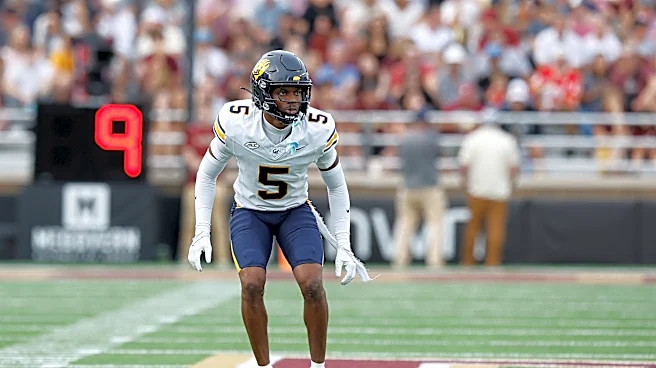



As the draft gets into the later rounds, most teams are looking for niche players who can fill a specific role or two on the team. So when the Las Vegas Raiders took former Cal cornerback Hezekiah Masses in the fifth round and 175th overall in the 2026 NFL draft, general manager John Spytek was likely looking for someone who brings ball skills to the Raiders’ roster.
Masses is coming off an impressive season where he recorded five interceptions and 13 pass breakups. According to Pro Football Focus,
that helped him allow a 49.2 completion percentage and notch a 20 percent forced incompletion rate when targeted. Those figures ranked sixth and tied for eighth among qualifying ACC cornerbacks (minimum 114 coverage snaps), respectively, and his 81.2 PFF coverage grade was seventh-best.
A big reason why the Cal product made so many plays on the ball last year is that he has a high football IQ, which stands out on tape.
Part of what makes Masses such an intelligent player on the field is that he’s good at reading the quarterback’s eyes and anticipating routes/throws.
Cal is in Cover 3 on the play above, and he does a great job of working for width and depth post-snap. That allows him to get his eyes in the backfield while using peripheral vision to read the route concept by maintaining outside leverage and keeping everything in front of him. So when the receiver runs the out route and the quarterback starts his throwing motion, the corner is in perfect position to jump the route and beat the receiver to the ball.
Finally, Masses high points the ball and shows off his hands and toe drag swag to come down with the interception near the sideline. That’s the result of a perfectly executed Cover 3 technique and a good read to take advantage of a quarterback staring down his throw.
This time, we’ll get an example of the first-team All-ACC performer playing games with the quarterback.
The Golden Bears are in Cover 3 again, and the Cardinals have a good play call for it. Louisville comes out in a three-by-one set where the trips receivers are in a bunch formation and all switch release post-snap. The second slot receiver (No. 80) runs a deep over route, while the outside receiver (No. 0) has a post route and the first slot receiver (No. 5) runs a fade.
That’s designed to create confusion for the defensive backs and test the execution of their coverage rules. The weak hook defender (No. 8) picks up the over route, and the outside cornerback (No. 5, Masses) passes off the post to the free safety (No. 2) to pick up the fade route. However, Masses understands what the offense is trying to do and uses the play design against them.
Instead of immediately passing off the post route to the safety, he follows the receiver for a couple of steps to make the quarterback think the fade route will be open. Meanwhile, the corner has eyes in the backfield the entire time, and once he sees the quarterback start to throw, he opens his hips and attacks the fade route. On top of that, the fifth-round pick high points the ball again to come up with another pick.
In other words, Masses was playing chess while the offense was playing checkers.
This next clip is similar to the last one, where Stanford comes out in a three-by-one set with the trips receivers in a bunch formation and all switch release post-snap. It is a different route concept and coverage, but the result is nearly the same for our subject.
The defense is in Cover 2 this time, and the offense is running a variation of double China, where the second slot receiver (No. 86) runs a corner route and the other two wideouts run short routes that break toward the middle of the field. So, there’s no threat to the strong side flat, which is Masses’ area.
At that point, Masses has two options, and both involve assisting teammates in coverage. He can sink and help the safety against the corner route, or squeeze the option route to help the strong hook-to-curl defender (No. 8) against the inside slot receiver. Masses lets the quarterback decide where he can help in coverage by keeping eyes in the backfield and reading the quarterback.
The QB’s throwing motion starts before the receiver on the corner route even gets into his break, so Masses helps defend against the option route by stepping into the passing lane and coming up with a PBU. Obviously, it’d be even better if he could come away with an interception, but the defense will take incompletions on third down, and this is a great play on the ball outside of his assignment.
This next clip deviates from Masses’ football IQ, as it’s really just a great play in coverage against high-level competition. He’s lined up across from Chris Bell, who was considered a potential first-round pick before tearing an ACL in late November and ended up getting drafted in the third round by the Miami Dolphins.
While Cal is technically playing Cover 3, with the offense in a heavy formation where the two receivers are in wide splits, it’s really more like man coverage for the two cornerbacks. They do have help in the middle of the field, but are on their own against a curl route since so many defenders are in or near the box and won’t have time to get enough width to help.
That’s why Masses lines up in press coverage, allowing him to be in a spot to defend the curl route while staying on top of his man. So, when Bell pulls up about six or seven yards into his route, the corner is in a great spot to drive on the receiver and make a play through the receiver’s back, swiping the hands at the catch point to come up with another PBU.
We’ll wrap up by shifting gears one more time and dive into how the former Golden Bear can provide run support on the perimeter.
He’s playing as the boundary corner as Louisville runs a pin and pull concept to the short side of the field. In other words, the offense is trying to target Masses in the running game by leaving him unblocked and creating a one-on-one opportunity between him and the running back.
When the corner sees the man he’s lined up across from release inside to block the safety crashing downhill, he works back toward the line of scrimmage to close the gap against the running back. Once he reaches the line, Masses breaks down and makes a solid open-field tackle to keep the offense to about a one-yard gain.
Now, there is room for improvement on the tackle attempt, as the Cal product has a bad habit of lunging and not bringing his feet with him, which can be seen on this play. This time, it’s only the difference between a short gain and a tackle for loss, but he did have six missed tackles against the run at a 23.1 percent rate last season, according to PFF.
So, that’s something he needs to clean up at the next level, but Masses is willing to get involved in run fits and is decently quick at diagnosing play designs to get to the right spot. The effort and the “know-how” are there; the technique just needs some work to be more consistent at bringing ball carriers to the ground.
Overall, the 175th pick may have a tough time developing into a starting NFL cornerback because he isn’t an elite athlete, earning an ugly 3.39 Relative Athletic Score during the pre-draft process. But his combination of football IQ and ball skills gives him a chance to carve out a role as a valuable backup. Who knows, maybe that will be enough to mitigate the lack of athleticism because it’s clear that Masses is a natural playmaker on the gridiron.