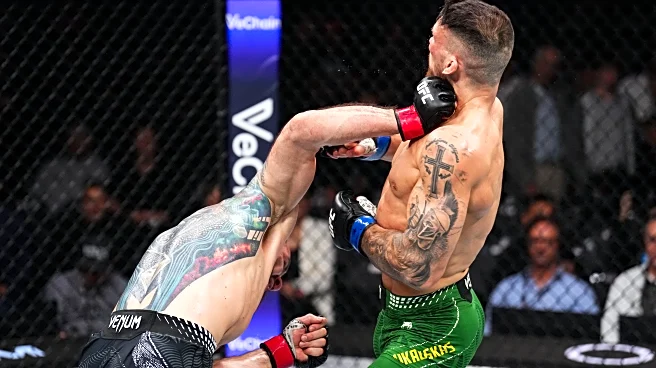

UFC 324 will go down in history as a landmark event.
The promotion’s debut on Paramount snapped a historic six-week absence, and fans were extremely eager for the string of knockouts that opened the evening.
Admittedly, the action slowed a bit by the main card, and the event as a whole suffered quite a few major hits before showtime. In the two weeks leading up to UFC 324, bouts were sacrificed to neck injuries, weigh-in kerfuffles, and questionable betting shenanigans.
Welcome to the fight biz, CBS.
Then, the main card as a whole didn’t exactly set the world on fire. Jean Silva vs. Arnold Allen was the definite highlight, a high-action affair between a pair of extremely skilled Featherweight contenders. The momentum quickly halted with yet another uneventful Flyweight Rose Namajunas performance, followed by Derrick Lewis looking tired and collapsing in exhaustion (officially a counter right hand) courtesy of Waldo Cortes-Acosta.
Once Kayla Harrison dropped off the card, pressure jumped for the main and co-main event to deliver. Sean O’Malley vs. Song Yadong, sadly, never really left second gear or resulted in any push for another “Suga” title shot. The main event was certainly fun, but the bottom line here is that an older, staph infected Justin Gaethje beat the piss out of a man UFC was hoping to turn into a star.
To my eye, the most eventful aspect of UFC 324 was announced the day prior when UFC CEO Dana White revealed a total restructuring of the bonus system. No longer would just four athletes received official bonuses picked at the whim of UFC brass. Instead, anyone who scores a submission or knockout finish is guaranteed a bonus $25k, and the original performance bonuses are still around to boost that number to $100k for a particularly impactful stoppage or scrap.
It’s a long overdue change, and it’s one UFC fans have been demanding for years. Previously, the pay structure incentivized winning much more than putting on a show. This directly contradicted the UFC’s actual preference, which involves cutting boring fighters who win too much. The new finishing bonuses are more honest, making clear the promotion’s need for violence over simple victory.
It’s great for the athletes as well. How often have we seen a spectacular undercard KO by a participant making pennies ignored for a more routine stoppage in the main event? It’s still not fair exactly, but this is a great move in right direction.
Interestingly, we might already be seeing results. Three of the first four fights produced knockouts in the closing seconds of their respective rounds. In the case of Nikita Krylov vs. Modestas Bukauskas, it was a genuine buzzer-beater. Krylov was seconds away from a clear-cut decision win, and instead he sat down on a right hand counter that turned off the lights. Generally, he pushed hard in the third despite his lead, clearly aiming for the finish.
His efforts to end the fight earned him an extra $25k. A month ago, it wouldn’t have scored him a bonus dime!
Given the scope of the Paramount deal, $25k is barely worth mentioning while balancing the checkbooks. The new bonus structure feels like a great way to improve the quality of the product cheaply. Based on the insane quantity of ads that aired during the broadcast, Paramount and company need that kind of victory wherever possible.