



The offseason will begin next week, and it will likely be a sprint on transactions until the collective bargaining agreement expires and transactions cease at the beginning of December. The Royals will have to make some moves to upgrade a team that took a disappointing step back in 2026, and that could mean creative trades to reimagine the roster.
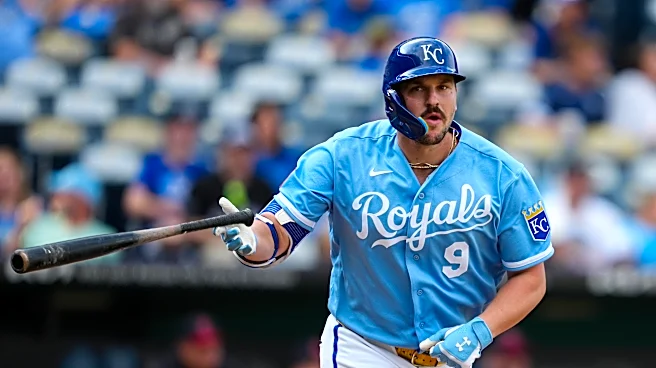
One way the Royals could reshape their roster is by trading veteran first baseman Vinnie Pasquantino. Writing for MLB.com, Perla Paredes raised the possibility
last week.
Pasquantino remains the club’s primary first baseman, but he could be among the position players Kansas City considers moving if a trade provides an opportunity to address its pitching needs. Such a move could open the door for Caglianone to return to first base on a more permanent basis.
The idea of trading Pasquantino would have been difficult to imagine a year ago, when he hit .264/.335/.477 with 32 home runs and 113 RBIs. But the 29-year-old took a step back in 2026, batting .249/.333/.428 with 17 home runs in 114 games. The Royals need his bat, but his regression has raised questions about whether he is part of the future of this club, particularly considering he has just two more years before he hits free agency.
The idea of trading Vinnie stems from three arguments.
First, Jac Caglianone has blossomed as a big leaguer. He was originally drafted as a first baseman out of Florida, but moved to the outfield to accommodate Pasquantino. His transition to the outfield has been about as smooth as you can expect for a 250 pound-Adonis, but Caglianone still rated poorly in defensive metrics such as Outs Above Average. Playing the outfield also cost Caglianone playing time due to injuries. He injured his shoulder crashing into the outfield wall in June, reinjured the shoulder making a diving catch in July, then injured his elbow making a throw in September.
However, Caglianone is all of 23 years old and is still learning the outfield. The Royals shouldn’t give up on his development there after one injury-plagued season. His defensive metrics may be poor now, but he has the athleticism to improve with experience. Bobby Witt Jr. was a poor defender in his first year at shortstop and is now a Platinum Glove winner. He has the perfect arm for right field, a cannon that can fire the ball in the high-90s. If he can learn to play with passable range, he could be an asset in the outfield.
The second case for trading Pasquantino is his record of injuries that have kept his bat out of the lineup. He missed the second half of the 2023 season with a torn labrum. A collision at first base cost him the final month of the 2024 season when he fractured his thumb. Back and wrist injuries cost him nearly 50 games this season.
Injuries suck, but Vinnie’s injuries stem mostly from bad luck, not a chronic condition. The fact that the offense fell off so much without him is a testament to how important he is to the lineup. The Royals went into a tailspin in September of 2024 once he got hurt, nearly missing the playoffs. Vinnie’s injuries also illustrate that moving Caglianone to first is not necessarily a solution to keeping him healthy – injuries can strike anywhere.
Another reason why some fans are open to trading Pasquantino is his penchant for getting off to a slow start. Vinnie is a career .207/.300/.382 hitter in the month of April. He has had pretty pronounced first-half and second-half splits.
- Pre-All-Star break: .247/.318/.409
- Post-All-Star break: .289/.353/.521
The Royals got off to a slow start in 2026, and much of that can be attributed to the lack of offensive production early in the year from Vinnie and Salvador Perez.
However, it is not as if early games count for more than games later in the year. Had Pasquantino reversed his splits and hit well at the start of the season, only to go into a slide in the second half, the Royals’ fortunes would not have appreciably changed. And while Pasquantino’s April numbers are concerning, monthly splits don’t necessarily predict future performance. The Royals shouldn’t trade a productive middle-of-the-order hitter simply because he has historically struggled early in the season. The bigger question is whether his overall production justifies his place in the lineup, not whether he delivers it consistently from April through September.
When judged on a year-by-year basis, Pasquantino has been a steady, above-average bat. Even after his slow start this year, he ended with a line of .249/.333/.428, an OPS+ of 113, perfectly in line with his past two seasons. Despite missing seven weeks, his 2.5 fWAR was 13th among all first basemen.
If the Royals were to trade him, it would leave a hole in their lineup that they would have to fill in the outfield if Caglianone moves to first. Can the Royals find an outfielder that can put up an OPS+ of 113? Only 26 outfielders with 300+ plate appearances did that last year. How many will be available? The team also needs upgrades in left and center field. Can they revamp all three outfield positions in one offseason with a mediocre free agent class and an overall decline league-wide in quality of right-handed hitters?
There should also be something said about the leadership Pasquantino provides on the club. Intangibles can be overrated, but they aren’t meaningless. Pasquantino has been the face of the team, the voice of the players during tough times. After this season, he called the year a “failure” and said the team needed to live up to the expectations placed on it. When the team struggled last year, he took responsibility, saying, “It starts with me.” He addressed the media when Carter Jensen missed a game for oversleeping, saying, “It can’t happen.”
Young players like Caglianone and Jensen need leaders who hold the clubhouse accountable and lead the team through tough times. Bobby Witt Jr. is more reserved, a star who leads by example. Vinnie is clearly the kind of player teammates gravitate toward, making him a valuable presence in the clubhouse beyond what he contributes at the plate.
The Royals should of course, be open to trading anyone under the right circumstances. The Brewers and Rays show how being transactional and unafraid to trade anyone can yield results. Trading Pasquantino might make sense if it brings back a major piece, but moving him just to solve a positional puzzle or capitalize on a down year could create more problems than it solves. Sometimes the best move is recognizing what you already have.