





One of the larger NFL conversations over the past year has been about the use of tight ends in modern offense.
The dialogue started during the middle of the 2025 season with the Los Angeles Rams. Wide receiver Davante Adams missed a few games midseason. To account for the loss of Adams, Rams head coach Sean McVay adjusted his entire offense. After relying almost exclusively on 11 personnel (one back, one tight end and three wide receivers), the offense pivoted to 12 and 13 personnel, putting more
tight ends on the field.
This unlocked a new element of Los Angeles’ offense. The Rams were able to get better blocking personnel on the field while also maintaining an element of verticality to their passing offense. The depth and versatility of skill sets at tight end made this work.
- Terrance Ferguson was the vertical threat that could stretch the field.
- Davis Allen and Tyler Higbee were competent blockers who could catch underneath checkdowns.
- Colby Parkenson was the best inline blocker of the group, but he has more receiving skills that most inline tight ends.
The Rams’ offense was able to run most of its base offensive concepts, just with different personnel. When teams put heavier personnel on the field, it forces the defense to make a decision on how to match that. Defenses can put an extra defensive lineman or linebacker on the field to help against the run. The tradeoff is that the unit has less coverage versatility. Defenses can also play Nickel or Dime, but it’s the risk of being soft against the run with light boxes increases.
The Rams got defenses off balance in this way better than anyone else in the NFL, and other teams have tried to adopt a similar model.
This offseason, teams like the Los Angeles Chargers have prioritized spending on blocking personnel. Los Angeles signed former Baltimore Ravens tight end Charlie Kolar to a three-year, $24.3 million deal. Kolar has only 30 catches in four NFL seasons, but his ability to block adds a different layer to their offense. The Chargers also signed fullback Alec Ingold to add more versatility to that skill-position group.
This personnel trend was also apparent in the draft. A staggering nine tight ends went in the top-100 of the 2026 NFL Draft. Of those nine, six of them – Nate Boerkircher, Marlin Klein, Sam Roush, Oscar Delp, Will Kacmarek, and Eli Raridon – are projected to be blocking tight ends without high-end receiving upside.
The Kansas City Chiefs certainly didn’t get in on the tight end bandwagon.
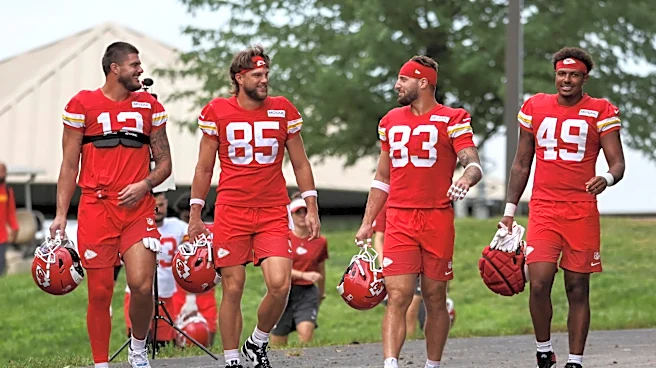
The Chiefs are running back the same tight end room with Travis Kelce, Noah Gray, and Jared Wiley, with deep roster guys like Tre Watson or Jake Briningstool, and undrafted free agent John Michael Gyllenborg behind them.
With Kelce, Gray, and Wiley, do the Chiefs have enough versatility for a modern NFL offense?
Travis Kelce
As Kelce has aged, his versatility has declined. At his best, Kelce dominated the intermediate parts of the field and was able to open space for other players. Over time, his route tree has gotten much shorter.
Kelce now gets many of his targets within five yards. He’s still very effective on those targets, but nobody has replaced the void Kelce left in the intermediate part of the field. That has left the offense feeling cramped over the past 2-3 seasons.
On top of that, Kelce has always been limited as a blocker and in how you can use him. Kelce often needs to play in the slot, which essentially negates any potential impact in the run game.
Noah Gray
Gray has always been a tough fit with Kelce. Gray has some receiving chops, but mainly as an underneath chain mover. He’s never been a great fit with Kelce as a blocker. Gray also needs to be off the line of scrimmage and inserted into gaps, but that’s also how Kelce needs to be used. Gray is often put in a worse spot as the in-line tight end trying to block defensive ends, and it rarely goes well.
Jared Wiley
Wiley has had a pretty minimal role in the NFL. He played 28 snaps last season and 94 the season before. He doesn’t really add any meaningful skill set to the offense. Frankly, I am more interested in seeing whether one of the deeper names on the offseason roster can overtake him as the third tight end, adding a different skill set.
Briningstool would likely be the best blocker of the three, so I could see him earning the third-tight-end snaps. Gyllenborg and Watson are more receiving threats, which could be a tough fit with Kelce and Gray. If either Gyllenborg or Watson can stretch the field, they could see some snaps in front of Gray in 13 personnel to open space for Kelce.
If the Chiefs want to establish more of a run game, particularly an under-center one, having more blocking versatility is going to be important. I don’t feel they currently have that with Wiley, Gray, or Kelce. My hope is that over the course of training camp, one of the other guys emerges and adds a new layer to the offense.
With the weaknesses of the team at wide receiver, having any ability to play multiple personnel could have immense value. I’m skeptical the offense has the players to do that, but if it does, that could be a massive part of the offense succeeding in 2026.