
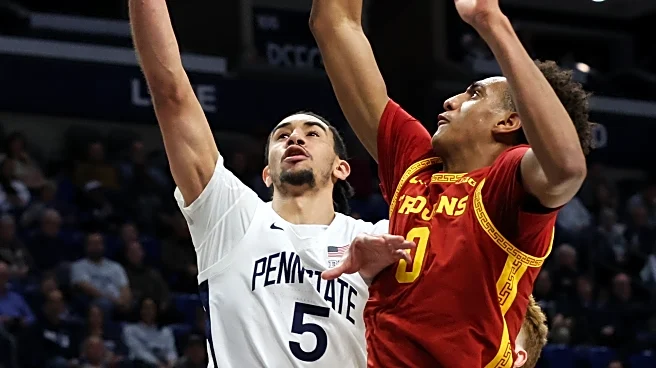


Maryland men’s basketball’s late-night bout against USC saw the Terps drop their sixth straight Big Ten game. They came up against a physically impressive opponent and were unable to mount any sort of a comeback.
Here are three takeaways from the game.
Coit can still go off… but at the expense of everyone else
Diggy Coit is the Maryland player outside of Pharrel Payne who has looked most likely to go on a tear for the Terps since the very beginning of the season. Some of his already legendary games for Maryland need no introduction.
But in recent games, Coit
had faded to the background. His shots were not falling, limiting the impact he could have as a high-volume shooter. The box score doesn’t always match the eye test — it was almost better for head coach Buzz Williams to leave him on the bench at times, despite every announcer keying in on him as the Terp to watch.
He had another impressive game against USC, becoming the first Terp to score 30 points in a road game since Jahmir Young on 9-of-18 shooting.
Lots of the shots Coit made were his ridiculous, how-did-he trademark style. They had to be, given the sheer size of the opponents.
Maryland needed every point it could get from him to try to hang with the Trojans. At the same time, though, once Maryland chooses to run heavily through Coit, the monkey’s paw twists.
He swallows up possessions looking to play his iso game, which limits what Maryland can do outside of him. The ball stops with him, and the offense can stutter once he eventually hands it off.
In high-scoring games, that just doesn’t work. Coit taking 41% of Maryland’s first-half shots keeps teammates from getting into a rhythm and finding their own shots.
Williams has previously referred to Coit as a player who hasn’t seen a shot he doesn’t like — that rings true, and it’s a high-risk, high-reward game that can leave Maryland even more vulnerable in transition.
But the simplest truth is that Maryland needs points. Coit has the biggest upside to get them those points. Cutting off the nose would spite the face, and Maryland needs to save as much face as it can.
The Terps can’t stop giving up big runs
Maryland had some good moments defensively against USC, particularly early in the game. The Terps had certainly done enough to build some confidence that they could hang with the Trojans; leading the game three minutes into the second half would have validated those feelings.
But behind every Maryland loss this season is a moment where the opponent stretched out the game — because Maryland was unable to keep up offensively, or because the Terps went and shot themselves in the foot.
Tuesday’s game fully encapsulated the second. Maryland gave up a 10-0 run over 96 seconds that completely flipped the momentum, turning its four-point lead into a six-point deficit.
A simple layup was followed by an and-one on the break and a 3-pointer, with USC then getting a standard shot in turn a few possessions later.
Offensive fouls on Solomon Washington — who got called for an illegal screen from walking upcourt — and Elijah Saunders left the Terps unable to punch back as the Trojans hit them in the mouth.
When Maryland finally got its next offensive opportunity, Coit took a corner 3-pointer while being contested by 2-and-a-half defenders — not the high-percentage shot that it needed to ease the offense back in.
Part of the problem for Maryland seemed to be the constant interchange of players through that stretch, which was exacerbated by Washington and Adams picking up fouls. The team hasn’t found a unified approach all season, but that certainly didn’t help them move in the right direction.
Should Payne come back?
If Pharrel Payne returns to full health within the next few weeks, he will leave Williams with a true conundrum.
It feels like a safe bet to say Maryland will not make the NCAA Tournament. Odds are, they won’t make the NIT or the Crown or any other postseason play either.
While it is difficult for a team to write off a season entirely, Maryland does not feel like it has much more to gain here outside of developing youngsters. Payne does not fit that bill — he is an impact player who is ready now.
Given all of that, hedging bets for the 2026-27 season seems reasonable. Several talented freshmen should come in and be impactful pieces that accelerate or complete the rebuild, but the Terps will need to grab veteran leaders from the portal.
Getting to stash one they already know is a culture fit and a true difference-maker — and potentially an excellent mentor for the bigs coming in — could be the best thing to come from the remainder of Maryland’s season.