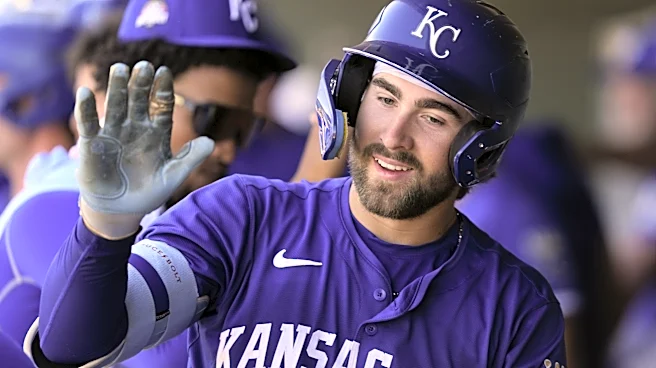





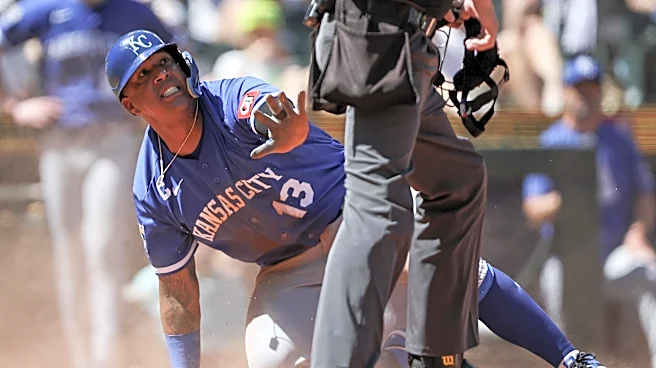
The Royals selected Blake Mitchell with the eighth overall selection in the 2023 Major League Baseball draft, a somewhat surprising pick at the time. High school catchers are an extremely risky demographic with a high failure rate, but the Royals believed in his hitting ability. To Mitchell’s credit, he had an excellent debut in 2024, hitting well in A-ball and forcing his way to High-A by the end of the year.
Unfortunately for Mitchell, he fractured his hammate bone last February and 2025 was therefore
a bit of a lost season for him. He displayed the same command of the strike zone and propensity for striking out as he did in his debut season, but the recovery from the fracture sapped much of the power from his swing.
A lot of eyes were therefore on Mitchell this year. Could he develop as a hitter? Would he get his power back? Additional organizational pressure was also on Mitchell thanks to the unfortunate fact that Kansas City’s three previous first round picks before him—Asa Lacy, Frank Mozzicato, and Gavin Cross—have flamed out in the minor leagues, with the Royals officially releasing Lacy this year. No team can endure drafting so high for so long and get nothing out those valuable picks, least of all a small market team.
So has Mitchell advanced? Well, he’s having a season for the ages, that’s for sure.
Let’s start with what kind of hitter Mitchell is, because that’s important. The Royals have, traditionally, valued defense, baserunning, athleticism, and contact ability. They have not valued power or plate discipline. But Mitchell is made up almost entirely of the latter two. Interestingly, the Royals knew it when they drafted him, comparing him to Bryce Harper.
And Harper, well, Harper is great, but he’s not a traditional Royals hitter. Harper knows the zone, has a swing built for home run power, and isn’t afraid of striking outs. As a result, he walks a lot, hits a lot of home runs, and strikes out a lot. Those three events are sometimes called the “three true outcomes” because all three events happen independently of the defense. For his career, Harper’s plate appearances have resulted in one of those three outcomes 43.6% of the time, which is a lot, but not quite the extreme upper end. The real platonic ideal of the “three true outcomes” hitter of recent years has been Joey Gallo, who has walked, struck out, or crushed a homer in 58.7% of his career plate appearances. That’s a huge percentage.
But Gallo can’t hold a candle to what Mitchell is doing, because Mitchell is achieving one of the Three True Outcomes an almost unbelievable 70.3% of the time.
The above video is really the key to understanding why this is happening at all. Mitchell generates crazy bat speed with a fly-ball swing, which translates to elite exit velocity figures and verrrry long homers. As a result, pitchers stay away from him, and Mitchell is more than happy to draw walks when they’re not giving him something to hit. At the same time, Mitchell isn’t a guy to choke up on the bat and look to poke pitches to the opposite field and is perfectly content with a full-throated swing—even if he ends up whiffing.
Mitchell’s triple slash in High-A is really funny because of this: .213/.479/.508. With a 33% walk rate, he’s gotten 31 walks on May 3; Salvador Perez has walked 31 times in a whole season just once. But he’s also struck out 30.9% of the time, which is just a crazy situation.
Walking a lot, striking out a lot, and hitting a lot of home runs is a relatively common combo. But what Mitchell is doing so far this year is literally unheard of. No qualified hitter in MLB history has ever ended up with a walk rate and a strikeout rate north of 30%. Heck, lowering that figure to a 20% walk and strikeout rate only yields 10 hitter-seasons since 1970 (not counting 1994 and 2020):
Now, let’s be fair: we’ve only had a month-ish of baseball so far, and the chances of Mitchell having his own bizarre 30/30 season over the full year are basically nil. But Mitchell does have 330 plate appearances in High-A ball overall, and he’s walked 23.3% of the time and struck out 32.4% of the time.
What’s the takeaway here, then? For starters, I don’t think High-A is challenging him nearly enough, and if it were up to me I’d promote him to Double-A tomorrow. Mitchell needs to cut down on his strikeout rate if he wants the best chance to succeed in the big leagues, but right now he can sleepwalk to being the most dangerous hitter on the team by simply murdering mistake pitches and spitting on the ones that aren’t in the zone.
The other takeaway here isn’t really a takeaway but an invitation to examine if Mitchell might indeed be able to succeed in the big leagues with a big ol’ strikeout rate. I have thus far been very skeptical of Mitchell for this reason, but he’s starting to show a level of plate discipline and game power where it just might work. I mentioned Gallo earlier, but his career .194/.319/.456 line, while bizarre, kept him in the league for a decade. Could Mitchell be a sort of Gallo at the plate? Maybe! The other potential guy to look at is Munetaka Murakami, the rookie Japanese slugger who has a 144 wRC+ despite a 33.1% strikeout rate because he walks almost 19% of the time and hits dingers left and right. Like, the White Sox could not care less that he’s only hitting .223.
I’d love it if Mitchell could wrangle his strikeouts down to a more manageable level. At the same time, it’s almost more fun to consider a world in which the Royals are the ones with the ridiculous Three True Outcomes player. Can the Royals develop such a hitter? That is another question, one that I don’t really like my gut answer to. I guess we’ll just half to wait and see.