


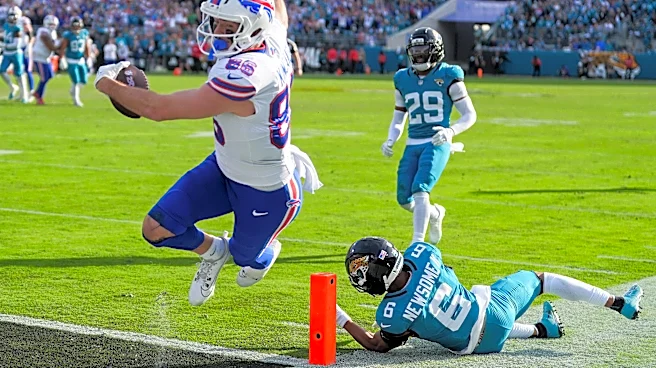
Josh Allen is going to throw the football to receivers more frequently this season than he did in 2025, but we can’t forget about the tight ends — particularly Dalton Kincaid — in this Buffalo Bills offense.
It’d be next to impossible for Allen to throw the ball to receivers less than the 270 targets to wideouts last year, which was the seventh-lowest figure in the NFL.
And for as much as we’re all aware of the receiver glitz and glam of Joe Brady’s national title winning season at LSU as the offensive
coordinator in 2019 with Justin Jefferson and Ja’Marr Chase at his disposal, that magical year isn’t necessarily a glimpse into how the Bills head coach will deploy offensive personnel — anyone in their right mind would’ve been wideout-heavy with Jefferson and Chase as headliners.
Remember, the Bills decided to keep just five receivers to four tight ends on their initial 53-man roster after the preseason, and Kincaid is playing on the final “cheap” portion of his rookie contract this season. Earlier this week, Joe Buscaglia of The Athletic wrote he believes Kincaid is in line for an “enhanced role” in the Bills, which won’t be difficult given former first-rounder only appeared on 26.8% of Buffalo’s offensive snaps in 2025.
Kincaid didn’t play against the Texans last season, a game in which Allen and Co. certainly could’ve used the tight end who ultimately led at his position in yards per route run — the ultimate efficiency metric — at 2.79 yards.
In his prolonged absences, Dawson Knox enjoyed his most productive season since his nine-touchdown 2021 and highest YPRR of his NFL career to date (1.35). Jackson Hawes, who played 43% of Buffalo’s offensive snaps, amassed a rather impressive YPRR of 1.89 and Allen had a 143.7 rating when targeting the rookie.
Another byproduct of Kincaid’s prolonged absences… the Bills were in fact not near the top of the league in ‘12’ personnel — the most common personnel grouping with 2+ tight ends on the field. In fact, Buffalo’s 11.5% usage of 12 personnel was the third-lowest percentage in football in 2025.
But what if we’ve been perceiving Kincaid wrong all along, or, at least differently from how the Bills have — and may continue — to view him?
Check this tweet from Cover 1’s Anthony Prohaska on how Buffalo utilized their tight end:
Note —it does feature a typo, it should read 2025 not 2026*
Add those slot and wide percentages together for Kincaid to get 66.9% at one of the classic “receiver” pre-snap alignments. Pretty insane, right?
And there’s more on this front:
For all intents and purposes, Kincaid was a tight end in 2025, and the Bills have used him as such for the majority of his NFL career to date.
Now, don’t get it twisted. I don’t look at Kincaid as a receiver, nor has he or should he be expected to provide the Bills with receiver-like volume and productivity. Being treated “like a wide receiver” is not actually being a wide receiver in the modern-day NFL.
For example, among all receivers and tight ends who have run at least 750 routes since the start of 2023, Kincaid’s 5.1 targets per game would rank 51st among receivers.
Of course, a quasi-argument of sorts can be made that the Bills could’ve / should’ve made sure they secured a receiver in the first round of the 2023 NFL Draft. Armed with the 27th overall pick and no receivers selected as the Seahawks went on the clock with pick No. 20, the Bills likely felt very good about their chances to pick a receiver in Round 1.
Then, four receivers went consecutively, and Beane feverishly traded ahead of the Cowboys to secure Kincaid’s services. Afterward we heard Kincaid was Buffalo’s final prospect with a first-round grade, which is what prompted the trade up, and I believe that. He also could’ve been the consolation prize for an offensive-weapon hungry club that didn’t get the chance to draft a Round 1 receiver. Whether the latter is how the Bills were actually thinking, we’ll never know.
But Kincaid has been deployed about as close to a receiver as a tight end can conceivably be through three NFL seasons.
We’ve all heard about Kincaid bulking up this offseason — was that intention due to his knowledge of a more traditional tight end role for him in 2026? If so, it’d significantly decrease the run-pass telegraphing for Joe Brady’s attack this season, which, theoretically, could have a massively positive impact on Buffalo’s offensive efficiency that’s already established as one of the league’s best.

On Sunday, with All-Pro Derek Stingley on the outside and Kamari Lassiter emerging as one of the better young No. 2 cornerbacks, in football, it feels like featuring Kincaid over the middle is the prudent decision for the Bills pass game. Yet, I don’t believe Knox and even Hawes will suddenly see their roles reduced.
In 2025, the Bills were middle of the pack in 13 personnel usage — one running back, three tight ends — at 4.32% of their offensive snaps. The Rams were lightyears ahead of the rest of the NFL in 13 utilization, at a whopping 30.4%.
Fascinatingly, Buffalo led the league in 22 personnel rate — two running backs and two tight ends — at 13.3% of their offensive snaps. With DJ Moore on the roster, it’d be easy now for the Bills to swap the extra running back for a receiver to ramp up multiple-tight end sets, right? Very easy.
Given Kincaid’s receiver-like prowess at tight end along with his added strength, Knox’s reemergence in the offense a season ago, and Hawes in Year 2 after a successful rookie campaign, we shouldn’t be surprised if Brady leans into his luxurious depth at tight end and features the position, with positional hybrid Kincaid as the headliner against the Texans and throughout the 2026 season.