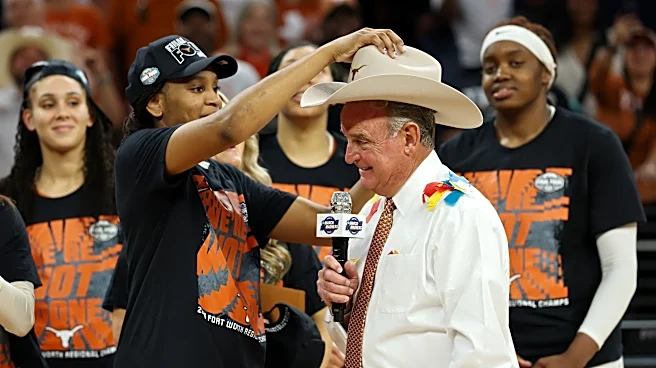




For the second-consecutive year, the Texas Longhorns are headed to the Final Four—a statement that, for such a legendary program, needs some historical context.
During the early days of the women’s NCAA Tournament, Texas was one of basketball’s dominant forces, led by Hall of Fame head coach Jody Conradt. In their first eight years of the tournament, the Longhorns made the Elite Eight seven times, the Final Four twice and won a national championship in 1986. They were, along with Tennessee, USC and Louisiana
Tech, the gold standard.
Forty years later, Texas has returned to the top of the women’s basketball world.
After winning the 2026 SEC Tournament with relative ease and earning a No. 1 overall seed in the NCAA Tournament, the Longhorns have dominated their competition on the national stage, winning their games by an average of 35.5 points and looking like a legitimate championship contender for perhaps the first time since Conradt retired in the mid-2000s. They were a No. 1-seed last year, too, and they haven’t changed much of the formula that got them to the 2025 Final Four; they’ve just done it even better this time around, and it has them closer to the promised land than they’ve been in decades.
The numbers behind the Longhorns’ success
As long as Vic Schaefer is coaching the Longhorns, they’re going to play defense. That’s a given.
A native Texan, Schaefer built Mississippi State into one of the SEC’s best programs prior to the COVID-19 pandemic, and he’s had the Longhorns on a similar trajectory since taking the job in 2020. Schaefer has the reputation of being one of the most defensive-minded coaches in the country, and it’s reflected in the energy, discipline and hard work the Longhorns bring on every possession.

The statistics reflect it, too. There are very few, if any, teams that get after it on defense quite like Texas. According to Her Hoop Stats, the Longhorns rank No. 2 in the nation in defensive efficiency, allowing a paltry 76.4 points per 100 possessions. Not only are they among the best in the business at forcing turnovers, they’re even better at grinding opponents down and forcing difficult shots late in the shot clock; Texas opponents have recorded an assist/turnover ratio of 0.41 on the season, which is the best such mark in Division I.
Again, this is to be expected from a Schaefer team. What’s truly set Texas apart this season is the improvement they’ve made on the other end of the floor. The Longhorns are putting up 116.1 points per 100 possessions (No. 5 in Division I), shooting 50.2 percent from the floor (No. 5) and posting an assist-to-turnover ratio of 1.51 (No. 4). To put it simply, while the Texas defense makes it nearly impossible for opponents to get quality looks, its offense has been having a remarkably easy time getting good shots of its own, and they’re downright crushing teams in the possessions battle.
Texas must stay true to its identity in the Final Four
Even so, the Longhorns are not an offensive avalanche, at least not compared to their rivals in the Final Four. They can’t lean on their guards like South Carolina, they don’t play with the surgical precision of UConn and they can’t match UCLA’s sheer star power.
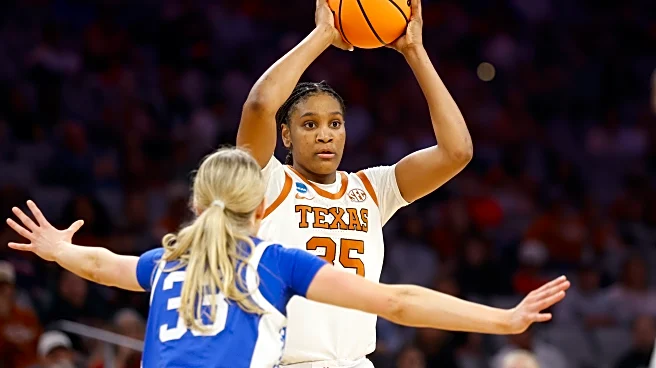
What they do have is one of the most brilliant scorers in the nation in Madison Booker, and a rock-solid infrastructure surrounding her.
Booker, who was recently named to her second All-American First Team by the Associated Press, has a remarkable talent for making the most difficult parts of the game look easy. Tall, skilled and explosive, Booker’s midrange game is nearly unguardable; opponents know it’s coming, but they still can’t stop it, and the way she occupies her space on the floor opens things up for the Longhorns’ other players. While this doesn’t necessarily mean Booker herself creates shots for her teammates—she averages 3.8 assists per game to go with her 19.3 points, but she’s going to hunt her own shot more often than not—she’s far from a black hole on offense, and she’s efficient, too, shooting 52.3 percent from the field.
The way Booker operates within the Longhorns’ system, rather than operate as a system unto herself, is key for keeping things moving. Point guard Rori Harmon is the engine that powers Texas, playing with boundless energy on both ends of the ball, and she’s one of the most prolific passers in the country at 6.3 assists per game. Sophomore Jordan Lee is responsible for keeping defenses honest with her 3-point shooting; she’s the only Longhorn who attempts more than two long balls per game, and when those shots are going down, it makes Texas that much more dangerous.
Then there’s the size. As a unit, Texas is massive; save for Harmon, who tops out at 5-foot-6 on her best day, the Longhorns have above-average height at every position, especially in the frontcourt, where Breya Cunningham (6-foot-4) and Kyla Oldacre (6-foot-6) control the paint. Texas never gets bullied on the glass (56.6 percent rebounding rate; No. 9 in Division I), which is crucial in fueling their transition offense.
All of this is to say that Texas has reached the Final Four by playing a very specific way.
No doubt, it’s worked for them. The overarching team philosophies of outworking their opponents and defending each possession like it’s their last earned the Longhorns a dozen wins over ranked opponents prior to the NCAA Tournament, and the results since then have been even more impressive. But at this point in the competition, everyone is talented and everyone plays hard. If Texas is going to avenge last year’s Final Four letdown and make it to the national championship game, they’re going to have to lean on their core principles more than ever.