



Carl Williams IV signed with Baylor in 2023 as a high 3-star (0.8803) corner having played both ways in high school. Despite not being a blue chip prospect, he saw snaps during meaningful time as soon as week 1 of his true freshman season. He played in all 12 regular games during 2023, beginning as part of a four-man rotation at outside corner before moving to his permanent spot at nickel corner in week 6 against Texas Tech.
Williams was the starter at nickel to begin his true sophomore season in 2024,
but suffered an injury to his miniscus that he struggled with throughout the year. He was limited to only seven games during the regular season but returned for the bowl game.
The injury continued to bother Williams throughout the off season heading into 2025. He was medically cleared to play in week 2 against SMU but was only on the field for a total of five plays during the entire game. After this he elected to take a medical redshirt, and announced his intention to enter the transfer portal in January. Less than a week after officially entering the portal he committed to Oregon.
Williams’ background is quite similar to 2025 starting nickel/STAR safety Jadon Canady’s before he arrived at Oregon. Both had experience at outside corner, inside corner, and deep safety as well as losing a year to a serious injury before becoming Ducks. Unlike Canady though, the film I had on Williams is all from before he took his medical redshirt. As such, I cannot predict exactly what his abilities will be once he returns to the field.
I suspect the Ducks’ staff did quite a bit of work checking on his health before offering him a roster spot, but also hedged their bets by taking Aaron Scott Jr. from Ohio State as a developmental player and backup as well. I’m hopeful Williams will be full go for the Spring game this Saturday so I can compare his athleticism to his previous tape. Assuming he is fully recovered, his experience in a very similar role at Baylor would seem to put him in contention for Oregon’s starting nickel role in the Fall.
Though he was listed as a cornerback coming out of high school and played outside in the first part of his freshman season, the Bears staff saw Williams talents were more suited to the nickel position. This meant he lined up over receivers in the slot or the #2 (inside) position depending on the offenses’ alignment. From here he could most often do what the film showed he did best: read the play in front of him and attack the ball carrier. I found his ability to properly diagnose what the defense was doing very impressive for an underclassman. He doesn’t have elite foot speed, but accelerated well when breaking on the ball. Below I’ve compiled a representative sample of clips from Williams’ true freshman and sophomore seasons show him successfully diagnosing and reacting to passing plays.
(Reminder: you can click on the gear icon in the upper right of the video to adjust the play speed.)
- :00 – Williams is #15 here (as he is in all clips shown in this article), lined up over the slot receiver to the offense’s left. This was his designated position against trips formations. Williams reacts immediately to the #3 (inside most) receiver heading toward the sideline behind the line of scrimmage and attacks the slot receiver’s outside shoulder to keep contain against a screen pass. He works through the block by keeping his arms extended and throws the ball carrier out of bounds before they make the line to gain.
- :09 – Iowa State runs the same screen as in clip 1, but has the receiver get up to speed in motion before the snap. Williams is lined up over the inside receiver on the offense’s left. He completely discards his blocker and cuts off the ball carrier’s path to the sideline. The WR ISU #13 is nimble enough to dodge the first tackle, but this forces him back in toward where the pursuing defenders can finish the job.
- :19 – The plan for the offense is to run a switch release with the receivers to the boundary (on the offense’s left). This will allow a catch-and-run that will at least put them in better field goal range if they cannot convert third and long. Williams is over the inside receiver, and knowing the down and distance gives ground at the snap to not let his assigned man behind him. Williams dodges traffic to follow ISU #13 outside to force him out of bounds well short of the line to gain.
- :31 – West Virginia tries to catch the defense in a bad alignment by putting four receivers to the field in an unbalanced formation. Williams is in tight press coverage against the slot receiver in the cup centered on the hash marks. He’s at a size disadvantage against a tight end, but makes up for it with proper leverage. He turns the blockers shoulders so the receiver (a split out RB) tries to go in-and-out but Williams effective hand use lets him disengage to assist with the tackle.
Listed at 6’ 1” and 192 lb. going into the 2025 season Williams was one of the smaller players who regularly saw the field for the Bears (though he is bigger than Canady was). I thought he used leverage very well to compensate when at a size disadvantage, but in some situations it led to poor match ups for him. Aside from his physical limitations my only concern for him in a read-and-react scenario is that I caught his tackling form getting lazy on occasion. This is something a new coaching staff will have a chance to address before competition begins in the fall. Below are examples of these issues.
- :00 – Williams has inside position against the stack on the offense’s right. Against this bubble screen he tries to keep the receiver in front of him to cut off his chosen path. The Red Raider does a good job with his path to guide the defender right into an offensive lineman releasing downfield, which is too much a difference in mass to overcome.
- :10 – Over the slot receiver to the offense’s right, we see again Williams’ excellent technique in engaging the blocker so he can get to the ball carrier. He fails to sink his hips before wrapping up though, allowing the receiver to shed the tackle.
- :31 – This play is why “keep your head on a swivel” is such a coaching cliche. Williams is so focused on reading the action in the backfield and the inside most receiver he doesn’t see the outside receiver coming to shoulder check him on his way to the corner.
- :46 – No excuse for tackling technique like this. Williams is playing zone over the #2 receiver and makes a good reaction too the short in-breaker to the #1. If he wraps up the TCU player’s thigh it’s only a three yard gain. Using his shoulder to try and dislodge the ball just lets the Horned Frog turn his body to protect the catch and keep running.
AtQ was able to acquire footage of all off Williams’ FBS games from 2023-2025, but unfortunately not all of it was high quality and most games I didn’t have access to all-22 camera angles. This made evaluating his performance as a coverage defender more difficult than it was for Aaron Scott (Ohio State all-22 is easier to find) on a per play basis but thankfully I had a much larger sample size. Another complicating factor is that I did not think he was always being properly deployed. Baylor’s defensive staff tended to run a lot of simulated pressures that left him on an island if called at the wrong time. I also found an uncomfortable number of instances where players in the Baylor secondary were playing with improper leverage. All of this comes down to coaching, though whether poor defensive play design or poor teaching of coverage fundamentals is something I was not able to determine. As long as he wasn’t being asked to do too much, I found Williams to be a capable pass defender at the nickel position. Here’s a sample of his successes in pass coverage.
- :00 – The challenge defending slot receivers is that there is usually space for them to break either inside or outside, so unless there is help from other defenders in zone defenders cannot over commit with their alignment. Williams initial foot placement has outside leverage, which is risky unless he is expecting help inside. He turns his hips to the middle of the field as he comes out of his back pedal so he can react to the receiver’s cut. As the ball arrives he strikes a good balance of getting his left hand in front of the receiver to break up the pass, but not turning the receiver with his right hand and drawing a flag.
- :14 – Often a coverage defender’s best plays do not show up on the stat sheet. Keep your eyes on Williams and the slot receiver on the offense’s left. The quarterback seems to want this out route even though Williams is in position to undercut it. The ball gets batted and falls short, but Williams played this as well as almost anyone could.
- :21 – The defense is playing man across the board with two deep safeties over the top, so Williams won’t have any help inside and his alignment reflects that. He’s on the inside of the hash marks even though his man is just outside of them. This does leave him at a disadvantage against out breaking routes, but those are somewhat harder passes to complete so it is smart trade off. As it is the receiver runs a slant, and Williams is able to use his hands at the top of the route to disrupt the timing and cause an incompletion.
- :33 – Over the #2 to the offense’s right, Williams runs stride-for-stride with his man as the receiver tries to shake him with an out-and-up move. I’d like to see him turn his head earlier to play the ball, but his positioning means only a circus catch could result in a completion.
Williams’ biggest disadvantage in pass coverage is his lack of elite foot speed. If he is lined up less than ten yards from the line of scrimmage he needs safety help over the top or he can be beaten deep. Deploying him deeper in the defensive backfield opens up short and/or comeback routes if there isn’t a linebacker available to take away the interior throwing lanes. I was frustrated that the Baylor defensive coaches didn’t seem able or willing to accept these limitations and would ask him to defend routes where he was at a leverage disadvantage against his assigned man. Such limitations seem to be something Oregon’s staff is willing to accept in their nickel defenders (see both Canady and his predecessor Brandon Johnson) so I hope they don’t plan on leaving him on any islands 1-1. Below are examples of unsuccessfully defended passes.
- :00 – Over the slot receiver to the offense’s right, Williams has good position here and doesn’t give up too much cushion. He does get caught in a kind of half-hearted almost backpedal at the top of the receiver’s route and gets thrown off to open up an easy completion.
- :13 – Williams plays this very similarly to the first clip in the previous video. He gives a bit too much cushion and it’s a stronger throw by the Colorado QB, so this pass is complete. I’m not sure why he’s giving up inside leverage in man coverage. Either his position coach needs to correct this in practice, or the DC needs to draw up a better coverage plan.
- :29 – BYU saw this outside leverage tendency on film and this play was specifically designed to exploit it. With three receivers to the offense’s right, the linebacker has to follow the #3 and cannot take away the slant. Either Williams needs to tighten his coverage up and trust the safety to handle a possible slot-fade, or the field safety needs to spin down to guard the middle of the field.
- :43 – For all his strengths, I didn’t see much evidence that Williams can be relied on to turn and run with receivers going deep. On this play Texas Tech is trying to trick the defense with what at first appears to be four receivers into the boundary, but the #2 is actually covered up and ineligible (hence why he fakes an orbit motion). Williams is smart to enough to recognize the true slot receiver is TT #3, but all the movement distracts him and he never gets into a backpedal so the receiver gets by him. If the quarterback had the arm strength to lead his man deep and outside this is a touchdown.
Once he had been moved inside Williams spent his freshman season as a pure nickel cover corner. He would be on the field any time the defense was prioritizing defending the pass. Against heavier personnel, or simply if the defense wanted to prioritize the run, he would be replaced by a “big nickel” or extra linebacker. By the time he was a sophomore he remained on the field against 11 and 10 personnel even in run situations, only being rotated off against heavier offensive packages. Throughout all of his tape I found him a willing contributor in run support and was particularly impressed at his ability to play with proper leverage to mitigate his lack of size. Some examples:
- :00 – This won’t show up in the box score, but Williams has to play a part to stop this sweep. He attacks the blocker’s outside shoulder and while he cannot make the tackle he stretches the play further outside. This buys time for the outside corner to come up and make the stop.
- :09 – The pin-and-pull on this toss to the offense’s left leaves Williams with a tough matchup against an offensive tackle. He is wise not to challenge the blocker directly. He gets outside the block to redirect the runner where the safety has a better chance to make a play.
- :16 – A quick diagnosis of this outside zone run means Williams doesn’t need to play conservatively and turn the run inside toward his help. Instead he cuts inside the slot receiver’s block to make a play in the backfield. The coaching mantra to defenders when it comes to undercutting a block like this is: “If you take it, you better make it.” Williams does so by coming under control, getting his helmet in front of the ball carrier’s path, and wrapping up his legs.
- :23 – The tight end has a size advantage, but in the open field Williams uses his quickness. He dodges around the larger blocker so he can take the runner’s feet out from underneath him as the other defenders spill the play outside.
Just as in defending screen passes, Williams modest size can be an issue for him as a run defender. As an underclassman he was still refining his instincts for taking proper angles, an area he’ll need to continue to grow in as gets experience in Oregon’s system. Below is a sample of rush defense errors I saw from Williams’ Baylor tape.
- :00 – Williams is playing with the proper leverage, but he lets the receiver get lower than him at contact so he cannot compress the running lane. It’s a gripping contest between the two, but if he’s going to play in the Big Ten Williams needs to get used to this blocking technique.
- :08 – It’s a fine line between an aggressive defender and a reckless one, and Williams crosses it here. He over penetrates when left unblocked, which opens up a cutback lane for the back to exploit.
- :21 – Playing from off the line of scrimmage to the offense’s right, Williams does all that can be expected of him. He doesn’t crash on the running back, and after the hand off he uses proper tackling technique to get his arms around the runner’s hips. He just doesn’t have the mass to drag the ball carrier down from behind before he crosses the goal line.
- :33 – Williams successfully stretches the play outside. Still, he should have aimed for where the back was headed rather than where he was at, which leads to a missed tackle that could have been for a loss.
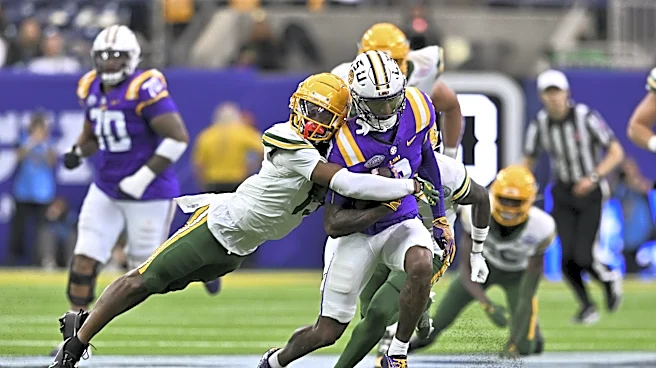
Williams was listed at cornerback in his two full season with the Bears, and his use reflected that. Occasionally certain formations from the offense would see him aligned in a position more like a traditional strong safety or SAM linebacker while playing his nickel corner position. I did a double take when I turned on the footage of the Texas Bowl against LSU after the 2024 season and saw him lined up as a deep safety to the wide side of the field. He stayed there the entire game, and was listed as a safety heading into 2025 (I watched the 2025 SMU tape and saw him lined up at field safety again, but given the circumstances I don’t consider those five snaps representative data points). I imagine this experience was part of what intrigued the Ducks as they began rotating nickel defenders to a deep field safety position last year in certain defensive alignments. Below I’ve compiled clips of Williams playing from a safety spot. First the good:
- :00 – Against TCU’s wildcat formation with three players in the backfield, Williams is on the line of scrimmage to the offense’s left in a kind of “strong” safety position over the tight end. Despite giving up close to 100 lb. on the pulling guard he halts the big Horned Frog in his tracks and draws a holding flag while spilling the run outside. Even in Big Ten play this would have only been a 1 yard gain.
- :25 – We’re now in the bowl game after the 2024 season, where Williams played the vast majority of his snaps from a deep safety position. Here he is lined up to the offense’s left, where he drives on this hitch route and prevents any run after catch.
- :40 – Williams is the field safety to the offense’s right and he properly bails deep in accordance with the coverage scheme. The boundary safety gets sucked up by the play action and leaves the post route open. Coming across to help with the tackle Williams makes a conscious effort to punch at the ball, turning what looked like a big play for the offense into a turnover.
- 1:23 – Against 12-pers from the Tigers, Williams is now the last line of defense as the single high safety. Ideally he wouldn’t be getting involved on an simple inside zone run, but when required he doesn’t hesitate to get stuck in and prevent any further gain.
Now the less good:
- :00 – Early in the game Williams’ inexperience playing from deep off the line of scrimmage shows up. He takes an improper angle when the runner breaks through the linebackers, forcing the boundary safety to make a solo tackle from behind.
- :21 – I don’t like the leverage Williams takes against this screen. He needs to attack the outside shoulder of the tight end as the running back is moving horizontally. If all three defenders on the edge gain outside leverage it will force the back to come to a full stop and the rest of the defense can pursue. By going inside Williams creates space so the ball carrier can make a move in the open field.
- :51 – Williams takes the proper angle this time, it is the linebacker who overruns the play to the outside. It would be better to break down under control and not slip, though.
- 1:11 – Pretty good tackling form here, the receiver simply shows great strength and balance for his size.