

We’re all relaxing here at BCB After Dark: the heppest joint for night owls, early risers, new parents and Cubs fans abroad. Come on in and join us. There’s no cover charge. The dress code is casual. There are still a few tables available. The show will start shortly. Bring your own beverage.
BCB After Dark is the place for you to talk baseball, music, movies, or anything else you need to get off your chest, as long as it is within the rules of the site. The late-nighters are encouraged to get the party
started, but everyone else is invited to join in as you wake up the next morning and into the afternoon.
Last night I asked you if you thought that Ben Brown could stay in the starting rotation all or most of the rest of the year. You all were very optimistic about that as 82 percent of you think the Cubs have another starter in Brown.
On Tuesday night, I don’t normally write about films. But I always have time for jazz and that time is now. You can skip ahead if you want.
We are continuing our celebration of Miles Davis in anticipation of the 100th anniversary of his birth on May 26. Every legend gets their start somewhere. For Miles, he left East St. Louis to go to the Juilliard School of Music in New York in 1944. There, Miles said the only class that taught him anything was music composition and the rest was a waste of time. His real education, according to Miles, came playing trumpet for Charlie Parker.
He soon dropped out of Juilliard to play with Parker full time. So here is the Charlie Parker Quintet in 1948 at a club in New York as broadcast on WMCA radio. Bird is on sax, of course, and Miles on trumpet. Al Haig on piano, Tommy Potter on bass and Max Roach on drums round out the quintet.
This is some pure bebop, music that Miles would soon leave behind.
Welcome back to everyone who skips the music and movies.
I don’t have to tell you that the Cubs are in the market for starting pitching. I’m sure the front office is calling around right now, but teams are generally loath to start selling in May for a few reasons. One, most teams still harbor playoff hopes at the moment. Two, selling teams know that as they get closer to the deadline, there will be more bidders and more desperate bidders, which means they can probably get more for them later on. Yes, there’s always the chance that a player gets hurt (See Clay Holmes), but most teams are willing to take that risk.
Still, what if I told you that there is a starting pitcher who is having a great year and is on a one-year deal playing for a team with less than a 30 percent chance of making the postseason according to Fangraphs? What if I told you that the Cubs had said pitcher last year and let him walk over the winter? Would you want to get him back?
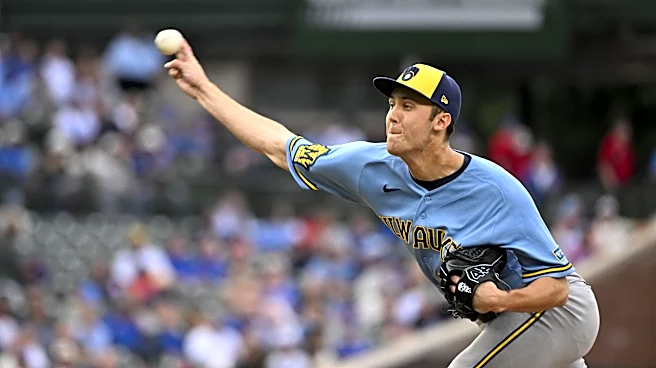
By this time, you know who I’m talking about. You likely knew when you saw the picture at the top of the article. The Cubs were desperate for starting pitching at the Trade Deadline last year and after striking out on several big names (none of whom ended up getting dealt), the Cubs acquired right-hander Michael Soroka from the Nationals. Then, as you no doubt remember, Soroka got hurt in his first start with the Cubs and missed the next six weeks. He rushed back to return before the end of the season, but that meant he didn’t have time to build up the arm strength to start. So what the Cubs ended up was two weeks of a middle reliever for two good prospects.
That’s always been the knock on Soroka: he can’t stay healthy. After being an All-Star in 2019, Soroka missed most of 2020, all of 2021 and 2022 and most of 2023 with multiple surgeries on his torn Achilles tendon that he kept on re-injuring. Once that finally healed, he missed much of 2023 with forearm inflammation. With the Cubs, he missed six weeks of 2025 with shoulder issues.
But this year, Soroka is healthy and having his best season since he was an All-Star in 2019. Soroka is 6-2 with a 3.49 ERA in nine starts for the Diamondbacks. His strikeout percentage is at a career high of 10.1 and his walk percentage is the lowest it’s been since 2019 at 2.57 percent. Except for one really bad start against the Brewers where he gave up eight runs in three innings, Soroka has gone five or more innings in all of his other eight starts. He’s allowed two of fewer runs in seven of those eight, or seven of nine starts overall. Basically, he’s been everything the Cubs had hoped he would be last year.
So would you be willing to roll the dice on Soroka again? To be clear, the Diamondbacks aren’t trading him right now. For one, their record at the moment is at .500 and they still have a 29 percent chance of making the playoffs per Fangraphs. But as May turns to June and July, Arizona could fall out of the playoff hunt and be looking to sell. Since Soroka is only on a one-year deal, the D-Backs would almost certainly be willing to trade him if they fall out of the Wild Card hunt. Since he’d only be a rental, I would imagine that the price for him in prospects would be similar to what the Cubs gave the Nats last year—two prospects in the lower half of the Cubs top 30.
Of course, the risk would be that the Cubs would trade for him and he’d injure himself again. Soroka has never demonstrated that he’s able to stay healthy for a long period of time. So were the Cubs to deal for him, they’d likely let him walk again at the end of the year. But the Cubs would just need to keep him healthy through October.
Soroka is also only 28 years old. I don’t know if that really makes a difference on a short-term rental, but maybe his body has matured now to the point where the constant injuries are a thing of the past. Many pitchers who do suffer injuries in their youth are able to stay healthy once they get older. Of course, some are just injury-prone and end up retiring early. There’s no way to know which one Soroka is.
So would you be willing to roll the dice on Michael Soroka again?
Thanks for stopping by. We always like to spend time with friends, new or old. Please get home safely. Recycle any cans and bottles. Tip your waitstaff. And join us again tomorrow evening for more BCB After Dark.