

Special thanks to Charlie Jacobs of InsideNU for joining me to discuss Northwestern’s roster on this week’s podcast:
Offense

Northwestern’s 2026 offense under OC Chip Kelly is a near-perfect recreation in the playbook, playcalling tendencies, personnel utilization, line grades, and situational down-to-down sequencing as his 2022 UCLA offense.
I’ve charted every snap of a Kelly-coached college team for two decades. With the exception of 2024, when he was under the shackled duo-playcalling system Ohio State
head coach Ryan Day imposed, the key to understanding Kelly’s system is that his backfield creativity in the run game is a magic trick meant to set up a heterodox passing game in which there’s only one live read in the pattern. When defenses fall for the trick, that run game can be very explosive, and when they panic over backfield disctractions, they allow easy completions to the only receiver who’s been engineered to be open.
The sleight-of-hand is that the run game itself is not anywhere as threatening as the passing game is. As Charlie put it on the podcast:
“Because of all of this pre-snap motion, and the switching and all that with Wagner, that could be a reason these guys are so open – they don’t want to get beat by a gadget or trick or designed play, and they end up getting beat by a basic nine route or curl or post route – most of the time it’s just going to Wilde.
Hyth: I think that’s exactly right – they don’t want to get beat by the Chip Kelly magic, and then–
CJ: –they get beat by the traditional.”
Unlike at UCLA, where multiple Pac-12 defensive coordinators had Kelly cracked, Big Ten defenses have fallen for the trick again and again this year (though I think Michigan State’s Joe Rossi had the right idea for the most part, then gave up an embarrassing final drive). The differential effectiveness of the rushing and passing offenses can be demonstrated graphically and situationally. Here are where the inflection points lie, and why only the very final tranche of very distracting super-explosive runs are having a massively outsized effect on defenses’ attention compared to — and I will contend necessarily enabling — the consistently effective passing offence:

Situationally, the rushing offense has an underwater success rate on 1st down, contrary to appearances they pass the ball 52% of the time, and are analytically irrational in 2nd & short, 2nd & long, and 3rd & short in which they give the ball to the running back over 70% of the time yet have 40% or lower success rates. They essentially never pass on 2nd & short or medium, which is analytically inappropriate even if they weren’t a much better passing than rushing team. Northwestern does have an efficiency spike on 2nd & medium, largely from getting about 4-5 yards but not converting.
Short yardage is a special category. While the running backs are not very good at converting these — 36% overall, with only 7.69% on 3rd & short — #0 QB Chiles has a perfect 100% success rate on sneaks, though they never get more than a couple yards. These have been run so often that I needed to categorize them separately, as they were starting to skew both the efficiency (too high) and YPP (too low). Suffice it to say Northwestern can convert very short yardage plays at will, though Charlie was probably correct on the podcast in his reasoning why Chiles only gets the call on about a third of them – to preserve his health and to give them the opportunity to break bigger plays.
1st & 10 and 2nd & long passing is prolific – over a 65% success rate, and past the sticks nearly every time. But on 3rd down, their passing success rate collapses by 20 to 30 percentage points. From watching tape — and simple logical extrapolation — it’s clear the reason why: the magic trick is no longer operational on 3rd down. Without any reason to be distracted by backfield illusions, defenses just get through the porous offensive line, cover the lone active target in the pattern, and the house of cards collapses almost inevitably into a sack or throwaway.
During the podcast, Charlie asked me to investigate an alternate theory that head coach Braun has suggested – that the offense has come out hot at the beginnings of games and finished with strong passing performances at the ends, but had lulls of passing production in the 2nd and 3rd quarters and hasn’t put together a complete performance yet. I said I’d look into whether the dropoff in 3rd down passing efficiency was really just about getting behind the chains in the midgame.
After controlling for garbage time and field position, I can’t find any good advanced statistical support for that proposition. Here’s the quarter-by-quarter breakdown of passing production:

There is a bit of a discrepancy in the 2nd quarter numbers, though even at face value it wouldn’t mean anything, it’s a dip in efficiency but a rise in explosiveness with the same YPA. It turns out the discrepancy can be traced to a single 2nd quarter sequence against Ball State, in which two giant passing plays sandwich a drop and a loss of ten yards on a holding flag. If the same net yardage over those four plays is normalized to, say, three catches and an incompletion, then the discrepancy would disappear – the success and explosiveness rates would become essentially identical for all four quarters.
Wide Receivers

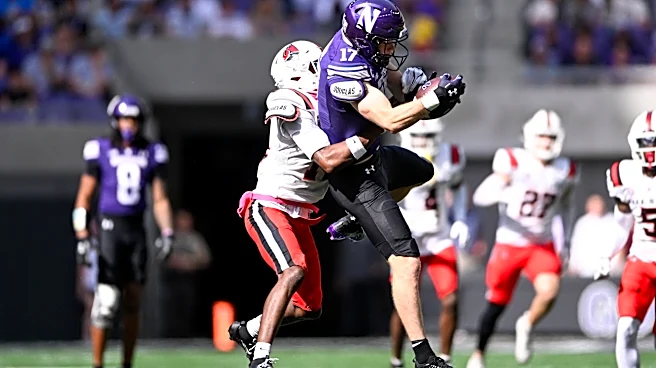
More than 52% of meaningful targets go to #17 WR Wilde. Remarkably, he’s been the single most targeted receiver in the league on whichever offenses he’s been on every year, going back to South Dakota State. Throws to Wilde are very rarely contested catches, as Charlie aptly put it on the podcast, his power is knowing how to get open and present himself to the QB. In 2026, Wilde is a jaw-dropping 80.56% per-target success rate for 12.1 adjusted YPT, despite every defense knowing based on track record the ball is going to him. At some point one would think defenses would put some coverage on him.
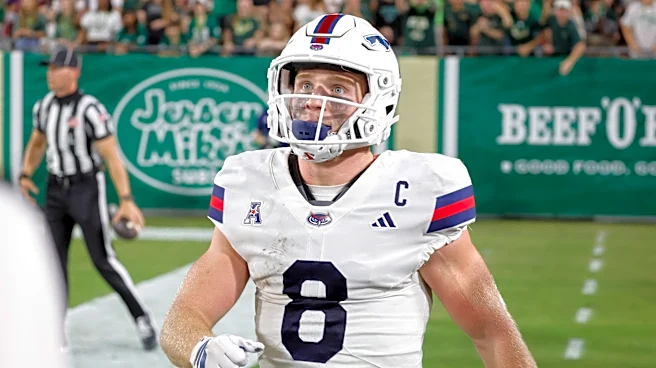
The other outside receivers are #8 WR Eligon and #10 WR Ahumaraeze. They’ve played a utility role in this offense – I’ve only seen Eligon used with any purpose against Michigan State, when DC Rossi had Wilde totally bottled up and Kelly had to move the ball with the tight end and running backs, Eligon picked up some vital play-action throws because the linebacker ignored him. Ahumaraeze was only used productively for two catches against Colorado in week 3 when Eligon was out.
#19 WR Wagner is the motion man on nearly every play. He isn’t really used as a traditional slot receiver, instead he has a couple of outlet targets in case Chiles gets in trouble on the scramble drill, and otherwise about twice a game he has something creative cooked up for him by Kelly. Wagner is more like “Winkle” Brown than Chuck Yeager – far more skunkworks test craft piloted than confirmed kills. As Charlie said in the opening quotation of this article, Wagner is part of the magic trick: for all the glamour of his schematically interesting plays, he’s averaging under 6.7 YPT.
Tight Ends

This unit has been vital to the offense but injuries have played a significant role. In the first two FBS games, on only nine targets, Division-II transfer #84 TE Dehnicke put up some spectacular numbers, and running a larger variety of routes which displayed some real athleticism (contra some of the lumbering beanpole walk-ons that Kelly had catching totally engineered wide open passes at UCLA, in lieu of recruiting). Dehnicke had some historic production at the lower level last year and I’m leaning towards thinking he’s the real deal, but he’s missed the last four weeks with injury. This week’s injury report lists him as probable and Charlie seemed to think we’d see him back sooner rather than later.
The second tight end is #86 TE Honig, who transferred in from UConn. Honig’s routes are limited to two of Kelly’s staples, Y-cross (technically H-cross in his case) and the seam release. His numbers are very good at 68.7% success and 8.9 adjusted YPT. Setting aside Wagner’s gadgets and panic throws, Honig is the clear second target other than Wilde. But also more than anyone else, it’s very clear from watching Chiles’ helmet that throws to Honig are pre-determined.
With Dehnicke out, on the offenses frequent 12-personnel plays they’ve brought in #41 TE Preckel. In previous seasons Preckel had been a fullback, then last year due to an injury to the starting RB Cam Porter, all the backs got bumped up a spot and Preckel was dragooned into taking some short-yardage carries. Charlie told me that this season he’s back where he’s supposed to be as a blocking TE / H-back, but he’s now being evaluated for an injury and may miss the game on Saturday.
If they have Dehnicke back with Preckel out, then their 12-personnel plays will likely be Dehnicke and Honig, rather than bringing in a new blocker to replace Preckel. The downside is that the entire offense only has three proven effective pass catchers — Wilde, Dehnicke, and Honig — and leaving one in to block is significant curtailment.
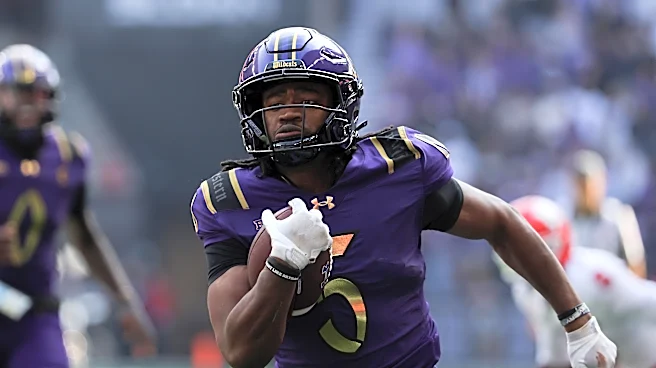
Here’s a representative sample of successful passing plays:
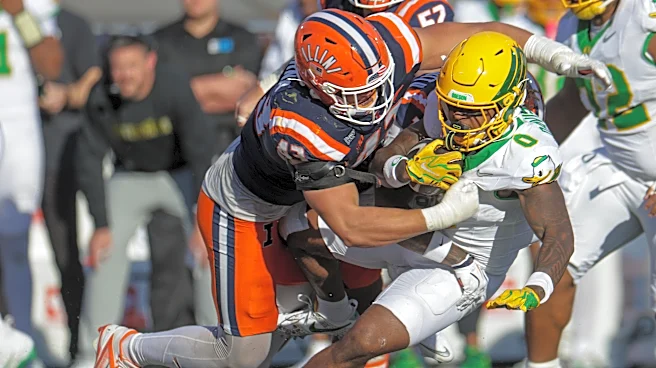
And unsuccessful passing plays:
Running Backs

I thought Charlie was right when I pressed him on the podcast about the irrational numbers in the running back room – he said it comes down to thinking that #5 RB Komolafe is built more like a three-down back, they’re all had some explosive rushing, so they just go with the hot hand.
As we talked about, there’s no one on the room who can’t hurt a defense, and the point of the run game is that defenses have to worry about something big coming out of the backfield on every play. But these numbers are pretty far off from optimal. #27 RB Sawchuck is getting both the lowest success rate at 41.4% and the lowest YPC at an anemic 3.5, has not produced any very long runs (longest is 11 yards, second longest is 8), and unlike the other two has zero targets out of the backfield.
It’s very puzzling then that Sawchuck has any carries at all, much less that he has the same number as #6 RB Himon, who’s clearly the best back under the circumstances (those being that all backs are underwater in terms of efficiency, including Chiles when his QB sneaks and passing play sacks and scrambles are excluded, and only his regular designed carries and read option keeps are considered – for such plays Chiles is at 47.4% and 4.6 YPT, pretty mediocre for a running QB). Himon’s in the doldroms in terms of success rate too at 43.3%, but unlike the rest of the backs, has a spectacular 8.1 adjusted YPC because he tends to be the best at breaking 2nd and 3rd level tackles.
Komolafe’s numbers and film look like a more pedestrian version of Himon – 45.5% success and 6.1 adjusted YPT. All of the backs’ situational numbers — other than Chiles’ bracketed 1-yard keeps — come out the same too, that is to say, no one has artificially depressed numbers being asked to run into a brick wall in short yardage or inflated numbers from getting more available yards from earlier field position. Analytically, there doesn’t seem to be much support for the current distribution – optimizing would require at least a 60/40 split in Himon’s favor and benching Sawchuck.
Here’s a representative sample of successful rushing plays:
And unsuccessful rushing plays:
Offensive Line

There was an unfortunate injury to I think the most talented lineman, #62 LG Oratokhai, very early in week 3, and Charlie told me he’s been ruled out for the season. I first watched him as a true freshman when he was technically unsound but physically very obvious that he’d be worth the investment, and I thought losing him this year was really awful. Oratokhai has been replaced with #71 LG Rahouski, who got some garbage time play last year, for the remainder of the season, though he missed a little bit of time himself and needed a backup. There was also some drama with #65 C Carsello who needed a court injunction to return to his starting center job.
At the other three positions, after the first two FBS games OL coach Drevno played a massive game of musical chairs. What it looks like to me is that the original starting right guard, #77 OG Cotton, was demoted to the reserves (he wound up later filling in for Rahouski for a bit, and playing as the 6th OL in a couple jumbo packages), two starters moved a spot over to fill the voids created so #73 RG McGuire took over for Cotton after starting at right tackle, and #74 RT Seagren took over for McGuire after starting at left tackle. The biggest surprise was #69 LT Schaller coming in off the bench to replace Seagren, who I hadn’t seen before at all, not even in garbage time, yet has had comparable grades to everyone else.
The baseline issue with the line should be plain from the listing – other than Carsello none had even serious backup experience before, one was benched and one was part of the disastrous crew that got Mike Gundy fired. The line looks like every one of Kelly’s since he left Oregon: on about a quarter of run plays they are very well coordinated and it’s clear what they’ve spent all week practicing, the rest of the time they look like they’ve never seen a football before, and pass protection is for extra credit only. Like all of Kelly’s offensive line coach choices, Drevno has burned bridges at all of his previous employers and requires a patron.
Northwestern is currently the last place team in the Big Ten for negative play rate with 17.11% – and that’s with only a couple turnovers and only one enforced penalty other than procedurals, if they’d had average counts in those categories their negative play rate would be astronomical. During meaningful play against FBS opponents in 2026 the offensive line has given up a dozen sacks, twenty TFLs, and about three false starts every game.
Defense

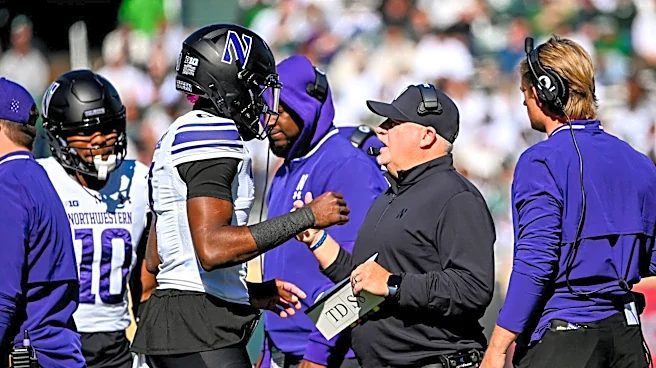
Head coach Braun and DC McGarigle have had the defense all to themselves – McGarigle is the one coach who survived Braun’s purge of Pat Fitzgerald coaches and is on his ninth year with the linebackers and third as DC, while Braun has handed the keys of the offense over entirely to Kelly, as Charlie put it.
For all that concentration, they’ve done very little differently that I’m able to detect. I flagged the defenses’s worsening 1st down defensive issues from their 2023 peak in their startling 2024 collapse, which I thought might have bottomed out in 2025. Last year the Wildcats were significantly underwater to begin sequences allowed every team they faced to play ahead of the chains, surrendering 6.52 adjusted YPP regardless of play selection on 1st downs, setting up cascading conversion chains of poor defensive success rates in subsequent short/medium yardage. If opposing offensive coordinators were more analytically conversant or had read a single work on game theory, they’d take the 2nd & short “money down” opportunities to take shots and avoid Northwestern’s red zone defense to really punish them for it.
2025 has not been a bottoming out – in 2026 Northwestern is surrendering 6.55 adjusted YPP on 1st downs. It’s 6.05 YPA for every pass attempt and an astonishing 7.05 YPC for every rush attempt on 1st down. Both rush and pass defense are at 43% on 1st down, that is, opposing offenses are getting enough yardage to stay ahead of the chains on 57% of their 1st down playcalls no matter what they select. Every 2nd down situational category — run or pass, short medium or long yardage — is underwater, as is 3rd & short at under 40% against both the run and pass.
Charlie brought up three saving graces to Northwestern’s defense. First is takeaways; the Wildcats have seven during meaningful play, including a pick-six, and all four times the opposing offense has put the ball on the deck Northwestern has come away with it. Second is redzone defense; they’re ranked 7th nationally in raw stats allowing only 39% of opponent redzone trips to score touchdowns. Third is planting their heels on the sticks and playing for 3rd down on every down, raising their 3rd & medium/long defense rate to 80%.
Looking more closesly the play-based charting data, this is pretty clearly a “bowing up” effect – Northwestern’s defense is appalling in all metrics when the ball is snapped between the opponent’s 40 and 20, that is with 60 to 80 yards to go, and the offense can attack the entire field. But as they approach midfield and then cross Northwestern’s 40 — well before they even reach the redzone — then the numbers flip and the Wildcats benefit strongly from the compression. The easy 1st down runs and 2nd down conversions that offenses got hooked on disappear on Northwestern’s side of the field, and now those opponents don’t have the space to operate their offense.
The most effective approach has been to take advantage of the Wildcats’ soft defense on the far side of their endzone to get to about midfield by whatever way they like but no closer than the NU 40, then go all out to hit explosive plays and score from outside the redzone. Offenses should resist the temptation once they hit midfield to try and go on an efficiency drive of 6-8 more plays of single-digit yardage, because those very rarely score touchdowns against NU.
Defensive Tackles

While explosive rushing disappears inside the NU 40, efficiency rushing remains above water at a 51% success rate and about 4.0 YPT, which means the compression effect with the secondary is explaining all of the benefit and the weakness is in the front. That’s unfortunately probably going to get worse as their most proven and effective defensive tackle, #15 DT Flakes, was listed as out for Saturday after missing last week. They have gotten back from injury, at about the same time that Flakes left the action, #88 DT M. Jackson – he’d previously transferred in from Utah State and when Charlie and I spoke about him in the past the staff was pretty high on him, he only played four games last year but shot straight up to 1st line rotational minutes against Michigan State and Rutgers. I don’t really have the grades on my tally sheet to support it, I like his motor but he doesn’t have the length to effect penetration if the lineman locks him up.
This is an even-surface defense and I expect to see interior penetration from the tackles and none really exists from this group, instead they play like they’re in an odd-surface and are just filling space, waiting for the backers to make the play. Charlie brought up that there’s no nose to this group, or even a 1-tech / 3-tech distinction, they just all play 2-tech and kind of pile forward to make a logjam.
Defensive Ends

There’s a much clearer starters / backups distinction with the ends, though I think this unit could use more of a shakeup. #47 DE Kilbane has a good frame for the position and the most havoc generation on a per-rep basis, though it’s still below average for this level of football, but his partner on the 1st line, UCF transfer #24 DE J. Johnson, has the lowest grades of any of the 11 defensive starters on my tally sheet. He’s not big enough to set the edge laterally against teams that are really pushing to run outside, and lacks the length beat the tackle and get into the backfield, with the lowest havoc per rep count of any player in the front including the backups and linebackers.
I think the redshirt freshman #91 DE O’Rourke has an appropriate frame for the position and will be good in a year or so when he’s added some more bulk. #5 DE Kirks, the Ohio State transfer who only got a little playing time last year, has had a much more interesting role, they’ve had him in as their interior lineman as part of racecar packages and I think they’d be better off switching that up with Johnson and moving Kirks to the 1st line instead of burying him – Kirks is the only one with Kilbane’s proportions.
To me it seemed like there was some attempt to get more havoc with the extra additions, a lighter player Charlie had to inform me was actually a linebacker but I’ve only seen play as a speed rusher so I’m going to call #32 DE M. Smith, and in the last couple games a walk-on #90 DE Trautman.
NU has only gotten one sack during meaningful play inside the 40 all season, and when passes connect, they’re averaging 9.89 yards – it’s not increased havoc that’s making for the improved defense, it’s just DBs playing closer to or inside the box, earning more knockdowns and stopping runs shorter.
Linebackers

I’ve been joking around with Charlie about the indisinguishable and unbroken chain of identical Northwestern linebackers stretching back to the school’s founding, of whom #33 LB Brus is the latest link – actually, a couple years ago I liked him better as a rotational backup than one of the starters. But the way that chain has been forged seems to be in danger to me, as there’s been no rotational playing time for anyone else (unless Smith, the defender I mistook for a defensive end, counts, but then to the point he’s not playing the off-ball position), and they’ve been taking transfers to boot. The other ironman at the position is senior #2 LB McKinzie from Oklahoma, and the backup with the most garbage time reps is Iowa State transfer #45 LB Sadowsky who’s a senior.
I would be interested in hearing from McGarigle why in his ninth year in Evanston he doesn’t have two developed linebackers ready or why go-nowhere transfer projects like Sadowsky, Nigel Glover from Ohio State, Yanni Karlaftis from Purdue keep filling his ranks. McKinzie was developed by Brent Venables at Oklahoma and is a downgrade on my tally sheet compared to the other Norman refugee, Sammy Omosigho who landed at UCLA.
Here’s a representative sample of successfully defended rush plays:
And unsuccessfully defended rushes:
Secondary

Charlie and I spent much of our time discussing the ways that injuries have affected this group, but really that was by way of saying how effective they’ve been despite injuries. They’ve been playing without one starting corner for almost the entire season, and each of the starting safeties plus the nickel have missed 2-3 games.
Athletically, the highest upside when I’ve gotten to see him has been the strong safety #21 DB Walters, but every year he’s missed substantial time with injury. This year he got hurt at the end of the week 4 game against Indiana and missed the next two weeks, so the backup, sophomore #29 DB Stevens came in for him. Then just as Walters returned, the free safety #6 DB Fitzgerald was hurt and missed the next two games, so Stevens remained on the field but he and Walters have been playing more loosley as to the safety assignments. Fitzgerald is listed as out still on this week’s injury report. Charlie and I agreed he has a bigger impact than most DBs’ absence because he’s a major part of that compression effect – he plays backed out high in cover-2 when they’re defending the full field, then as a box safety when in their own territory, to leverage his great tackling. I haven’t seen as much of the same out of Stevens, who’s a lot younger.
The nickel is #9 DB Turner, who as Charlie recalled kind of came out of nowhere and surprised us both previously to seize the job the year before last and hadn’t been dislodged at all since … until midseason this year, when he missed three games with an injury. They moved a transfer cornerback from CMU over, #3 DB Deasfernandes to fill in, which I wasn’t wild about, but Turner has been back the last two weeks.
Passing offenses this season have mostly been challenging the cornerbacks. I’m not sure why this is given how much cover-2 this team plays, looking at the reaction to the pattern on the all-22 I think there’s been lots of opportunities to attack split safeties with middle of the field open, but I just don’t have film on it to see how it’d go.
As Charlie and I discussed on the podcast, the perverse-sounding good news for Northwestern’s secondary on running the personnel coverage numbers is that everybody’s fingerprints are on the plays they give up – nobody in particular is getting picked on by opposing QBs any more or any less than anyone else, including the call-ups. So there may not be any absolute lockdown player — Charlie suggested Fussell may be, but he remains on the injury absence list — but there’s no liability either, and offenses have to beat the defense honestly.
Here’s a representative sample of successfully defended passing plays:
And unsuccessfully defended: