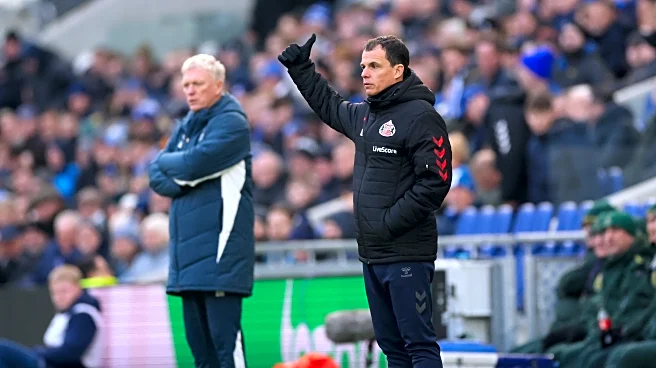

Sunderland returned to FA Cup action on Saturday as the lads travelled down to the Hill Dickinson Stadium for the first time to face an Everton side who faced the prospect of their third home defeat in a week.
With questions around how seriously both teams were going to treat the competition, two strong sides took to the field and Sunderland were unlucky to find themselves staring down the barrel of extra time as the final whistle blew.
With a mix of old heroes and new faces Sunderland put in an encouraging performance and finished their penalty shootout in as comfortable style as they come, so how did Le Bris set his side up with a blend of old and new to put Sunderland’s name in the hat for the fourth round?
Sunderland Line-Up
Following a humbling experience down at the Gtech Stadium, much was made as to whether Le Bris would stick or twist as his current crop of players faced their third game of the week after a gruelling winter schedule. Many of the heroes of last season now find themselves on the fringes of the squad, and therefore, we expected to see the likes of Anthony Patterson, Dan Neil, and Chris Rigg all get starts in this one; however, Le Bris opted to retain much of his core team. Luke O’Nien, Romaine Mundle, Noah Sadiki, and Dennis Cirkin all came in to replace Dan Ballard, Omar Alderete, Chris Rigg, and Lusharel Geertruida, with O’Nien and Mundle making their first starts of the season.
Simon Adingra shifted out to the right wing, whilst Eliezer Mayenda moved up top to lead the line. Trai Hume moved back to his preferred right-back position, whilse Mukiele shifted across to the centre of defence to partner O’Nien, and Sadiki slotted back into his usual midfield role following his return from Morocco.

Back to their usual 4-3-3 shape, Granit Xhaka resumed service in the base of midfield with Noah Sadiki and Enzo Le Fée supporting ahead of him and Sunderland looked more like the side they were prior to the festive fixture congestion now that players were not required to fill in for the absences of others.
Opposition Line-Up
With much of Everton’s attacking potency nullified due to the absences of their three main attacking threats behind the striker, David Moyes had to shuffle his pack with the further suspensions of Michael Keane and Jack Grealish after their midweek dismissals against a resurgent Wolves side. Moyes made four changes himself as Nathan Patterson, Beto, Tyler Dibling, and Merlin Rohl all came into the side.

Moyes continues to operate in his 4-2-3-1 system which sees three attacking midfielders deployed behind the main striker with the intention of utilising their positional rotations and creative freedom to contribute to most attacks. While neither Thierno Barry nor Beto has been prolific in front of goal, both strikers provide a physical presence and utilise their hold-up play to allow Everton’s most technical attackers to run off and create chances.
Given the imposing physical presence of both forwards, Luke O’Nien was to have his work cut out in having to marshal both strikers throughout the game, and with the team announcements, I’m sure Moyes will have looked to exploit the size mismatch when going direct.
Early Possession to Quieten the Crowd
In what felt somewhat like a bizarre fever dream, during the opening quarter of an hour a statistic flashed up on the screen to say Sunderland had controlled 87% of the possession during the opening period. Whether this was the result of specific instructions by Moyes, or just a subconscious consequence of Everton’s poor home performances that week, it played massively into Sunderland’s favour.
With over 7,000 Sunderland fans stacked behind the goal Sunderland were attacking, the early possession dominance helped to settle Sunderland in and get both the home crowd nervy and the away support boisterous which meant although there wasn’t much in the way of goalmouth action meant Sadiki was able to re-integrate back to his position with ease while O’Nien and Mundle could shake off any rust without fear.

O’Nien’s distribution is something worth mentioning here. One of Luke’s key attributes has always been both his ball progression and ability to play out from the back whilst in central defence and he once again showed that he’s got the credibility to play central defence. Sunderland completed 229 passes in the opening half at an accuracy of 85%. For context, we’re rock bottom of the Premier League for completed passes per game at an average of 289 (78.8%), therefore, to see such a lion’s share of possession in the opening period will have helped O’Nien settle in tremendously.
Enzo’s Response
After a slow start to the game, Mayenda was able to break away from his marker and Noah Sadiki had a silky backheel blocked. With Sunderland’s possession dominance we now saw this translate into chance creation and before long Mukiele lined up on of his traditional long throws to cause chaos in the Everton penalty area. Following a crowded melee, Mayenda was able to control the second ball and pop up a lay-off to Le Fée, who dispatched the volley past Pickford with ease.
Take note of Mayenda’s layoff to Le Fée here as at first glance it looks like he’s handed the Frenchman somewhat of a hospital pass, but on closer inspection the bounce pass is actually perfect as it provides Le Fée with the elevation on the ball in order for him to bend it over the covering defenders, had this pass been on the floor then there wouldn’t have been enough space for Le Fée to generate the whip to bypass the onrushing players.

In a weekend which has seen xG hotly contested I think Le Fée’s goal provides a great example of how the metric can be utilised in a more productive way, his goal was scored from an xG of 0.02 demonstrating just how difficult of a volley it was to execute however his Sot xG (Shot on target xG based after the ball was struck) flew up to 0.84 showcasing that Le Fée’s absurd technique turned a chance that 98% of the time is volleyed high or into the defender, into an almost certain goal.

After the week Le Fée has had, it couldn’t have happened to a better person and shows that despite that penalty miss, the technique and quality that he possesses technically is unlike anything we’ve had in our side in years and is something we should look to celebrate rather than shun. Smashing work Enzo.
Second Half Stalemate
Truth be told, the second half played out rather comfortably for Sunderland and both sides looked like they were happy to reside with the result as it stood without the need for any further torture of an extra time period. That being said, Sunderland did produce several saves from Pickford and their overall chance creation was greatly improved over the usual metrics with four shots on target registered during the first half including a few testing strikes from Romaine Mundle.

Much has been said for Sunderland’s chance creation or lack of in recent weeks. While it’s hard to argue with facts – Sunderland’s rolling xG looks pretty bleak – it’s important to attach context behind why this is the case. Whilst it’s not a way of strictly making excuses, in Chemsdine Talbi and Bertrand Traore, Sunderland have lost two of their creative outlets from the wing. Talbi and Traore are creating an average of 0.84 and 1.17 chances per 90′ respectively, which when compared to Adingra and Mayenda drops down to 0.72 and 0.54 chances per 90′.
Whilst this doesn’t seem like much in the grand scheme of things, both wingers have also been involved in four goals between them compared to Adingra and Mayenda’s two. Traore also continues his trend of being ranked in top quartile for shots on target from the right wing position, sitting in the 77th percentile and showing that without both wingers, the rest of the team suffers from a chance creation standpoint.

Once again, though, when context is placed behind these numbers, it helps to explain Sunderland’s recent downward trend, but with a full contingent of players looking likely within the next 10 days, hopefully, Sunderland should see an uptick as January comes to a close.
Extra Time Slog
In what can be considered a real moment of red mist with only seconds remaining on the clock, John Brooks awarded a very soft penalty and gave Everton a chance to square the game up and present an additional half hour of football for an already tired set of players who definitely looked like they were ready to call things a day.

From the opening kick in extra time, both sides were resigned to a penalty shootout, and the subdued atmosphere within the Hill Dickinson Stadium showed. The only two efforts on target from either team came from Romaine Mundle, once again stinging the gloves of Pickford from range; however, both efforts were straight down the Everton goalkeeper’s throat and didn’t look like troubling him.
Roefs Rewards
As we entered the shootout it’s fair to say whilst Sunderland fans remained quietly confident in Robin Roefs ability to save penalties bearing in mind he saved one against Brentford and close to James Garner’s penalty at the end of regulation, Jordan Pickford remained the firm favourite following his England heroics of the past.
Having only faced three penalties at professional level before the match, Roefs had conceded one during his stint in the Eredivisie before saving one during the Euro-21 tournament in the summer and one in the Premier League against Brentford. The rest of his penalties have all come in youth leagues/competitions therefore are hard to judge.

Roefs clearly backed himself and, in spectacular fashion, managed to save not one but all three of Everton’s opening penalties, which is an incredible feat of goalkeeping. Much can be debated as to whether the penalties themselves were the greatest; however, Roefs got a strong hand to each, and it can’t be understated how fantastic an achievement that is at a professional level.
To provide some maths behind his mind boggling achievement, a penalty on average has an xG of 0.78 therefore a 78% score rate, the probability of Roefs to pull out three consecutive saves sits roughly at 0.01% or 1 in 1000!
A week to take stock
After surviving Sunderland’s heaviest and weakest period of the seasonal calendar, Le Bris will be thankful to finally spend some time on the training pitch with his squad and look to address some of the issues he’s identified during the festive period. It’s easy to forget that during the last week, Sunderland haven’t returned to the AOL, and even when they could do so over the Christmas weekend, they were limited to recovery and rehab due to the limited rest the players had.

With Afcon drawing to a close and nice run of fixtures coming up for Le Bris, the Lads will look to get back to winning ways in the league with a visit from struggling Crystal Palace in the hope of ending their run of six draws from seven games (although Everton really should be a win) and make a strong push into the second half of the season.