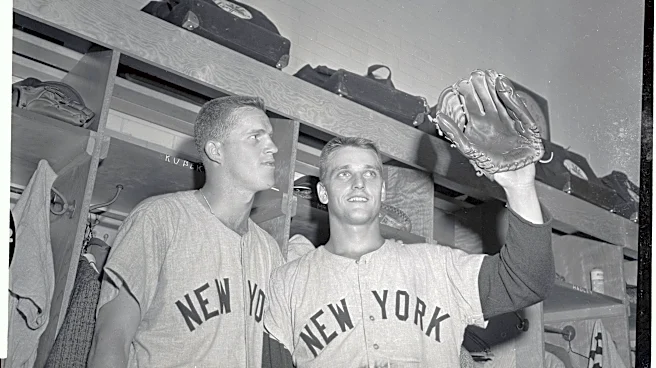

A great defensive shortstop with solid bat-to-ball skills and a knack for reaching (and winning) World Series, Tony Kubek played in one of the best and most prolific eras in franchise history and shared the same clubhouse as some of the most relevant historical figures in the game. That wasn’t the end of his story though, as went on to offer his baseball insight and direct, outspoken style in the booth with a marvelous broadcasting career that earned him the Hall of Fame’s Ford C. Frick Award in 2009.
Today, Tony celebrates his 92nd birthday.
Anthony Christopher Kubek
Born: October 12, 1935 (Milwaukee, WI)
Yankees Tenure: 1957-65
The son of Jennie and Anthony Alfonse Kubek, Tony was born in Milwaukee on October 12, 1935. The older Anthony played minor league baseball and helped a young Tony fall in love with the game at a very young age.
At Bay View High School, however, Kubek stood out in other disciplines, most notably football, basketball, and track. Baseball was actually dropped from the school program while he was there, so he played the game in sandlot leagues across the city of Milwaukee. There, he was spotted by Lou Maguolo, who worked as a scout for the Yankees from 1947 until the mid-seventies. A left-handed-hitting shortstop, Kubek signed with the Yanks after graduating from Bay View in 1954, and received a $1,500 bonus.
With the dream of eventually replacing Yankees legend Phil Rizzuto, Kubek started at Class D and worked his way up until reaching the majors. In the spring of 1957, manager Casey Stengel prepared the young and hungry prospect to play all over the diamond, since the Yankees had the solid Gil McDougald at shortstop. That year, Kubek started 31 games in left field, 22 in center field, 41 at shortstop, and 38 at third base, all while forming a close friendship with second baseman Bobby Richardson, another long-lived dynasty Yankee.
Kubel was 21 when he debuted in 1957, and he went on to earn American League Rookie of the Year honors after hitting .297/.335/.381 in 127 games and 475 plate appearances. He only hit three homers and stole six bases, but he doubled 21 times and played solid defense on a team that lasted until Game 7 of the World Series.
The Yanks lost that Fall Classic 4-3, but Kubek was excellent against his hometown Milwaukee Braves with eight hits, two homers (both in a 12-3 rout in Game 3 at County Stadium), four runs scored, four RBI, and a .786 OPS.
Sal Maglie, who was on the Yankees roster in that 1957 season but was ineligible for the World Series, offered an accurate scouting report on Kubek from that year while analyzing the series for Sports Illustrated:
“He’s going to be a great player. He’s a fine hitter right now. He hits with the pitch, and it’s hard to fool him. His wrists are so quick he can wait to see where the pitch is thrown before he commits himself, and then he can push it to left or pull it to right. And he’s never satisfied with himself. That’s the sign of a good ballplayer.”
The following year would see Kubek slump a bit offensively with a .265/.295/.317 line (71 wRC+), two round-trippers, and five thefts, but he was an All-Star and earned the first of three World Series rings with the Yankees. He only had a hit in 21 at-bats in this Fall Classic though, and the Yanks exacted revenge on Milwaukee with a seven-game triumph.
Kubek was also recognized as an All-Star in 1959 and finished the year with a .279/.313/.391 line, 25 doubles, seven triples, and six home runs. After hitting a career-high 14 round-trippers in the 1960 regular season, he was part of the team that lost the famous 1960 World Series to the Pittsburgh Pirates.
In Game 7 of that Fall Classic, Kubek was rendered unable to field a groundball hit to him with the Yankees up 7-4, no outs, and a man on first. The ball took a weird bounce off the shoddy Forbes Field infield dirt and struck him in the throat, sending him down to the ground. He had to be replaced and sent to the hospital. The play haunted him for years, as it opened the door for a Pirates rally. It turned out to be the Bill Mazeroski walk-off homer game.

Fate would give Kubek a chance for redemption just one year later. As the Yankees shortstop, he witnessed Mickey Mantle and Roger Maris’ historic home run chase from up close and played on a World Series-winning roster, racking up five hits in the Fall Classic victory over Cincinnati. He played in both All-Star Games that year and finished second in the league with 38 doubles.
In many ways, 1961 was a big year for the Yankees’ shortstop. He got married to Margaret Timmel in October, and just a few days later, on November 4, joined the 127th infantry of the 32nd Division, a Wisconsin National Guard unit, according to his SABR profile.
The expectation was that the Yankees would lose Kubek for the entire 1962 campaign, and Tom Tresh turned in a Rookie of the Year-winning campaign of his own at the six in Kubek’s absence. But the veteran returned in August to post an excellent .314/.357/.432 line in 45 games. He logged eight hits with a .276 batting average as the Bombers beat the Giants in seven games in the World Series. It was his third and final title.

The 1963 and 1964 campaigns would bring World Series losses for the Yankees. His decline would start around those days, probably accelerated by injuries, most notably a back issue suffered in 1963.
After a rough 1965 season that saw him hit a paltry .218/.258/.295 line, Kubek was diagnosed with nerve damage at the top of his spinal column. He believes the origins of the injury stem from 1961, when he was playing touch football. He decided to hang up his cleats at 29. Not too long after that, he started what turned out to be a brilliant career in broadcasting.

Through NBC official David Kennedy, Kubek landed a job as a color commentator for Game of the Week. In a career that spanned over 20 years, the former Yankees great worked alongside voices such as Curt Gowdy, Jim Simpson, Bob Costas, and Joe Garagiola, among others.
Kubek went on to broadcast 11 World Series, 14 League Championship Series, and 10 All-Star Games. In addition to his work at NBC, he also had stints with the Yankees, the Blue Jays, and also at TSN and CTV before stepping away from the game in 1994.
You could certainly say that Kubek has lived life to the fullest. He and his wife Margaret had four children and five grandchildren. He was a star with the bat, the glove, and the microphone, while also serving his country. Not bad at all.

See more of the “Yankees Birthday of the Day” series here.