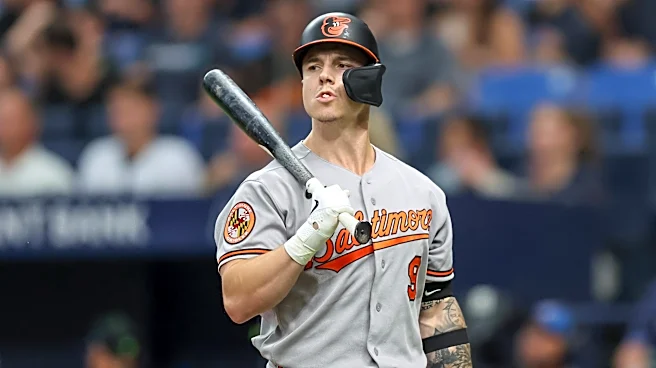



Through two seasons with the Orioles, Tyler O’Neill has played in just 139 total games, hit 19 home runs, and made five trips to the IL. While the 2026 campaign was a slight improvement from his debut season in Baltimore, the Canadian outfielder was once again a gigantic disappointment.
The Orioles attempted to handle O’Neill more gently this time around. He was limited to just 54 games in 2025, and the hope was that they could avoid a similar fate in 2026. Of the 85 games in which he appeared in this year,
only 61 of them were starts, and he played defense in just 67 of them. It was not a massive workload, particularly for someone being paid $16.5 million per year. But that didn’t stop the injuries from coming anyway.
O’Neill suffered a concussion early in the season when an illness led to dehydration, which resulted in him fainting and hitting his head. That left him sidelined from April 9 through April 23. He returned to the lineup in late April, and would remain an outfield option for much of the year until late August, when he suffered a rotator cuff strain. There was some hope at the time that O’Neill could rehab the injury quickly and return before the end of the season. But it didn’t work out that way. O’Neill received PRP injections in September, and his season was over.
There really weren’t any positives to speak of for O’Neill through the end of June. To that point he owned a .182/.282/.270 batting line with two home runs, six doubles, 17 walks, and 43 strikeouts. You could squint and see some potential for positive regression in things like hard hit rate and lower than expected BABIP, but it was grasping for straws.
July is where O’Neill finally became a spark for the lineup. From July 1 through August 17, O’Neill hit .289/.359/.602 with eight home runs, two doubles, nine walks, and 26 strikeouts across 30 games. His season totals jumped up to a respectable (if still underwhelming) .223/.310/.395 thanks to that seven-week stretch.
That would be the peak of O’Neill’s campaign. He finished his season by going 0-for-11 over his final four games, and then hit the IL with the shoulder injury that shelved him. His last game of season came on August 22.
There is an argument to be made that O’Neill had finally figured something out in July. It’s possible that the early-season concussion lingered and, paired with a less consistent role in the everyday lineup, it was difficult for him to get into an offensive groove. Then, as soon as things were clicking, the injury bug bit him again. Just bad luck.
But it’s pretty much impossible to actually make that argument for O’Neill given his history. The guy gets hurt a lot. The most games he has ever played in a single MLB season was 138, which came way back in 2021 with the Cardinals. He played 113 games for the Red Sox in ‘24, his platform year before inking the three-year contract with the Orioles prior to 2025. So, even when he is productive, he is good for at least one lengthy IL stint per season. In order to be of value, he needs to play really well in those games he can actually suit up for. As an Oriole, that is yet to happen with any sort of consistency.
As the Orioles plan for 2027, the reality that O’Neill is probably going to miss time has to be factored into roster planning. It cannot be assumed that he will hold down an outfield corner for 140 games next summer. That’s not something he has ever done, and it’s unlikely he starts now. The fact that he ended the season on the IL with a rotator cuff injury for which he received PRP injections already sounds dicey, though reports indicate that he should be ready for spring training.
O’Neill will be entering the final season of his contract in 2027. That gives the Orioles more flexibility with him if he struggles, if the team falls out of contention, or if he is consumed by injuries again. The team has already paid out a majority of his salary, and the chance for him to “turn things around” will dwindle by the day. Should the team need a 26-man roster spot sometime midsummer while O’Neill toils, cutting him will be on the table.
But in all likelihood, that is a consideration for sometime during the regular season. At the moment, the Orioles outfield, outside of Colton Cowser’s glove, is one big question mark. O’Neill, despite his flaws, may be closer to a productive and known commodity at the plate than any other outfielder on the Orioles 40-man roster. And it’s not as if the team is going to be able to save any money by cutting or trading him now anyway. So the incentive for doing so before other plans are in place is basically zero.
The outfield should be a top priority for the Orioles this offseason, whenever it is that they can actually make moves. It’s a shallow free agent class, and many of the top options (Randy Arozarena, Ian Happ, Seiya Suzuki) are already older than O’Neill is now, so it doesn’t feel like a market where the Orioles are going to seriously compete. Perhaps the trade market is more open. Or, and this could be the best path, the Orioles explore converting some of their infielders into corner outfielders. Coby Mayo and Blaze Alexander feel like the two most prominent candidates should their peers on the roster come into the spring healthy.
The O’Neill experiment has been a failure through two years. Given the uncertainty on both the roster and in baseball broadly, he’s unlikely to be going anywhere this offseason. At this point, he can be a very expensive insurance policy if the Orioles fail to solve their outfield issues this offseason. Hopefully the organization holds a similar view, because going into 2027 with the plan being for O’Neill to be an everyday option in one of the corner spots is a recipe for yet another underperformance.