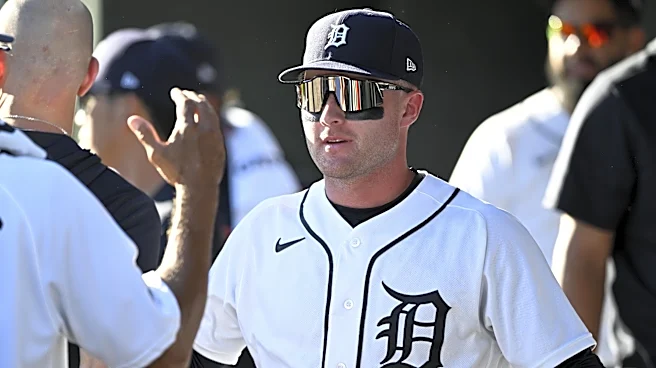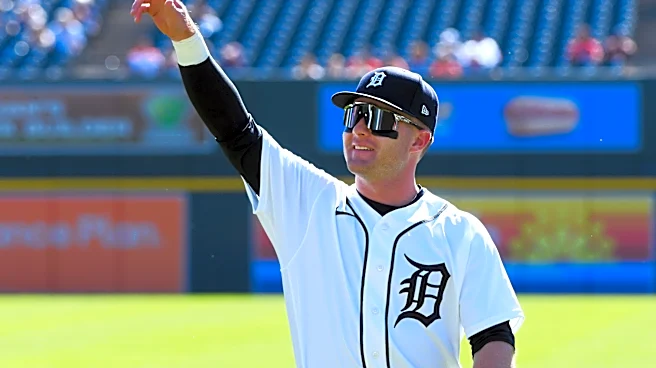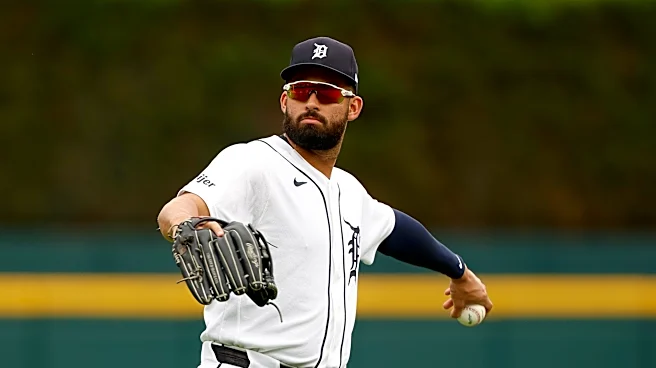


On Tuesday, Jon Morosi of FOX Sports reported from the GM Meetings in Las Vegas that a few executives have mentioned Detroit Tigers’ slugger Riley Greene as a possible trade candidate this offseason. The 26-year-old left fielder has two years remaining until free agency and Scott Harris has shown absolutely zero interest in a long-term contract extension. Yet when Morosi asked the question, Harris also downplayed any rumors around Greene, saying only that he’d listen as part of his due diligence,
but views Greene as one of the key players to the Tigers plans. Something here doesn’t add up.
Tigers fans will recall that for the majority of the 2025 season, it looked like Riley Greene had reached a new level as one of the premier sluggers in baseball. He then endured a catastropic collapse after the All-Star break that extended through the postseason. Suddenly Greene was in the doghouse. With his speed declining, the talk of Greene’s new level of dominance rapidly pivoted to whether he was physically breaking down, and whether the Tigers should consider dealing him at peak value.
At the time, my argument was that the 2025-2026 offseason was the perfect time to seek a long-term contract extension. After getting humbled by the worst stretch of his career and with three years left to free agency, it was a pretty good time to strike if they were ever going to do it, but for all the same reasons it was easy to see why the Tigers weren’t pursuing an extension. The Tigers said almost nothing about Greene all offseason and made no move to initiate extension talks. Nor was there ever a hint that they were shopping him in trade.
Greene bounced back at the plate in 2026, shaking off his tough August-October of 2025 stretch. He was a huge force at the plate once again, posting a whopping. 370 on-base percentage with 21 homers and a .194 isolated power mark (ISO) on the year. However, concerns about his declining athleticism only got louder as Greene’s defensive numbers collapsed.
Greene was a net -11 in defensive runs saved (DRS) in 2026, and his -5 outs above average (OAA) was the first time in the negative in his career. His 26.6 ft/sec spring speed per Statcast was awful, putting him in below average territory for the second straight season. Other than Gleyber Torres, Spencer Torkelson, and Eduardo Valencia, Greene was the slowest player on the team. He can’t outrun the Tigers’ starting catcher. At age 26, the athleticism that allowed him to play a solid center field early in his major league career is gone. What’s left is a more sluggish outfielder with a noodle arm who can still really punish the baseball.
Greene trimmed his strikeouts this year, and continues to boast premium batspeed and power. This is still a very dangerous hitter, but between his struggles in big spots and the collapse of the rest of his game, he’s looking more and more like a player who should be at least a part-time designated hitter going forward.
So, declining to extend Greene is understandable. He may well be a good power hitter for another half decade, but he’s becoming a liability in most other respects. That makes the possibility of a trade more realistic, perhaps. Harris did say that he considers Greene a big part of their lineup, but he also acknowledged that it’s his job to listen to offers. That’s standard fare, but the circumstances themselves are what adds some interest in the idea.
Maybe finding a good offer for Greene just isn’t in the cards. Even at just 26 years old, and despite some signs that he may have another level yet to unlock as an all around hitter, teams are only going to pay so much in prospects for a player who is at least a minor liability in left field and is declining in speed.
For now, the move is to keep Greene unless somehow aggressively pursues a trade, and instead try to help him rebuild some speed in his offseason conditioning. That didn’t happen last season, but then it hadn’t really affected his defense too much at that point. Greene has always thrived as an outfielder by getting good jumps and closing well on the ball to make every catch possible. He was never fast. With those defensive numbers collapsing this year, perhaps he’ll be more motivated to find solutions. His potential value as a free agent two years from now is tracking a lot worse than would’ve been predicted even a year ago. If Greene can turn it around defensively to a degree, the Tigers might find more aggressive suitors for his services at the deadline next summer or next offseason. They might also be more apt to offer an extension offer were that to occur, but he’ll have free agency in his sights by then.
Riley Greene remains a dangerous hitter and one of the more consistent power producers in the game over the last few seasons, but the rest of his game is in shambles. Without any hint of extension talks, we have to assume that Greene is going to reach free agency, and that probably means he’s more available to reasonable trade offers than Scott Harris would like to admit. There’s no reason to diminish your own player by criticizing him publicly or by shopping him aggressively. Harris will do none of those things, but if there’s going to be a surprise trade of any magnitude this offseason, Greene does feel like the likeliest candidate. It’s just hard to picture many teams offering enough for the Tigers to bother right now.