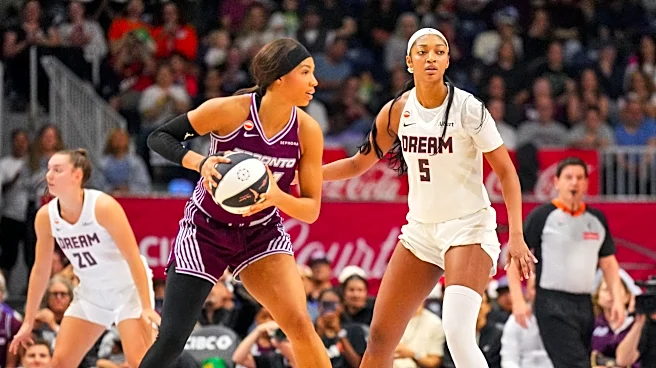









Expect there to be no shortage of spice when the Toronto Tempo visit the Atlanta Dream on Monday night (7:30 p.m. ET, WNBA League Pass).
The extra curriculars that occurred between Isabelle Harrison and Angel Reese during Atlanta’s win in Toronto, which resulted in an early exit for Harrison after she was ejected for unnecessarily wrestling Reese on a post up, guarantee lots of attention will be on the rematch between the former Chicago Sky teammates.
However, the Izzy-Angel battle might not be the most interesting head-to-head showdown that unfolds in State Farm Arena.
The Tempo and Dream feature the WNBA’s foremost gravity queens.
The Tempo’s Marina Mabrey sits atop the leaderboard of the WNBA’s new gravity stat, which strives to estimate how much defensive attention a player commands when she is on or off the ball. Ranking No. 3 and No. 4 are the Dream’s Rhyne Howard and Allisha Gray, respectively.
The stat, which attempts to quantify the fear induced in opponents by the shooting skills of Mabrey, Howard and Gray, also can strengthen our understanding of Toronto’s and Atlanta’s offensive contexts.
After a slow start, the Dream offense has taken off, now with a 112.6 offensive rating that matches the league-best Minnesota Lynx. The Tempo are trending the opposite direction, although they sport a still-solid 108.7 offensive rating that is good for eighth in the league.
Here’s more on how the shooting gravity of Marina, Rhyne and Allisha is evident in the Tempo and Dream offenses.
Marina Mabrey gives the Tempo unmatched gravity
Mabrey’s on-ball perimeter gravity is a league-leading 9.8, a number that’s an absurd 6.5 points higher than the second-place player.
At the other end of the spectrum, Laura Juskaite’s off-ball perimeter gravity is -7.9, the second-lowest mark in the league. María Conde likewise registers as having negative off-ball gravity at -2.4.
Quite simply, Tempo opponents are going all out to guard Mabrey when the ball is in her hands, often leaving Juskaite or Conde open to do so. Considering Juskaite is hitting 37.5 percent of her 2.5 3s per game, while also demonstrating facility as a cutter, it’s a risky bet. That Conde is converting 40.6 percent of her four 3s per game further underscores that high-stakes gamble opponents are opting for by prioritizing Mabrey.
When off the ball, Mabrey is not freed from intense defensive attention. Her perimeter off-ball gravity is also the league high at 13.1. “Anybody but Marina” seems to be the mantra repeated by Toronto opponents.
As such, the Tempo’s success significantly depends on the ability of Juskaite, Conde and the Tempo’s other ancillary players to make opponents pay for all the attention diverted to Mabrey. This dynamic partly explains the degree to which shooting variance is the defining distinction between a Tempo win and a Tempo loss. Toronto makes almost 10 3s at 36.3 percent in wins, while dropping to eight 3s at below 30 percent in losses.
The previous game against Atlanta, however, was an outlier.
Toronto was blown out, despite making nine triples at 37.5 percent. The Dream effectively contained Mabrey, limiting her to 22 percent usage, her third-lowest single-game usage percentage of the season, and permitting her to score just nine points on 2-for-11 shooting, tied for her third fewest of the season.
The Dream, in short, defied Marina’s gravity.
Open shots for Rhyne Howard and Allisha Gray are a nightmare for Dream opponents
In contrast, both Howard and Gray demonstrated why they are sources of gravity, dousing the Tempo for a combined nine 3-pointers in the win.
Howard fired off 11 attempts, hitting four, as Gray got up nine triples and swished five of them. Rhyne finished with 24 points, with Lish matching her season-high with 26 points.
According to the statistical estimates, the pair have a greater gravitational pull when off the ball. From the perimeter, Howard ranks fourth in off-ball gravity at 10.7; Gray is seventh at 9.5.
As with Mabrey, Howard and Gray see teammates sitting at the other end of the gravitational spectrum. Naz Hillmon’s perimeter on-ball gravity is a league-low -13.9. A familiar sight in Dream games is Hillmon standing unguarded with the ball at the top of the key or on the wing as defenders stick to Howard and Gray. Angel Reese also registers negative on-ball perimeter gravity at -11.9.
Last season, Hillmon increasingly punished opponents for such an approach, gaining confidence as a 3-point shooter. This season, her percentage from 3 has dipped below 30 percent, yet her confidence hasn’t wavered, as she’s still upped her attempts to 4.2 per game. Reese’s 3-pointer is behind Hillmon’s, but she’s been empowered to begin experimenting with the shot.
That Naz and Angel pose a limited threat from the perimeter can explain some of Atlanta’s early-season offensive clunkiness. Opponents were more than happy to remain glued to Rhyne and Allisha.
However, the Dream might have begun to find their offensive groove, scoring over 100 points in three-straight games. Hillmon’s gotten hot from downtown, going 5-for-8 over the Dream’s last two games, both wins over the Indiana Fever that saw Atlanta ring up 108 and 113 points. Reese also keeps gaining comfort in the Dream offense, unleashing strong drives from the perimeter when she’s given space.
Against Toronto’s 12th-ranked defense that is down two of their better defenders in Brittney Sykes and Kiki Rice, the Dream should have the opportunity to continue to refine how they can exploit the attention drawn by Howard and Gray to again enjoy a big offensive night.
For the Tempo to hang, Mabrey likely needs to ignite for another near-record 3-point explosion.
What’s your opinion of the WNBA’s new gravity stat?
Do you see value in it? What names that are near, or not near, the top of the various gravity leaderboards are surprising to you? Or, is just this another fancy number or two that can be ignored or endorsed, depending on your agenda? Share your thoughts in the comments.