




The last time the United States hosted a World Cup was in 1994 and that tournament was very much about establishing soccer in America. The USMNT had only barely made the previous tournament and had done poorly, MLS didn’t exist, and the players existed as a collection of college athletes and lower division journeymen. Indeed, this is how the opening ceremony for the 94 World Cup went:
Sure, it’s not an actual game or anything, but it was still a sign that Americans still didn’t have a handle on the
whole soccer thing.
That is the case no more.
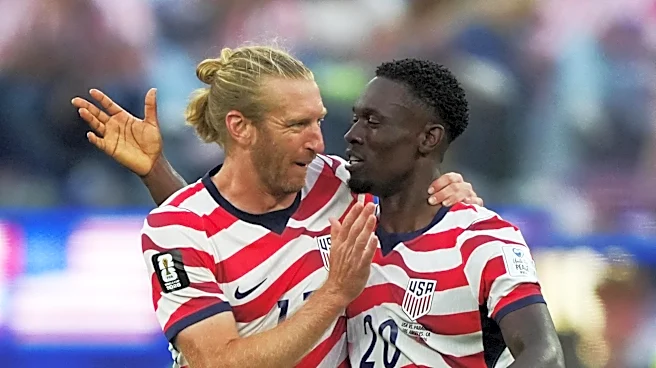
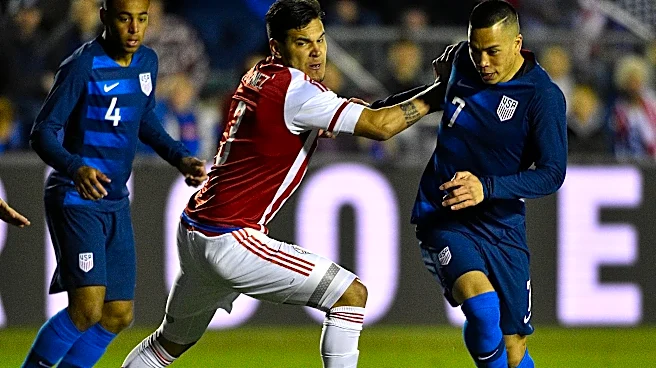
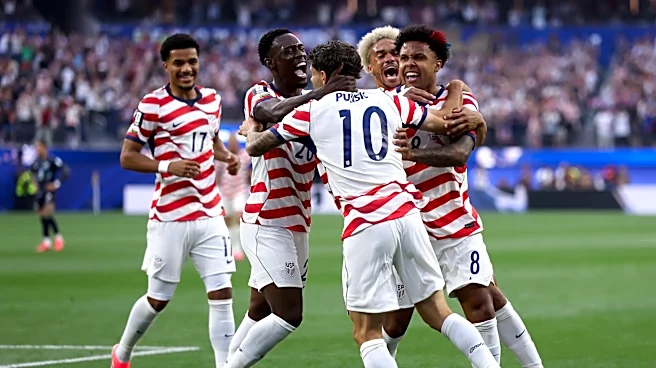
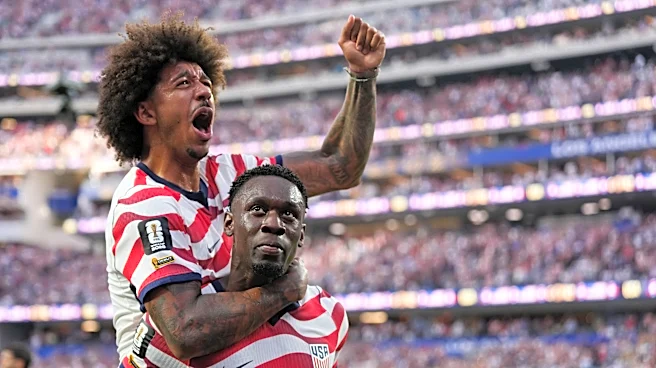
For 90 minutes, the United States Men’s National Team didn’t just dominate Paraguay in their opening match for the World Cup — the first World Cup match the team has played at home in 32 years — and didn’t just dominate, but eviscerated their opponent. Up to that point, the matches of the tournament had been tense and close. And this performance stood out as the exception, with the USMNT dominating every phase of play in every part of the pitch for nearly every minute of the game. This wasn’t like the kinds of dominations we have seen from time to time against CONCACAF minnows in competitions like the Gold Cup, where the US is able to built moments of good play to rack up a high scoreline against a much weaker opponent like Trinidad and Tobago. This was sustained excellence against a quality opponent. Paraguay qualified automatically by going through the ringer that is South American qualifiying, finishing with 28 points though 18 games, tied with Brazil, Uruguay, and Colombia. This was a side that had a reputation for a stingy defense (though not the strongest offense), and the USMNT ripped them apart. I’m not saying that the US is actually going to win, but they played as if they were a serious contender.
The 1994 World Cup was about soccer finally arriving in America. The 2026 World Cup is about showing the world that soccer did indeed arrive, that it has thrived, and that we are now ready to show what we’ve got to the world. And what did we learn? That the soccer is indeed good. A lot was made by how improved
So how did the USMNT actually achieve this comprehensive dominance? A huge part was just how effective the US was at winning back possession from Paraguay. Here is a heat map of Paraguay’s possession overlaid with the USMNT’s attempted tackles and interceptions, data courtesy of WhoScored (though my overlaying may be a little rough.) Paraguay attacks from right to left, while the US is the reverse, attacking from left to right.
 WhoScored." data-portal-copyright="" />
When I saw this heat map, I actually started snickering. Yellow and red highlight where they had most of their possession and this map shows that Paraguay was pinned back all the way to their own box. Paraguay struggled to hold the ball in much of their own half, barely any in the US defensive half, never mind the American defensive third. On top of that, we can see that the US had a large number of defensive actions in Paraguay’s half, with some dots corresponding to places in the map that show Paraguay having less possession. Which is to say, you can literally see where the US was consistently stripping the ball away. For comparison, here is the American heat map, going from left to right:
 WhoScored." data-portal-copyright="" />
We’ll touch on what the US did in possession in a bit, but let’s go back to Paraguay for a bit. Here is what their coach had to say about how the USMNT played against them:
I wanted to highlight a specific part of that quote, the part where he mentioned how the midfield played with a pentagon. Paraguay had a midfield duo and the US outnumbered them on defense with a set of 5 players: Tyler Adams, Malik Tilman, Weston McKennie, Christian Pulisic, and Folarin Balogun, or perhaps one of the wingbacks pinching in. Excluding the wings, that is the entire attacking contingent in front of the backline. Which is to say, this was a coordinated and dedicated effort. Every single player knew what they needed to do in defense and did it consistently, whether it was being in their place for the press, or covering for a teammate when the moment demanded it. With the exclusion of the goal conceded, the US was rarely out of sync. This also extended to possession. Going back to the US’s possession map, the US had a massive amount of possession in Paraguay’s half. A lot of that is to that pentagon shape that the Paraguay coach mentioned. The US always had options and it allowed a player — particularly Weston McKennie — to push forward and drag the defenders out of position and still have options to pass to for security AND to advance the ball. At the same time, you have some excellent circulation from the centerbacks. In that heat map, there’s a huge red blotch in the middle of the field, with red arms off the side. That’s the backline circulating between itself, and especially Tim Ream and Chris Richards. Speaking of Richards… the Crystal Palace man had a perfect 84/84 pass completion rate, setting a new record.
 The Athletic" data-portal-copyright="" />
This isn’t the first time that the US has been lauded for how they played. In 2022, the US dominated Wales and got plaudits for how they played, especially in the first half. But the difference between that game and this one was that, while the US dominated possession against Wales for a solid half, they only managed a single goal. They struggled to create clear goal scoring opportunities and struggled to finish them when they did. This time, the US created better chances and then actually finished them. They didn’t dominate in merely in front of the box, but at the goal as well. As I said before, in all phases of play, at every position.
And we shouldn’t hold this as something to take for granted. Other teams have struggled against weaker opposition. At the time of writing, the Spain – Cape Verde game had just ended, and Spain just got held scoreless by one of the lowest rated teams at the tournament. Likewise, the expectation was that Turkiye would dominate, but they just got knocked down 2-0 by an Australian team that some were saying would finish at the bottom. The US did play well and against a decent team and is in a good place to make it to the next round. This team has shown well and has the potential to continue to do well, deep into the tournament. And hopefully they can show that talent again as we go forward.