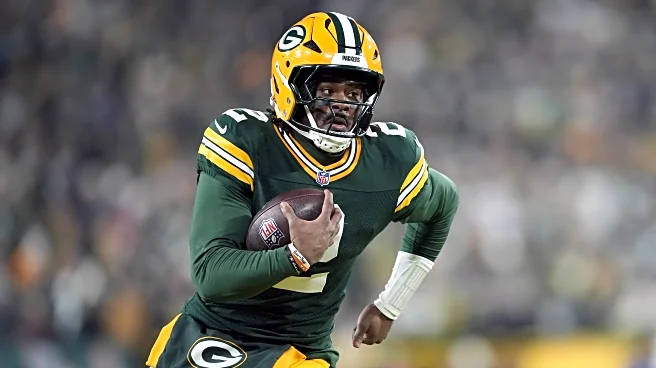


It’s pretty clear at this point that Green Bay Packers backup quarterback Malik Willis will be playing for another NFL team in 2026. Willis should command a deal in the range of Justin Fields’ two-year, $40 million contract, a benchmark deal for the “prove it here and you’ll get a real starting quarterback contract” market.
Generally, the market for true blue veteran backup quarterbacks now, ones who do not have to compete for their spot on the 53-man roster, is around $5 million per year in 2026.
The Packers, due to their cap situation, aren’t really in the position to be throwing out that kind of money on a non-starter, especially without owning a first-round pick in either of the next two drafts.
So, how will the team back up starting Jordan Love moving forward? Well, over the past two weeks, they made two moves, adding Desmond Ridder and Kyle McCord, that will help quarterback coach Sean Mannion sleep a lot better at night.
Before we talk about Ridder and McCord, I want to take you back to the 2023 draft to show you how this could have gone wrong.
The 2023 NFL Draft
With Aaron Rodgers traded to the New York Jets and Love moving into a starting role, the Packers needed a backup quarterback in 2023. The problem is that, like in 2026, the team didn’t have much cap space, as they were one of the highest cash spending teams on the player level from 2020 to 2022. They paid a lot of money to go “all-in” at the end of the Rodgers era (were the 2nd-highest cash spend team on players in 2022) and now had to play within a restricted cap situation (were 27th in cash spend on players in 2023).
They were cheap in the backup quarterback market because they had to, just like the reality that they faced at the kicker position that year.
Another important piece to remember is that it wasn’t clear that the Packers were going to move on from Rodgers after the 2022 season. Had they known that, maybe they would have been more aggressive in the reserve/futures market for practice squad quarterbacks after their season ended (practice squad players usually sign deals right after their campaigns are over).
With cheap practice squad players (Green Bay just had Danny Etling, on his second stint with the team, come back from the practice squad in 2023) and veteran backups off the table, the team had to turn to the draft to backfill for Love moving into the starting role.
On draft weekend, five quarterbacks were picked in the top 68 selections, all players who were projected to be first-round picks based on the consensus draft board: Bryce Young, C.J. Stroud, Anthony Richardson, Will Levis and Hendon Hooker.
Going into Day 3, the Packers were sitting pretty, as there were still nine players who had draftable grades on the consensus draft board who were still available to them. Then the run from hell started.
One after another, seven total quarterbacks were taken from the 127th overall pick in the 2023 draft to the 164th pick, just 38 slots. By the time the run started, the Packers’ next pick was 149th overall in the fifth round, which they spent on Sean Clifford, the 11th quarterback off the board, after each of the following quarterbacks was drafted above their consensus board ranking after Green Bay’s fourth-round pick (defensive tackle Colby Wooden): Jake Haener, Stetson Bennett, Aidan O’Connell, Clayton Tune, Dorian Thompson-Robinson. Shortly after Clifford was taken, Jared Hall was also taken, another quarterback who was picked above his consensus ranking.
You can’t control runs in the draft. Just because you need a quarterback on a cheap deal doesn’t mean that other teams will allow you to make a value selection. Ultimately, none of these passers in that seven-quarterback run ended up being worth their selections.
Haener, Tune, Thompson-Robinson and Hall are out of the league completely, while Bennett is the Rams’ third-string quarterback (28-year-old with 0 career pass attempts in the NFL), O’Connell is the Raiders’ third-string quarterback and Clifford finished the year as the fourth-string quarterback on the Bengals’ practice squad.
Bad picks across the board, but this is what happens when you draft for need instead of value: A bunch of punted selections that you regret down the line.
The road to Malik Willis
Willis is one of the Packers general manager Brian Gutekunst’s best success stories. He turned a 2025 seventh-round pick, which the Tennessee Titans ultimately used to trade up to the 188th pick (sixth-round) for running back Kalel Mullings, into a massive value add. Mullings had three carries for seven yards as a rookie.
It’s safe to say Green Bay, which got a 134.6 passer rating out of Willis over 89 throws, and 261 yards (three touchdowns) on top of that, got the better end of this deal. The Packers will also probably net a compensatory fifth-round pick in 2027 for Willis leaving in free agency this cycle.
But between Love’s promotion and the addition of Willis, Green Bay burned three draft picks while trying to find a medium-term backup.
First was Clifford, whom we have already mentioned. Clifford beat out both Etling (who was released in the summer of 2023) and Alex McGough, who was signed to the team after earning the USFL MVP and ended up making the Packers’ practice squad that year, for the backup job as a rookie.
In 2024, the Packers drafted Tulane quarterback Michael Pratt in the seventh round to push Clifford and McGough, and they later signed Jacob Eason, a 2020 fourth-round pick, for about two weeks. That was Eason’s last stop in the league.
After clearly being unhappy about the non-Love quarterback performances that summer, Gutekunst sent the pick for Willis. Clifford was brought back on the practice squad while Pratt left for the Tampa Bay Buccaneers’ practice squad. McGough was cut in July. McGough is no longer on a roster after playing with the Birmingham Stallions of the UFL in 2025. Pratt is now a member of the UFL’s St. Louis Battlehawks after being waived by the Buccaneers in August with an injury settlement.
It took three choices over three drafts and two years of a rotating cast, but the Packers finally got a quality backup going into the 2024 regular season.
How the Packers avoided another 2023 situation
Without the will-he, won’t-he surrounding Rodgers that was very much a factor in 2023, the 2026 Packers had no excuse to be so short-handed going into the upcoming draft. This year’s practice squad quarterback, the team’s third-stringer behind Love and Willis, was Tune.
Tune played two games for Green Bay. The first was at the end of their matchup against the Baltimore Ravens in Week 17, when Love was out for a concussion and Willis was dealing with shoulder and hamstring issues. His statline for that game was 1 of 4 for 8 yards, 1 interception and a sack of -3 yards. Not good.
His next performance was even worse, a Week 18 start against the Minnesota Vikings, alongside the rest of the Packers’ junior varsity offense, when he went 6 of 11 for 34 yards and took 4 sacks for -41 yards.
In 20 dropbacks, he had -2 net passing yards when you include the sacks.
Thankfully, Green Bay was forward-thinking and actually signed a fourth quarterback going into Week 18: Desmond Ridder. For the playoffs, Ridder was brought up to the 53-man roster to be the team’s emergency quarterback. Tune, after his effort against the Vikings, was released and is now signed to the UFL’s Columbus Aviators.
Ridder was taken 74th overall in the 2022 draft and was ranked as the 31st overall prospect on the consensus board in that class. While that doesn’t mean that he’s going to put up Willis numbers, it is worth noting that he has an 8-10 record as a starter, completing 374 passes out of 588 for 4,002 yards, 16 touchdowns and 14 interceptions, while taking 50 sacks for 294 yards. His adjusted net yards per attempt is 5.33, which would be near the bottom of the league most years, but it’s not in the negatives, like it was with Tune (-2.2, including his first two years with the Arizona Cardinals).
Then on Tuesday, the Packers added Kyle McCord to push Ridder for the backup role. McCord was taken in the sixth round by the Philadelphia Eagles this year. McCord wasn’t really needed in Philadelphia, as the team had a starter in Jalen Hurts, a backup in Tanner McKee and also received Dorian Thompson-Robinson, one of those quarterbacks drafted ahead of Sean Clifford in 2023, in a pre-draft trade that sent former first-round pick Kenny Pickett, later traded to the Las Vegas Raiders, to Cleveland.
McCord ultimately beat out Thompson-Robinson for the practice squad job, but the Eagles also traded for Minnesota’s Sam Howell in August, which meant that McCord served in the fourth-string quarterback role throughout the year.
After spending 20 weeks on the Eagles’ practice squad, McCord didn’t sign a reserve/futures deal to come back with the team. Instead, he was plucked by the Packers, who got the 2025 consensus board’s 132nd overall-ranked player for next to nothing. (Funny note: He was actually ranked ahead of Dillon Gabriel, 178th, who was taken 94th overall.)
—
I don’t know how Ridder or McCord will play out in Green Bay, but the team has brought in two passers who were once considered at least mid-round prospects for basically free. At an absolutely minimum, the team is being more proactive about the backup quarterback position in 2026 than in 2023, when they only had Danny Etling, possibly because they are actually certain that they will lose one of their top two quarterbacks this time around.
If you had asked me about the team’s draft needs in Week 17, before the addition of Ridder, I would have told you that quarterback would have quietly been one of their biggest problem areas on the roster, just from a numbers perspective (I did not believe that Tune was legit, to be fair). Now, I feel much more comfortable about the position.
If there’s value in the draft at the position, by all means, the team should go and take it. If there’s not, and there’s another weird run like in 2023, maybe it’s not the year to draft a quarterback. The additions of Ridder and McCord have given the Packers that freedom.
The 2026 NFL Draft
For fun, below are this year’s consensus board rankings at the quarterback position and when Green Bay would be expected to take these passers, based on where the Packers’ picks are scheduled:
- #1 Fernando Mendoza, Indiana (should be off the board before Green Bay’s top selection)
- #25 Ty Simpson, Alabama (should be off the board before Green Bay’s top selection)
- #42 Trinidad Chambliss, Mississippi (should be off the board before Green Bay’s top selection)
- #57 Garrett Nussmeier, LSU (second round)
- #93 Carson Beck, Miami (third round)
- #114 Drew Allar, Penn State (third round)
- #148 Taylen Green, Arkansas (fourth round)
- #154 Cade Klubnik, Clemson (fourth round)
- #163 Sawyer Robertson, Baylor (fifth round)
- #173 Diego Pavia, Vanderbilt (fifth round)
- #198 Cole Payton, North Dakota State (fifth round)
- #229 Jalon Daniels, Kansas (sixth round)
- #236 Behren Morton, Texas (seventh round)
The last three rounds of the draft are only expected to have five total quarterbacks go off the board, which could have easily set up a Clifford-panic-pick-type situation like in 2023. Thankfully, recent moves mean that the Packers can be more choosy in 2026.
Last note: I’ve been told that Green Bay is at least semi-interested in Iowa quarterback Mark Gronowski, either as a potential late-round pick or a priority undrafted free agent, this class. The connection there is that Iowa’s offensive coordinator, Tim Lester, was a Packers analyst in 2023 before returning to college football, where he had spent the rest of his coaching career. The two sides still talk. Worth noting, Sean Mannion, Green Bay’s quarterbacks coach, will be the offensive coordinator of the West team in the East-West Shrine Bowl next week. Mannion will have hands-on access to Gronowski.
I don’t think this is surprising, considering how much the Packers seem to like at least semi-mobile quarterbacks under LaFleur. Each of Love, Willis, Clifford, McGough, Tune and Etling could move around a bit, to varying degrees (McGough was even moved to receiver, which Etling also played in his NFL career). Gronowski is more of a sledgehammer runner, taking 515 career college carries for 2,312 yards and 53 touchdowns, peaking with his 130 carries for 545 yards and 16-touchdown statline in his lone year at Iowa after transferring up to the FBS from South Dakota State, where he played with Green Bay tight end Tucker Kraft and running back Pierre Strong Jr.