


When something transcends its own arena, gauging its greatness becomes a very difficult thing.
As a film lover, I have found it difficult to assess something like The Godfather fairly — it has almost become its own island within the artform, people joke about it without having seen it, and it is held on a pedestal that can easily block out the light of the truth. And the most difficult part about a situation like this, is that sort of status is sometimes reasonable, given something’s greatness, if not
warranted.
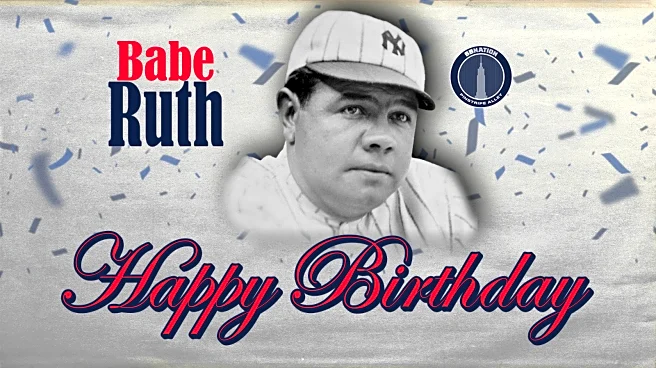
The February 6th entry into the Yankees birthday series is none other than Babe Ruth, a man whose legacy often suffers a similar fate. It would be redundant, with regard to the oral and written history of baseball, to follow the same general formatting for the Babe’s birthday post. If you’re looking for something along those lines, I’d direct you to my colleague Josh’s entry for the Great Bambino at No. 1 (where else?) on our Top 100 Yankees feature from a few years ago.
Today, however, we will honor him with a more stream-of-consciousness piece about becoming a mythical figure, written by someone born over a century later than Ruth.
George Herman (Babe) Ruth
Born: February 6, 1895 (Baltimore, MD)
Died: August 16, 1948 (New York, NY)
Yankees Tenure: 1920-34
In all fairness, it wouldn’t be right to completely disregard the basics for Babe Ruth, either. After being spotted clowning the International League as a 19-year-old with the Baltimore kid’s local Orioles (a minors club back then), Ruth was signed by the Boston Red Sox in 1914 and debuted that same season, beginning what was a transcendent 22-year career in Major League Baseball. He spent the first six seasons of that span with Boston, primarily as a pitcher, and a very good one at that as the Red Sox won multiple championships. He began to play primarily as a position player over his final two years with the Sox, giving a preview of what was to come — though something like this couldn’t be predicted.
The Sultan of Swat’s services were famously sold to the Yankees before the 1920 season, cursing his former team in the process, kicking off the stretch of Ruth’s career that defined him. As we all know, from there, Ruth went on to out-homer entire other teams, become the first player ever to hit 50 home runs in a season, and then the first to hit 60 seven years later — a record that stood for multiple generations.
It was his 15 years with the Yankees that helped him build on his mind-boggling 162.2 bWAR, his 10 seasons leading the league in OBP, and 13 leading in slugging percentage. With New York, he hit 659 of his near-universally known 714 career home runs, a phenomenon that points to the significance of what Ruth did for the history of the Yankees and baseball on the whole.
With little doubt, Babe Ruth is the most famous name in the history of this game. This is due mostly, of course, to his decades-long scourge of opposing pitchers, but also because of the era during which he played. Before every game was filmed, and every opinion and recollection was recorded and shared in one way or another, Ruth was out there playing the game to a degree that had simply never been seen before.
How exactly, can we compare someone of this stature to a modern player? To do so would be impossible, not to mention mostly useless. I am willing to admit that a lot of contemporary players could probably match Ruth’s skills if they were given his circumstances with their own ability and knowledge, but that’s not how this works. What Ruth did really happened, and it was so hard to believe that Ruth himself is for more akin to a ghost or a Paul Bunyan/John Henry-esque folk hero than a former All-Star and MVP.
There is a famous line from a certain beloved movie, which came out nearly a half-century after his death, in which his laundry list of nicknames is recited (the Yankees themselves reenacted this in a commercial a decade ago). The Sandlot’s premise of course, surrounds a lost baseball bearing the Babe’s autograph. It’s not uncommon for someone to be referred to as “the Babe Ruth of X” — standing in as a descriptor of an undisputed pillar of one’s craft. Ruth’s most famous moment, when he allegedly called his shot during a World Series game, can not even be proven to have happened, because the only evidence is a grainy photograph and old-timey paintings of the event.

The “called shot” is not unique in the story of Babe Ruth, as his career and life contained many myths, the validity of which can vary greatly. I don’t personally care to figure out what the truth is with many of them, I’m just glad that baseball’s rich history provides a character like this: a player whose stat sheet looks like (and is) a ledger of all-time records, doing so in a way and during a time where his mythical status was still a possibility.
There are photographs and videos of Babe Ruth, but it’s almost hard to imagine that he was playing in the same world as us, let alone in a league and with a team that is still thriving. It’s not dissimilar from acknowledging some kind of historical site that now holds homes of people using smartphones.
With all of this in mind, and constantly referred to in the baseball canon, it can be hard to proportionately appreciate what Ruth did on the baseball field. One of the great virtues of Major League Baseball is the overwhelming degree of record-keeping, something that thankfully preserves what Ruth did. He really did hit that many home runs, he really did outpace entire lineups, he really was good enough to make his name nearly synonymous with the sport he played.

In another entry to this series, one about Johnny Sturm, I mentioned how baseball can be a microcosm for the world and the time it inhabits, and how Sturm’s career was an interesting reminder of a time that was done and gone. That aspect of Sturm’s story, a largely unknown one-year player from the ’40s, is not all that different from Ruth’s, a ubiquitous character in American history.
In a way, Ruth’s status as a pillar of baseball history, one that comes with overwhelming statistical greatness, historical significance, and a satisfying level of intrigue and uncertainty, has become his defining factor.
Happy 131st to the Babe! They say it’s the new 30.
See more of the “Yankees Birthday of the Day” series here.