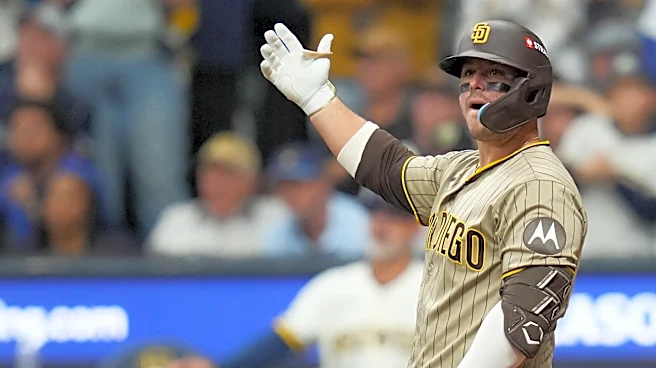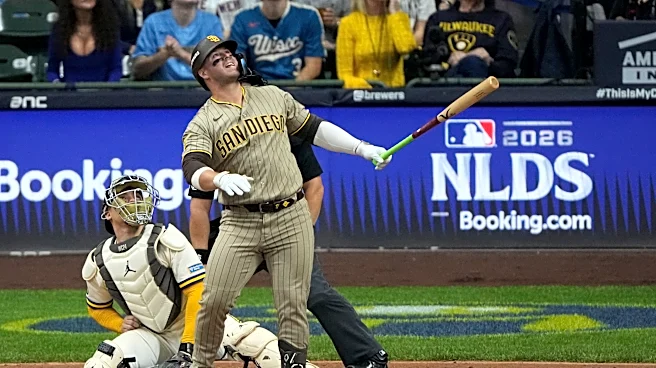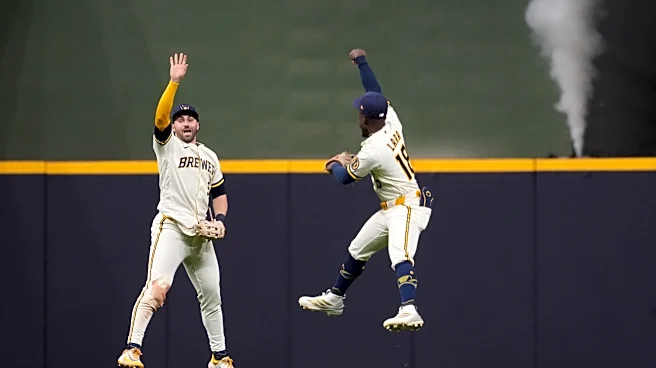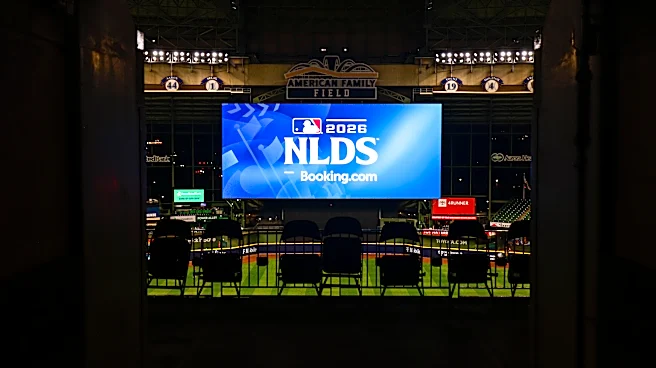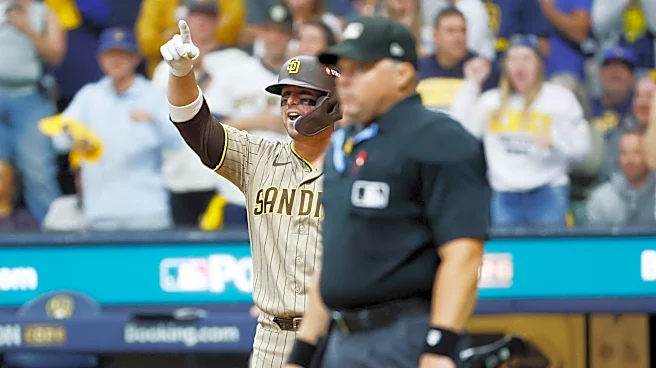



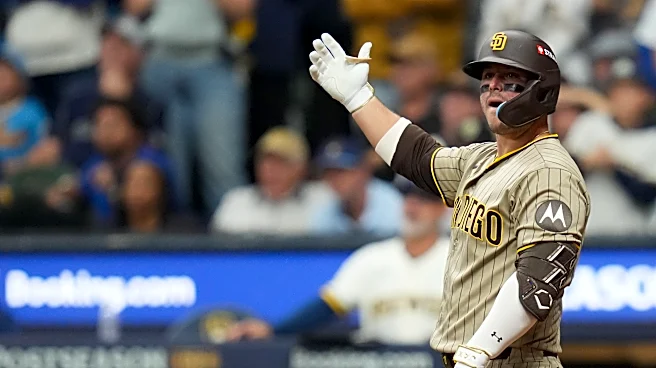
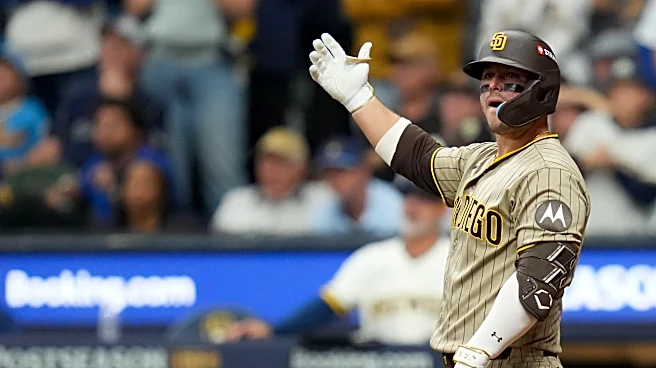
With one on and one out in the ninth inning of Saturday’s NLDS Game 1, the Padres trailing 3–2, Ty France lofted a deep fly ball to left that hit the roof at American Family Field — and dropped right into the glove of Brewers left fielder Jackson Chourio.
Was it a home run? An out? Even the broadcast booth couldn’t agree on the ground rules, and things only got weirder from there.
The immediate reaction from FOX analysts and former big-leaguers AJ Pierzynski and Adam Wainwright, citing the pregame ground-rules meeting, was that a ball hitting the roof meant a home run. Meanwhile, play-by-play man Adam Amin was adamant that the umpires had it right in calling it an out.
Despite three-ish minutes of absolute chaos and a massive spike in Google searches for “what happens when a ball hits the roof in baseball,” Amin did have it right. Per American Family Field’s ground rules, a ball that hits the roof over fair territory stays in play, so France’s fly ball was ruled a catch by Chourio for the second out. Now down to their last out, San Diego challenged whether the ball hit the roof over fair territory and lost.
If Pierzynski and Wainwright didn’t know the ground rules, the average baseball fan probably didn’t either. Here are (brief) answers to all of the questions you may have had while watching last night’s game.
This doesn’t happen often, right?
Correct, although France’s fly ball was at least the third time in history that a ball has hit the roof in fair territory at American Family Field. It’s actually not the first time that it’s happened in the NLDS; in Game 4 of the 2008 NLDS, Phillies outfielder Jayson Werth hit a fly ball that struck a roof truss and was snagged on a diving catch by none other than Craig Counsell. The second time was in a regular season game in 2018; Reds infielder Scooter Gennett hit a fly ball that, again, came down in fair territory and was caught for an out by Eric Sogard. The third time was last night.
Is this quirk unique to Milwaukee?
Definitely not — almost a quarter of big-league stadiums (7 out of 30) have retractable roofs, and the Rays’ Tropicana Field has a fixed roof. There have been some way crazier examples than what happened in last night’s game.
One of the most famous examples of balls hitting roofs occurred over fifty years ago, on June 10, 1974; Mike Schmidt crushed a towering fly ball that hit a public-address speaker hanging from the roof at the Astrodome — about 117 feet up and 329 feet from home plate. The ball dropped into shallow center field, and under the ground rules it was in play, so Schmidt only got a single despite estimates suggesting it would have traveled over 500 feet. In the words of Schmidt himself, “That damn speaker cost me a homer.”
On May 4, 1984, Dave Kingman of the Oakland Athletics hit a fly ball that rose towards the roof, then disappeared and never came down. The ball had gone through a seven-inch-wide drainage hole in the roof. Umpires Jim Evans and Ted Hendry conferred and realized there was no ground rule for this situation. Evans made a judgment call and awarded Kingman a ground-rule double, partly based on precedent: he had made a similar call in Seattle’s Kingdome when a fly ball got stuck in a speaker. A’s manager Steve Boros backed the call, saying that Evans used common sense.
The Tropicana Incidents
Tropicana Field, the home of the Tampa Bay Rays, has perhaps the most famous roof in baseball. The “Trop,” as it’s known to Rays fans, has four catwalk rings, lettered A (highest, innermost) through D (lowest, outermost). Because the dome tilts toward the outfield, the catwalks hang lower out there.
Under the current rules, the A Ring and the fair portion of the B Ring are in play, so a ball can drop for a hit or be caught for an out. The C and D Rings are out of play, and hitting either between the foul poles is a home run. Those rules are only in place because of a number of weird roof-related incidents that led to rule changes; for the sake of brevity, I won’t cover all of them, but here are the ones most similar to the France fly ball.
On May 26, 2008, Rays slugger Carlos Peña hit a pop fly to center that Josh Hamilton probably would have caught, but it hit the B Ring and stayed there. Peña was mistakenly given a home run before the umpires conferred and changed it to a ground-rule double.
On August 5, 2010, with the game tied 6–6 and two outs in the top of the ninth, Jason Kubel of the Twins hit a sky-high infield pop-up that would have ended the inning. Instead, it hit the A Ring and fell safely on the infield, letting the Twins score the go-ahead run in an 8–6 win. MLB then made A and B Ring hits automatic dead balls, but that change lasted only for the 2010 postseason.
In June 2018, the Yankees’ Clint Frazier hit a ninth-inning fly ball in a 6–6 game that bounced off a speaker on the B Ring and was caught by Adeiny Hechavarría. Some argued it would have been a go-ahead homer; the Rays went on to win in extras on a walk-off.
This season, on May 2, the Giants’ Heliot Ramos hit what looked like a two-run homer, but it came down in Cedric Mullins’ glove. The Giants challenged, believing it had hit a catwalk, but crew chief Vic Carapazza said no camera angle could prove it, so the call stood. Two members of the Giants (pitching director Frank Anderson and Brewers legend Adrian Houser) were ejected for continuing to argue.
Would France’s fly ball have been a homer?
No, probably not. You can’t say definitively one way or another (because, well, the ball did in fact hit the roof), but Statcast data strongly supports the conclusion that France’s ball would have fallen short of the left field fence.
France hit that ball 105.3 mph at a 49-degree launch angle, which — per Statcast — would have been a homer in only one park: Daikin Park in Houston. There were 27 fly balls this season at 105 mph and 49 degrees, and none were home runs. Batters hit .038 this season on balls with a 49-degree launch angle.
The most convincing point: only 10 over-the-fence homers in the Statcast era have had a launch angle that high, and there has never, ever been a home run recorded at American Family Field with a launch angle above 46 degrees. Ironically, the ball clearing the fence would have been rarer than the ball hitting the roof. The most likely scenario would have been a deep fly-out, which is exactly what ended up happening.
So, should we ban roofs in baseball?
Every baseball stadium has its quirks. Fenway Park’s “Green Monster” wall in left field is extremely close and extremely tall, meaning that line drives that would go out at, say, American Family Field turn into doubles (and sometimes singles). Wrigley Field’s outfield walls are made of ivy-covered brick. Daikin Park used to have a “fun and quirky” hill in center field.
A roof is just another quirk, except unlike a hill in center field, it actually serves a purpose. Cold-weather cities like Milwaukee, Seattle, and Toronto deal with freezing temperatures and weather concerns in April and sometimes late September. Hot-weather cities like Houston, Phoenix, Miami, and Tampa face the opposite: brutal summer heat, humidity, and frequent afternoon thunderstorms.
Eevery park has its own ground rules, and both teams go over them with the umpires before every game. A ball hitting the roof once every ten years doesn’t offset the positives of being able to play baseball when Mother Nature would deem it impossible.
In short, baseball is weird.