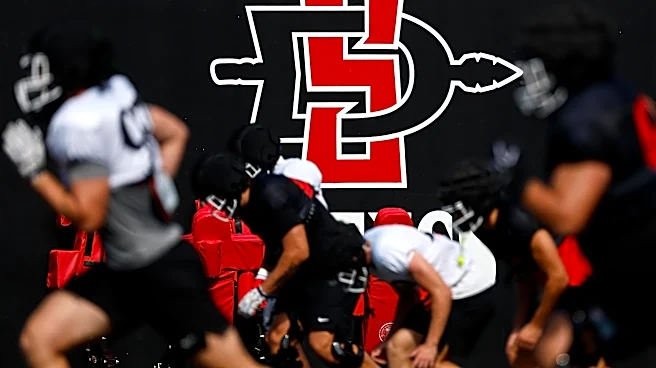


Moving on down south to the sunny beaches of San Diego, California, it’s time to get to know the San Diego State Aztecs.
Founded in 1897, San Diego State is the third oldest university inside the California State schools system. Originally beginning as two schools, San Diego Normal School and San Diego Junior College, they merged in 1921 and played their first football game that year. They went without an official nickname for the first few years, going by media-assigned names like “Staters.” Eventually,
after a vote, the student body settled on Aztecs as the official name.
Similar to Boise State, the Aztecs played their first few decades in the junior college division of NCAA football competition. They won a handful of conference titles in the 1920s and 1930s but didn’t appear in their first bowl game until 1947. After a 7-3-1 season, the Aztecs were thumped by Hardin-Simmons in the Harbor Bowl in San Diego, 53-0. They picked up their first bowl win in 1951 after an undefeated 1951 season. In the final iteration of the Pineapple Bowl, the Aztecs were victorious over Hawaii, 34-13. These successes of the late 1940s to mid-1950s were led by Bill Shulte, who finished his nine-year career at San Diego State with a 48-36-4 record, going 1-1 in bowl games. Following his departure in 1955, the Aztecs fell into a lull under Paul Governali, going 11-27-4 over his five years. Don Coryell stepped in in 1961 and instantly revived the program.
In his first two years, Coryell passed Governali in wins, going 15-4-1 and taking home a conference championship in 1962. After three more solid seasons, Coryell’s Aztecs popped in 1966. Part of their great success was their dominant defense. The Aztecs let up just 105 points over 11 games. Their defense was led by a young up-and-coming coach at just 30 years old. In fact, his success this year would lead him to an NFL job up north in Oakland the following year and an NFL head coaching job two years after that. His name? John Madden.
But back to the Aztecs. They survived a couple close games to open the year against some tough opponents. They narrowly got past a number seven-ranked Weber State 38-34, followed by a one-point win over Cal Poly, 14-13, and another close win over Long Beach State, 21-18. Their next big test came against a North Dakota State team that was ranked first in both the AP and UPI (United Press International) polls, while the Aztecs were ranked second in both polls. The Aztecs left no doubt, shutting out North Dakota State 36-0 in front of 35,000+ at Balboba Stadium. They’d roll the omentum into a 21-0 victory over Valley State and survive another close scare against Northern Arizona 16-8. They concluded the regular season with a 39-12 win over Cal State Los Angeles. It set them up with a date with Montana State in the Camellia Bowl, the western regional final of the small college division. The Aztecs cruised to a 28-7 win and were crowned the national champions in both the AP and UPI polls.
Coryell’s Aztecs didn’t settle in 1966. The Aztecs rolled through their 1967 season, winning their first nine games in a row to extend their winning streak to 25 across three seasons. Their only loss was to Utah State 31-25 to conclude the regular season. Utah State was also playing in the University Division at the time, now known as FBS, and the Aztecs still made things close, losing 31-25. The Aztecs again played in the Camellia Bowl, this time against San Francisco State and repeated as Camellia Bowl champions, winning 27-6. For the second straight year, San Diego State was crowned by both the AP and UPI polls for back-to-back national championships.
In their final year in the college division, San Diego State still couldn’t be stopped. Their lone blemish came in a tie near the end of the year against Tennessee State 13-13. They ended the season with a 30-19 revenge win over Utah State. Operating as an independent in 1968, the Aztecs didn’t play in the Camellia Bowl that year but still finished as the UPI poll champion for a third consecutive year and second in the AP poll to North Dakota State.
After dominating the college division with a three-peat to end their tenure, the Aztecs made the leap to the University Division, joining the Pacific Coast Athletic Association for the 1969 season. They joined Long Beach State, Pacific, San Jose State, Santa Barbara, Fresno State, and Cal State Los Angeles in the conference. Even in a completely new division, Coryell’s Aztecs still were unstoppable, going undefeated again in the regular season with their only one-possession game coming at the end of the year against Long Beach State, winning 36-32. The Aztecs would face off with Boston University in the Pasadena Bowl, winning 28-7. Coryell led the Aztecs for three more seasons, winning nine, six, and 10 games, respectively, before departing to be the head coach of the St. Louis Cardinals (now Arizona Cardinals) in 1973. Coryell finished his Aztec career with a 104-19-2 record, an .840 win percentage.
Claude Gilbert, the defensive coordinator, was promoted to the head coach and kept the momentum rolling. The Aztecs played three more years in the PCAA before becoming independent for two years and then joining the WAC in 1978. After more than a decade of bowling over every opponent in their path, the Aztecs finally were met with some adversity in the WAC. They went 2-4 in conference and finished with an overall record of 4-7. They turned things around in 1979, going 8-3, but came right back down with a 4-8 1980 season and a 6-5 in 1981 season.
The Aztecs fired Giblert after the 1980 season and hired BYU’s offensive coordinator, Doug Scovil. Scovil’s five years at San Diego State were a mixed bag, going 24-32-3. He left after the 1985 season to become the quarterbacks coach with the Philadelphia Eagles. The Aztecs then hired former Bowling Green head coach Denny Stolz. He was able to lead the Aztecs to an 8-3 regular season in 1986, a WAC conference championship, and their first bowl appearance since 1969. The Aztecs would fall just short against the 19th-ranked Iowa Hawkeyes, 39-38. That would unfortunately be the peak of Stolz’s career at San Diego State, as he went a combined 8-15. Al Luginbill took the torch in 1989 and led the Aztecs to a Freedom Bowl loss in 1991. Similar to his predecessor, a bowl loss would be the height of his Aztec tenure. Ted Tollner would follow the same fate, losing the 1998 Las Vegas Bowl after taking over in 1994.
San Diego State spent the 2000s floating around three to five wins while playing in the Mountain West Conference. It wasn’t until Brady Hoke’s second season as the boss that the Aztecs finally snapped their bowl drought. The Aztecs went 8-4, with narrow losses to third-ranked TCU, 40-35, and 25th-ranked Utah, 38-34. The Aztecs met Navy in the Poinsettia Bowl in their home city of San Diego. The Aztecs thumped the Midshipmen 35-14 to secure their first bowl victory since 1969. Hoke turned that success quickly into a big-time job, moving over to Michigan. The Aztecs promoted their defensive coordinator Rocky Long to fill Hoke’s shoes. Long helped turn the Aztecs’ long bowl drought into a string of consistent bowl appearances as the Aztecs played in 12 straight bowl games (excluding the 2020 season). In his second season, 2012, the Aztecs took home a share of the Mountain West conference title after going 7-1 in conference. Three years later, San Diego State rebounded from a tough 1-3 start to the year and finished by winning their final eight games of the regular season to make an appearance in the Mountain West Championship game. The Aztecs defeated Air Force, 27-24, to win the Mountain West outright. They finished it off with a 42-7 drubbing of Cincinnati in the Hawaii Bowl. They repeated their success with another Mountain West championship in 2016, beating Wyoming by the same score, 27-24.
Long would step down as the coach of the Aztecs following the 2019 season, finishing with a record of 81-38. His 81 wins are second all-time in Aztec history behind Coryell. Hoke returned to San Diego State after being run out of Ann Arbor, Michigan, and making stops as a defensive coach at various spots around college football and the NFL. He served as the Aztecs defensive line coach during the 2019 season.
Hoke got results in his first full season in 2021, leading the Aztecs to a 7-0 start before suffering their first defeat to the hands of Fresno State. The Aztecs rebounded to finish 10-2 and make it to the Mountain West title game but lost to Utah State 46-13. Hoke’s Aztecs would fall off after that 2021 season, going 7-6 in 2022 and 4-8 in 2023, his final year, as he would retire at the end of the season.
The Aztecs are now led by Sean Lewis. After a mediocre 3-9 inaugural season, Lewis quickly turned the tides of the program, going 9-3 in 2025 with a close loss to North Texas in the New Mexico Bowl. Lewis will hope to roll this momentum into a great first season in the new Pac-12.