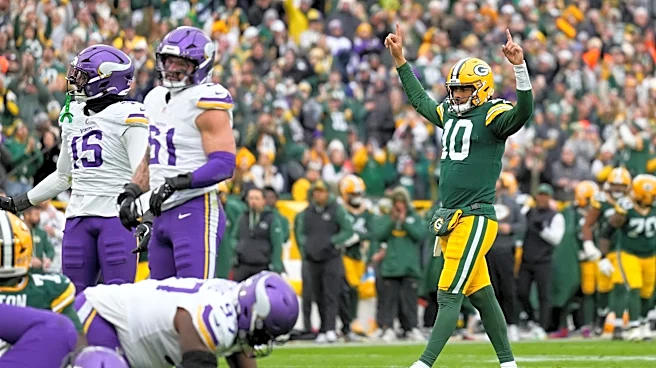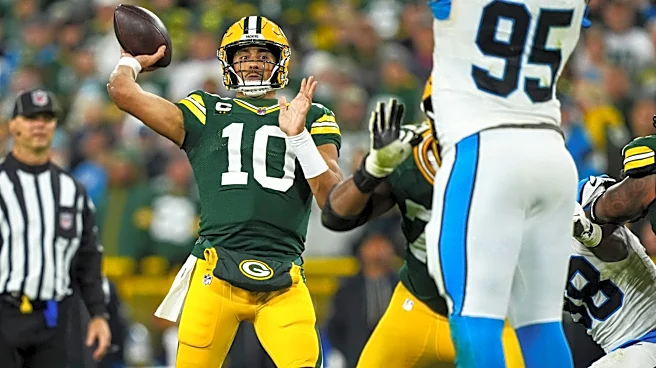


As I tend to do every week, I found myself talking about the Green Bay Packers a lot this week. Some of that was just muttering to myself in the hallway of my house, but sometimes I was talking to real, live people and sometimes those conversations were recorded. One question that keeps coming up has been this: is the Packers offense sustainable?
On its face, the answer is “probably not.” We’re coming off a performance where Jordan Love had fire shooting from his hands: completing 79.3% of his passes
for 372 yards and 3 TDs. He posted that 79.2% completion rate while bombing: 27.6% of his attempts were 20+ yards down the field (his highest rate of the season).
The question of sustainability revolves around Jordan Love (“can he keep this up”), but it’s really more about the run game. Can an offense continue to be successful into the playoffs with a high pass rate and a bad running game?
No matter where you look, the run game metrics are bad. They’re dead-last in EPA per Play at -0.26 (per NFL Pro). They’re dead last in DVOA at -32.6% (per FTN). They’re 31st in Yards Per Attempt at 3.0 (per Pro Football Reference). Pick your favorite football analytics site and they’re going to be right near the bottom in rushing on every single one of them.
In looking at the overall team, I believe it’s sustainable. On top of being an aggressive attacker down the field, Love has become a very good operator in the quick game, and the Packers have the offensive pieces to make that work. Whether that’s working an old favorite like Slant/Flat or hitting some of those quick outs he has become so fond of, it’s an area of his game that has seen a ton of improvement over the years. If they need to supplement the lack of a run game with a quick pass game – and take enough deep shots to keep defenses from sitting on the underneath routes – that feels like it could work. Combine that with a defense that has been playing extremely well (2nd most turnovers, 5th in DVOA, 9th in EPA per Play) and that feels like a recipe for sustainability. But is it really?
I dug into some numbers to see if that’s something that we’ve seen before. Have we seen a team this bad at running the ball find success? I had to define success, so I determined that any team that made the playoffs could be assumed to have some sort of sustained success. So I grabbed every team that made the playoffs from 1999-2025 and looked at a handful of their metrics during the regular season to see if this is something that has happened. If you’re asking “why 1999”, the answer is because that’s the furthest back the data I am using for this goes back.
The main metrics I looked at were Pass Rate, EPA and Success Rate.
Here’s where the Packers sit. For these numbers, I’m only looking at games after Week 3, since the offensive line was non-functional for the first few weeks. Is that cheating? Maybe! But it felt like the best thing to do, and I’m making the rules here.

We’re going to lock that Packers line so we can keep it in mind, then look at some other teams that may fit the bill. If there is a * next to a team name, it means that team was in the Super Bowl that season.
First up: Pass Rate.

These are the highest pass rate teams in our group. As you can see, a pass rate of 61.1% isn’t crazy given some of these other teams. It’s still relatively high – a pass rate of 61.1% would rank 97th highest out of 336 teams – but it’s not some crazy outlier. Among these teams, the Packers’ EPA per Pass far exceeds the other teams, but their running game is worse than all of them except for the 2022 Bucs. Their Passing Success is better than everyone except the 2021 Bucs and the 2011 Lions, but their running game is worse than all of them in terms of success.
That led me to look at Rush Success Rate. Where does the rushing success rate from this year’s Packers team stack up against our sample?

The Packers would still be a bit of an outlier – their 36.3% rush success would be the 22nd worst success rate among our 336 teams – but it has been done. The one that jumps out (because of course it does) is the 2007 Packers. I’m not alone in believing that, if they hadn’t lost to the Giants, they would have won the Super Bowl that year. For this year’s Packers to be significantly better in EPA per Pass – and slightly better in Rush Success Rate – is pretty surprising. That team also had a slightly higher Pass Rate than this year’s Packers, as well. That 2007 team had a better Pass Success Rate, so they were better at moving the chains, but this team is better at generating points. If you want to point to a volatility point, something like that would be it. A high EPA per Play but low Success Rate could suggest that a team is punching a bit above their weight.
We could do this all day, but we’ll end with this. I wanted to see what teams had a Rushing EPA worse than this year’s Packers:

Those are all the teams with a worse Rush EPA than this year’s Packers. A few of those teams (2022 Bucs, 1999 Lions, 2014 Colts) had a higher pass rate, but most of them were more run-heavy than this year’s Packers, despite having worse results while doing so.
Of these teams, the Packers outpaced all of them in EPA per Pass and Pass Success Rate. They have a better overall Success Rate than all but 2 of these teams (2022 Bucs, 2014 Colts).
We’ll stop here, or we’ll be here all day. There’s more that can be combed through, but I think we have a pretty good idea of where this Packers team stands. Let’s close by revisiting our question:
Question: Is this Packers offense sustainable?
Answer: History tells us that it is, but it’s also a fairly narrow path to walk. Teams with this makeup have been “sustainable” enough to make the playoffs numerous times, but it’s not the norm.
Albums listened to: Blondshell – Violins; Leem of Earth – See; Remi Wolf – Mud