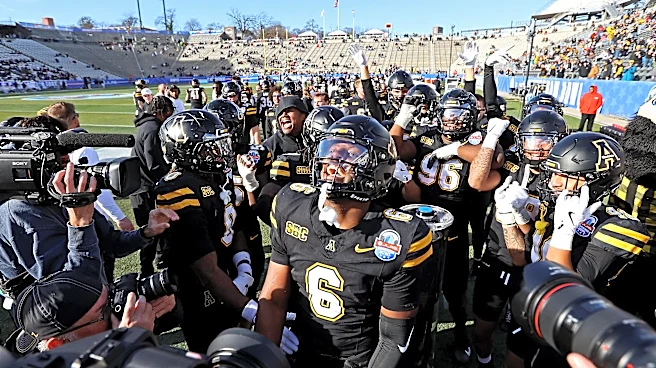




It takes one look at a continuity table for the Sun Belt to understand the challenges that face G6 programs like App State in the portal era, which requires these programs to adjust to losing their best players to the power conferences each season. Nine Sun Belt teams rank 105th or worse in returning production, and App is one of those, coming in at 127th.
The Mountaineers have 75 new players on the roster for 2026, including their high school signees. G6 programs also tread heavily in the portal,
but the difference is that while P4 programs are bringing in bushels of experienced players (many of them coming from the G6), G6 programs are largely working with guys who washed out at the P4 level and haven’t played much. App State brought in 45 transfers this offseason, yet is adding only 16 starts’ worth of experience from that group.
The experience drain is a new but permanent problem for the G6, but the good news at least, for App and everybody else, is they’re all dealing with it. This group is still going to produce good teams here and there, but there’s no real budgetary outlier—no Gonzaga of college football—among them. Every single one of them is like a T-1000 made out of kindling. They will reconstitute after each fatal blow, yet remain easy to set on fire.
Inevitably, the downward leveling of the portal era has most harmful to the G6 programs with the most built-in recruiting advantages, since those these qualities are diminished now that money is involved. App State was a model of mid-major success for a long time but has watched its fortunes sink of late, winning six games or fewer in three of the last four years.
Last season’s campaign was noteworthy only in that App finished 5-8, becoming maybe the first FBS program to do that. On a down-to-down basis, the Mountaineers were worse than the record implies—just not good at anything at all.
But with roster overhaul comes at least the potential for a new fate, and early in 2026 it looks as though App has improved at quarterback and on the defensive side (both quite low bars to clear, mind), while the rest remains to be seen. After spending years on the bench at Arkansas and Purdue, Malachi Singleton is making the most of his opportunity with the Mountaineers, and it’s clear already that his success as a passer will determine the quality of App’s season.
Singleton has thrown for nearly 900 yards through three games, with a completion rate just short of 75%. He is averaging 9.5 yards per attempt, and has five passing scores against one interception. The schedule has not been good, but hey, he’s taking advantage, which is a good sign. He’s delivered a bragging-rights win at ECU and given his team a decent shot at improving on last year’s record.
But there are not-so-good signs elsewhere, which is why his arm is going to be so important. In two games against FBS teams, App is averaging 109 rushing yards on 2.8 per carry. Against Charlotte, which might well be the worst team in FBS, the Mountaineers managed only 90 yards on 33 carries. They’re bottom-of-the-barrel in terms of EPA/rush, their stuff rate is poor, and with that so is their rushing success rate. All of this has hindered App’s ability to finish drives in scoring territory.
This weakness is likely to prove fatal on Saturday, and while Singleton’s mobility is a concern, it has not been impactful thus far. We’ll see how they alter their approach this week, because they’re going to have to try something. But I’ll be surprised if it alters the bottom line too much.