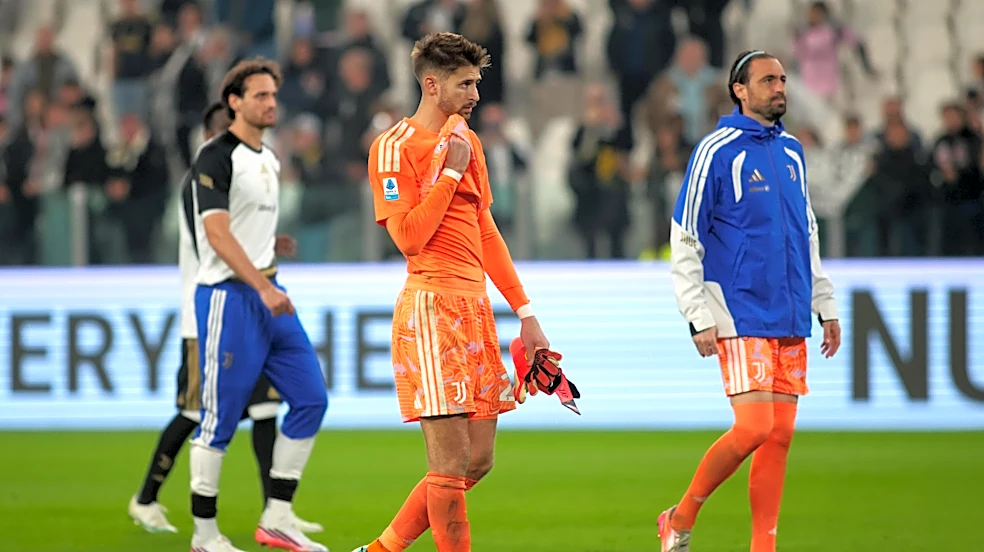






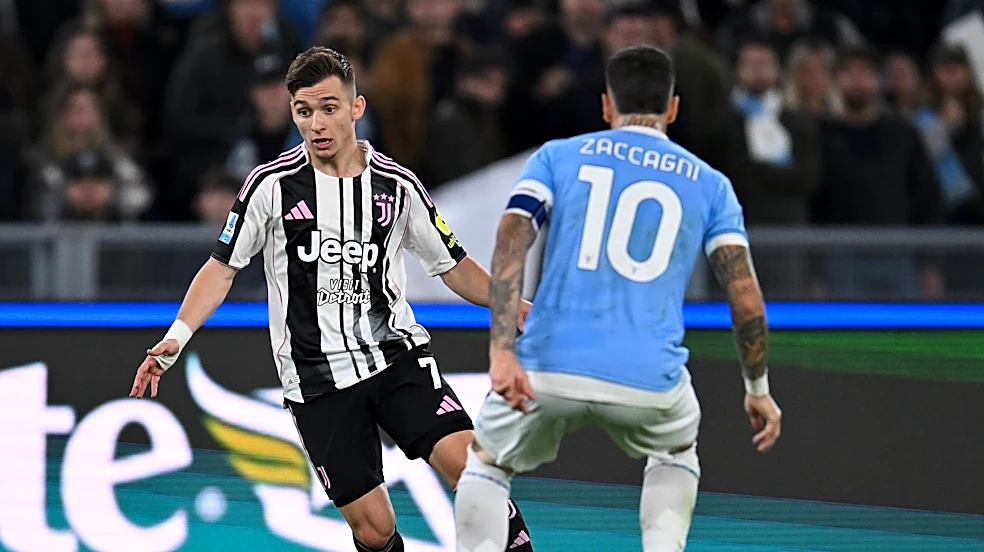


A 3-0 home defeat to Lazio is the kind of result that immediately triggers alarm bells. To look at the scoreline alone is to assume a complete structural collapse — a performance where Juventus were swept off their own pitch and systematically dismantled from front to back.
Yet beneath the immediate sting of the result lies a much stranger story. The raw data tells us this was far from the defensive disaster the final score suggests: Lazio created very little in open play, and the bulk of their goals
came down to isolated individual errors rather than a broken defensive blueprint. Instead, the real damage was done further up the pitch, where a hollowed-out midfield, a stranded left flank, and a total lack of early urgency rendered Juventus completely ineffective.
To understand how a match that was largely kept at arm’s length turned into a three-goal blowout at the Allianz Stadium, you have to look past the scoreline and examine the two structural realities that defined the afternoon: a defensive system that largely held up until individual errors exposed a stranded left wing, and an offensive setup whose broken spacing and passive tempo neutered the team long before they fell behind.
Defensive problems: mostly individual, occasionally systemic
It’s easy to look at the final scoreline, or situations that led to the three goals, and walk away thinking there’s a systemic issue with the defense. Three quality shots — all from different situations — that put the game out of reach can often feel like the problems run deeper. But looking back at the match, all three situations were created by individual mistakes that opened the door for Lazio to take advantage of. The moments weren’t created from pieces of individual brilliance or even a team systematically finding weak spots and taking advantage of them. Instead, Lazio managed just nine shots on the match — including zero for the first 30 minutes — most of which were speculative efforts that never threatened the goal.

Run back through the shots that were taken, and you’d expect Lazio to be shutout a little more than half the time (they were shutout in 55.5% of the simulations, to be exact). Further, you’d expect them to score exactly 1 goal another 35% of the time. Lazio scored more than one goal in less than 1-in-10 simulations, and they scored three goals in just 1-in-100 simulations. Unfortunately, the simulations aren’t real life — and Lazio did score those three goals. The point isn’t to say that what happened didn’t or shrug it off as though it’s nothing. The point is that the issues don’t seem to be systemic. Systemic issues — generally speaking — lead to more chances and opportunities.
Once teams find the weak spot, they tend to attack it over and over. In American football, there’s an adage, “Run it until they stop it.” The premise is basic: if you can do one thing over and over and get good results, do it. A coach I used to work with had his own version of it, saying that the point of an offense is to score as simply as possible — and there’s no more simple way than repetitively doing the same thing. That’s not what happened, though. While Lazio did overload the left flank consistently (and we’ll get to that in a bit), that tactic isn’t what led to their scoring opportunities.

Their first goal came from a set piece, with Lazio recovering Juventus’ initial clearance before whipping in another cross that beat Gleison Bremer. Their second goal came from quickly switching play and goading Zeki Çelik into biting too hard on a fake, opening space for Gustav Isaksen to carry the ball centrally and take a good shot. Their third goal came against the run of play, in a 2-v-4 situation, in which Juve’s best defender was dribbled past with ease. Three goals, all different situations, all different setups, all heavily involving individual players getting beat (something no system is going to successfully overcome).
With all of that said, the system is obviously not perfect — nothing ever is. There were two key areas that Lazio managed to attack consistently that put Juve in precarious situations, and they played into each other well. Lazio was quite intentional in overloading the midfield and their right wing to create numeric advantages. For the midfield, their trio of Davide Frattesi, Reda Belahyane, and Kenneth Taylor all stayed compact, with striker Tijjani Noslin and left-back Nuno Tavares both stepping into the midfield periodically to provide numeric support. The result was that Juve’s midfield was often outnumbered and overmatched, with Weston McKennie often having to drop from playing behind the striker to functioning as something of a right midfielder to compensate.
That overloading of the midfield also allowed them to create numeric advantages out wide, with Romano Floriani Mussolini joining the right wing with Isaksen. With Pape Matar Sarr already overwhelmed and overloaded in his area of the pitch, and Kerim Alajbegović often staying high and wide to provide an outlet once the ball was recovered, Çelik was often asked to hold down the left flank by himself. Lazio was able to take advantage of this once for the second goal. Isaksen owes a bit of gratitude to Mussolini’s relentless commitment to the right wing — using the Italian’s overlapping run as bait to sell the fake, leave Çelik stranded, and open up the lane to cut inside and score. Still, Çelik should have done better — in both his positioning and his movement — to focus more on the ball carrier than on the player overlapping, with the Turkish defender’s mistake ultimately being what allowed the second goal to be scored.
When goals did go in, they were the product of individual breakdowns under sustained pressure rather than Lazio unlocking a broken system. Bremer was beaten in the air on a cross for the first goal, Çelik bit heavily on an overlapping dummy to hand Lazio space on the second, and Bremer was cleanly run past on a late counter for the third. Having two match-deciding errors come from the team captain and defensive anchor makes the result feel like a structural collapse, but the reality is more nuanced: the defensive system generally kept Lazio at arm’s length, but constantly left Çelik on an island until individual execution inevitably failed.
Offensive problems: mostly a problem with the system
There’s a bit of irony in a coach like Luciano Spalletti — mostly famous for his attacking systems throughout his career — producing a team that’s top of the table in expected goals allowed who have held their opponents to one goal or less in seven of their nine matches this season (including four clean sheets) while sitting 10th in both goals and expected goals. While the coach most famous for deploying strikerless systems with Roma in the mid-2000’s and playing highly fluid, attacking football with Napoli, that creativity and ingenuity has been missing from Juventus to start the season. The team is often languid and stagnant in possession, with players rarely opting to make off-ball runs and the team often falling back on crosses into the box (despite not having any attackers who even average at attacking the ball in the air).
Those traits were once again the hallmark of Juventus’ attack (if you can even call it that) on Sunday. Juventus notched just three shots — two of which were from long range — and 0.14 xG in the first half, and the process was exactly what you would expect from such a performance. For most of the match, the midfield was operated singularly by Sarr — with Douglas Luiz often pushing up and McKennie often pushing wide (occasionally wider than nominal winger Nico Gonzalez). During some periods of the match, there wasn’t a single player whose average position on the ball was actually in the center of the pitch, with the team instead attempting to overload either wing.

This was exacerbated by players rarely making forward, off-the-ball runs, leading to situations where several players would sit close together. This allowed Lazio to defend three, sometimes four, players with fewer men as there was no concern for runs to spread the committed men apart. This, in turn, allowed them to find numerical advantages around the rest of the pitch defensively, making any switches nearly impossible without going all the way back to the backline and resetting play. Ultimately, the languid and stagnant offense made it difficult to work the ball into the box with the team managing just 27 touches in the box despite holding nearly 58% of possession. By comparison, Lazio managed to get 25 touches in the box on just a touch over 42% possession.
It seems that in the absence of Manuel Locatelli — and the stagnation problem predates his injury, to be clear — Spalletti’s solution to not having midfielders who can comfortably play through the middle is simply to abandon the midfield altogether rather than trying to add numbers and make it easier on the players in those spaces. That’s what Gennaro Gattuso’s done with Lazio, as mentioned above. While none of those players thrive in tight spaces or possession, he’s made their jobs easier by giving them more outlets. Fullbacks and forwards join the midfield, ensuring that players are never isolated or outnumbered. Spalletti seems to be going in the opposite direction, asking players to do more where they’re comfortable and less work where they’re not, and it has — mostly — not been working.
There were a few moments where the opportunity presented itself for the game to flip on its head. In the first half, Juventus managed to work the ball into the box with multiple players managing to find space. In the end, however, no player seemed to want to shoot it as the ball pinged around multiple times before Kolo Muani finally pulled the trigger from an offside position. Then, coming out of the break, Spalletti tried to make a change with Nick Woltemade coming on in place of Alajbegović, pushing Randal Kolo Muani out wide. The change seemed to make an immediate impact with Juventus moving the ball with more cohesion and ease. In the 55th minute, Woltemade pushed a ball just wide trying to score at the near post. A minute later, Gonzalez took another shot — this time just wide of the goal — but wasn’t able to get enough spin on the ball to curve it at the far post.

Had any of those moments clicked, we’d perhaps be talking about a different game. Lazio wouldn’t have been able to sit as deep and compact. They would’ve had to come out and contested for possession to try to score goals. They would’ve had to concede space and better opportunities. They would’ve been in the position Juventus were in for most of the match, and Juventus could’ve taken advantage of that given a team full of players who thrive when given the ability to run into space but wilt when asked to move the ball in tight spaces. But that’s football, right? A missed shot here, a defensive mistake there, and suddenly instead of playing to your strengths you’re chasing a game by playing to your weaknesses with no way out.
Ultimately, this offensive stagnation isn’t just a matter of players having an off day. It is a structural failure that forces creative players into self-defeating loops. By vacating the central channels and relying on static wing overloads, Spalletti’s system strips the attack of its verticality and leaves forwards isolated in heavy traffic. When off-ball runs disappear, possession becomes purely defensive — holding the ball without ever threatening the space behind the block. Until the system provides structured central support and demands early, unselfish movement into space, Juventus will continue to look like a side trying to solve an 11-man puzzle with individual moments of magic that simply aren’t coming.
It is easy to walk away from a 3-0 home defeat feeling like the sky is falling. I feel that dread right along with you. When I started writing these analyses, the goal was always to judge the process over the results. Right now, there is no sugarcoating it: the offensive process stinks. The lack of central presence, the abandonment of off-ball runs, and the reactive nature of the team’s urgency are deep-seated structural issues that demand immediate correction. If Spalletti continues to abandon the midfield and rely on late-game desperation to generate threat, these stagnant performances won’t be anomalies. They will be the blueprint for every organized opponent in Serie A.
And yet, two things can be true at once. The process desperately needs fixing, but we are also not nearly in the dire straits the scoreline suggests. Football is a game of fine margins, and this 3-0 loss was fundamentally built on a few bad bounces, isolated individual errors from key leaders, and a handful of inches on misses at the other end. A match that could have easily ended as a muted 0-0 or a narrow 1-0 win spiraled into a headline disaster because Lazio maximized their chances while Juve’s structural flaws amplified every mistake.
The takeaway isn’t that this team is fundamentally broken beyond repair, nor is it to blindly trust that everything will magically fix itself. It is a reminder that we are riding the razor’s edge between a frustrating transition phase from which we come out the better for and a complete free fall during a period in which our best players are injured. The defensive foundation is largely intact, and the squad possesses the profiles needed to play dynamic, space-seeking football once given the proper framework.
But until Spalletti fixes the engine room and restores basic off-ball movement, we will keep finding ourselves chasing matches on the wrong side of those fine margins.