

If I asked you to name a great single season from a player in Yankees’ history, you can probably come up with a few strong options. That player will probably also be a legend in franchise history. Feats like Joe DiMaggio’s 1941 with his 56-game hitting streak, Aaron Judge’s 62 homers in 2022, and Ron Guidry’s Cy Young 1978 probably come to mind first. Hell, any one of a number of Babe Ruth campaigns could be your answer.
The thing about individual seasons as opposed to great careers is that it’s possible
to have an outstanding season and then somewhat fade back in obscurity. You’re more likely to be a pretty good player overall if you put up a great season, but random successes aren’t unheard of.
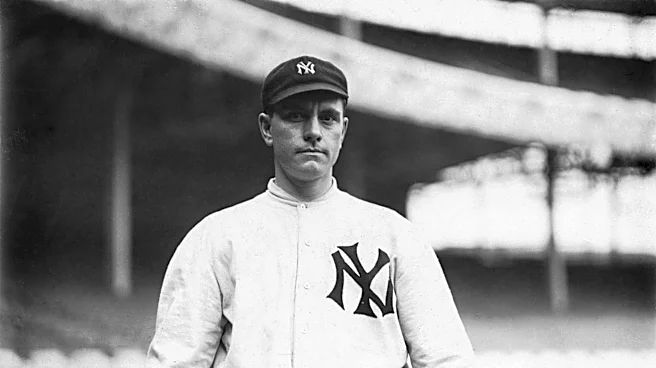
In Yankees history, Russ Ford had a couple solid campaigns in general, but then also had one of the best single pitching seasons in franchise history — despite being someone whose name you might not know. With today being his birthday, let’s look back on the original Ford pitching standout and his unbelievable 1910 season.
Russell William “Russ” Ford
Born: April 25, 1883 (Brandon, Manitoba, Canada)
Died: January 24, 1960 (Rockingham, NC)
Yankees Tenure: 1909-13
Born in 1883 to Walter and Ida Ford — the latter of whom was a second cousin of soon-to-be U.S. president Grover Cleveland — Russ Ford was born in Manitoba, Canada. In his childhood, the Ford family — which also featured Russ’ older brother and fellow future big league pitcher Gene — emigrated to the United States and eventually settled in Minneapolis.
While there, he caught the eyes of some teams, and began to pitch in the minor leagues after his schooling. Ford started off his baseball career with the Springfield Senators in 1905. He played the next couple season with them, the Cedar Rapids Rabbits, and the Atlanta Crackers. It was with Atlanta in 1908 where he figured something out that would forever change him as a pitcher.
One day in Atlanta in 1908, Ford was warming up before the game on what had been a rainy day. He was a little bit wild, and one pitch got away from the catcher and struck an upright on the stands which they had been throwing under. After the ball was returned to him, Ford started to notice some odd movement on his next couple throws. He examined the ball and noticed that it had been scuffed up a bit where it had hit the upright. He then started to grip the ball opposite the scuff, and suddenly began to see some severe movement, as he had discovered what was set to take him to the big leagues.
The then-New York Highlanders picked up Ford after the 1908 season, and he ended up making the roster out of spring training for 1909. Tabbed for his MLB debut in the 11th game of the season, Ford ate some innings after Highlanders starter Jack Quinn got knocked out early by the Red Sox. Ford went four innings that day, allowing six runs. Shortly after that, he was assigned to the minor leagues, joining the Jersey City Skeeters. He had a good season there, experimenting with using an emery board to scuff up the ball, leading to him returning to the big leagues for 1910, when he would have his legendary season.
With his emery pitch, Ford hit the ground running when he returned to the big leagues in 1910. After coming out of the bullpen once, he was given his first major league start on April 21st. Tasked holding down that year’s World Series champions, the Philadelphia Athletics, Ford fanned nine batters en route to a complete-game shutout victory. Of Ford’s first nine MLB starts, only one didn’t end in a Yankees win, as he racked up 51 strikeouts across them.
Arguably the most impressive outs of Ford’s rookie season came on July 19th. Facing off against the St. Louis Browns, Ford’s defense behind him let the pitcher down, as an error allowed St. Louis to score a run in the top of the first. After that, Ford was dominant, at one point retiring 19 hitters in a row. As the offense took and grew a lead, Ford continued his dominance, and still had allowed no hits as the game moved to the ninth inning.
After issuing a walk and then getting the first out of the inning, Ford allowed a blooper hit by Danny Hoffman that was headed towards shortstop. However, Highlanders shortstop Roxey Roach misjudged the fly ball, allowing it to gently drop in for a Browns hit. Ford got out of the inning after that, finishing with a one-hitter, but came incredibly close to a no-no, which would’ve been the first in Highlanders/Yankees franchise history.
In total, Ford finished his rookie season with a 26-6 record, a 1.65 ERA (160 ERA+), a 1.87 FIP, 209 strikeouts, and would’ve led the league with just 5.8 H/9, had that been a stat calculated at the time. MLB awards didn’t exist back then, but Ford would’ve been in strong consideration for several of them. He almost certainly would’ve been a Rookie of the Year lock, and while this was the Walter Johnson Era and a Cy Young would’ve been a longshot, he would’ve earned some down-ballot consideration for that and the MVP. Ford’s 26 victories that season also set an AL rookie record, which still stands and will likely never be broken.

From 1911-13, Ford was still somewhere between good and very good, but he never quite matched 1910 again. He dealt with arm fatigue in 1913, which led to the Highlanders/Yankees’ contract offer for 1914 including a sizeable pay cut. That led him to leave the team and jump to the newly founded Federal League with the Buffalo Buffeds. He looked the part in 1914, leading the FL in a number of pitching stats.
However, the leagues all began to ban the use of the emery ball, and that plus Ford’s injury issues led to a massive drop-off in 1915. The Federal League also disbanded after 1915, and no AL or NL team were interested in the pitcher. He played in the minors before a few years but could never get back to close to his best. He eventually left baseball and move to his wife’s native North Carolina, where he passed away in 1960. Years later, the Canadian Baseball Hall of Fame honored the Manitoba-born Ford by inducting him in 1989.
Ford was not remotely good enough for long enough to merit induction to the National Baseball Hall of Fame in Cooperstown, but that one season in 1910 is a better single season than many Hall of Famers have ever had.
See more of the “Yankees Birthday of the Day” series here.