
In case you haven’t heard, the 2026 Mets will look very different from the teams we’ve rooted for over the past several years. The four longest-tenured Mets—Brandon Nimmo, Jeff McNeil, Pete Alonso, and Edwin
Díaz—are all gone, having either been jettisoned from the team or allowed to walk away. The breaking up of this core of franchise players have resulted in some exhausting discourse about the path the organization has chosen to take, and whether you personally agree or disagree with said path, one simple fact cannot be denied: this core, while having achieved some fun highs over the past several years, is ultimately one that failed to reach its full potential, which is what led to David Stearns’s decision to chart a new direction.
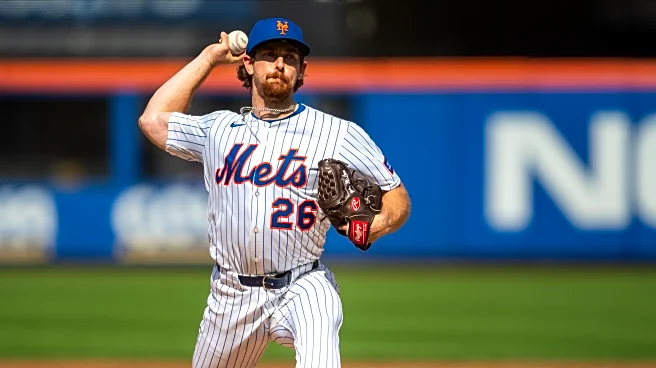
We haven’t fully seen the vision of this new direction just yet—the offseason has gone at a snail’s pace, and there are a lot of players still out there on both the free agent and trade market, so the exact makeup of the 2026 Mets remains to be seen—but certainly a major part of Stearns’s vision involves a new, younger core of homegrown players taking the place of the old one. And while it can be a fool’s errand to place all of one’s hope on unproven prospects, there are nevertheless a lot of reasons for optimism about what this future core might look like. The player development apparatus that the Mets have put into place over the past few years has continued to show a lot of positive strides, as several minor league players took noteworthy steps forward in 2025 and positioned the team’s farm system as one of the very best in all of baseball. And when you look at the various prospect lists for the Mets that several publications have or will put out this offseason, the name you’ll consistently see at the very top is Nolan McLean.
Of course, at this point McLean is really only still a prospect in technical terms, as he made his major league debut this year and finished just two innings shy of using up his rookie eligibility. And he sure as hell looked nothing like a rookie when he came up to the big leagues. Instead, while everything else was going up in flames during those final couple months of the season, McLean proved to be the one clear bright spot for the team, providing the most dominating performance from a Mets pitching prospect since Matt Harvey over a decade ago. And while it ultimately wasn’t quite enough to secure the team a playoff spot this year, it did provide them with the hope that they have a crucial building block for their new core moving forward: a bona fide homegrown ace.
It would be easy to dismiss that previous statement as hyperbole, even when taking into account the topline stats that McLean put up in his eight major league starts. Sure, that 2.08 ERA in 48 innings is mighty purdy, and it was paired with a nice and shiny 30.3% strikeout rate (a number that would have ranked him third amongst all MLB pitchers—behind only Tarik Skubal and Garrett Crochet—had he pitched enough innings to qualify). Still, pitchers are capable of going on short-term hot stretches all the time—even ones without the prospect pedigree that McLean boasted prior to his call-up. He certainly wouldn’t be the first young pitcher to come crashing back down to earth with a little more exposure after initially bursting onto the scene in a blaze. And of course, there’s also the unfortunate reality that young pitchers break all the time, as Mets fans have learned several times over (we did just mention Matt Harvey in the last paragraph, after all). So pinning all our hopes on one young pitcher based on eight major league starts may well be setting ourselves up for yet another heartbreak.
All that is true. And yet we can’t deny how utterly dominant McLean looked from the moment he came up to the big leagues. And we can point to a lot more than just his flashy ERA to justify that characterization. While there had been plenty of scouting reports on his wacky spin rates long before he made his debut, it was impossible to be prepared for just how silly he would make certain hitters look and just how flabbergasted he would make announcers sound with his pitch mix. His sweeper had been the pitch that generated the most whispers prior to his call-up—and indeed, we saw a comical level of movement on some of the ones he threw in his eight starts—but his curveball actually turned out to be his most impressive offering, as he generated a ridiculous 50% whiff rate on the pitch while opposing hitters put up a .099 xwOBA.
Those two weapons, along with his sinker, proved to be McLean’s bread and butter in his major league outings, though he also mixed in a good number of four-seamers, changeups, and cutters. So what we’re talking about here is a pitcher with a deep arsenal and multiple dominant putaway pitches with excellent traits. We’re also talking about a freakish athlete—someone who previously thrived as a two-way player in both college and in his first year of pro ball, which is a lot longer than most non-Ohtani players are able to last in both roles—who continued to excel late in the season despite shattering his previous innings limit. Indeed, McLean actually proved to be the most effective innings eater the Mets had late in the season, as he lasted at least five innings in each of his major league starts and pitched 7+ innings twice. Oh, and remember that 30.3% strikeout rate we mentioned earlier? Well, as MLB.com recently noted, as impressive as that number was, perhaps equally impressive was his 60.2% groundball rate, as no pitcher has ever paired that high a strikeout and groundball rate since the pitch-tracking era began in 2008.
Simply put, these are all the characteristics of an ace-level pitcher, not just a flash-in-the-pan outlier. We will have to see McLean do it over the course of a full season—while also avoiding the injury bug that plagues so many young pitchers—before we can officially proclaim him an ace, of course, but the ingredients are all there. It’s those tantalizing traits that have essentially made the Mets place him off-limits in any trade talks this offseason, while several of their other top prospects have at least been theoretically available. In a world where no prospect is a sure thing—least of all a pitching prospect—McLean certainly seems as close to the mark as anyone realistically can be. And his presence for the Mets provides hope in a number of different ways. There’s the hope that he will help to excise the ghosts of last season by providing a reliably dominant stopper in the rotation in 2026. And long-term, there’s the hope that he will join forces with some combination of current Mets prospects—Carson Benge, Jonah Tong, Brandon Sproat, A.J. Ewing, Jett Williams, Jacob Reimer, Ryan Clifford, Will Watson, etc.—to form a brand new core that will prove to be just as lovable as the previous one was, but also one which will get over the hump in a way that the previous core did not. There’s a long way to go before we get to that point, but with so much of the discussion over the past two months being all about the homegrown players we will no longer be watching suit up for the Mets moving forward, it’s good to spend some time focusing our excitement on the ones like McLean whom we will hopefully be able to enjoy watching for years to come.