



As a football fan over the years, you’ve grown more or less accustomed to a cornucopia of non-traditional metrics like DVOA, QBR, ANY/A, aDOT, CPOE, EPA and many others that have added to our understanding (some would say: confusion) about football. Today, we take a deep dive into one specific metric that we haven’t often looked at, but that provides some interesting insights into the Cowboys receiving corps.
Yards Per Route Run (YPRR) is an advanced football metric that measures a pass catcher’s
efficiency by dividing their total receiving yards by the number of passing routes they ran, essentially giving us the average number of receiving yards a player makes every time he runs a route.
Calling it an ‘advanced metric’ might be stretching it though. At its core, YPRR has two two building blocks: yards and routes. One points to production. The other signals involvement. Blending the two via division gives us a measure of a pass-catcher’s on-field efficiency.
Why YPRR Matters
- Controls for Opportunity: Unlike raw receiving yards, which can be inflated by simply playing more snaps or being on a pass-heavy team, YPRR evaluates what a player does on a per-snap basis.
- Separation & Efficiency: It is an excellent indicator of a player’s ability to create separation from defenders and perform well in space.
- Predictive Value: YPRR is a stable metric year-to-year in the NFL and historically has been one of the most reliable metrics for predicting future wide receiver success and identifying which players deserve more targets in an offense.
- College to NFL: YPRR also has value as a draft evaluation metric, as it is mostly stable from college to the NFL.
How to Evaluate the Numbers
- ≥ 2.0: Elite. Generally indicates a top-tier wide receiver.
- 1.5 – 2.0: Above average to solid NFL starter.
- < 1.5: Below average.
- < 1.0: Poor. Indicates a rotational player or someone struggling to earn playing time.
In the NFL, hitting 2.0 YPRR or higher is a difficult task reserved for true No. 1 options. To put it in perspective, out of all NFL players running significant routes in a season, usually only 15 to 25 wide receivers break the 2.0 barrier. In 2025, 16 wide receivers (min. 250 routes run) achieved that mark.
The absolute elite-tier players will occasionally push above 3.0 YPRR but maintaining anything over 2.0 over a full season establishes a player as an elite, high-volume weapon. Two players exceeded 3.0 YPRR last year: Puka Nacua (3.70) and Jaxon Smith-Njigba (3.61).
College vs NFL
YPPR is probably a bit more ubiquitous in college football, but the target numbers differ significantly from the NFL. In college football, elite prospects regularly post a YPRR between 3.0 and 4.5 due to wider talent disparities and simpler defensive coverage schemes.
When analysts evaluate college prospects entering the NFL draft, they use 2.0 YPRR as a bare-minimum baseline floor, rather than the ceiling. A college receiver finishing below 2.0 YPRR is generally flagged by analytics models as a high risk for failing to adapt to the professional level.
YPRR Benchmarks for NFL Tight Ends
Tight ends spend a significant portion of their snaps blocking or running shorter, safety-valve routes, which naturally reduces their average depth of target (aDOT) and overall yardage per route compared to a true No. 1 wide receiver.
The NFL scale for tight ends looks something like this:
- ≥ 1.9: Elite (Historically achieved by absolute tier-1 options like George Kittle (2025: 2.15), Trey McBride (2024: 2.13) or Travis Kelce (2022: 2.21).
- 1.5 – 1.9: Above Average / High-End Starter (Highly reliable, focal points of their team’s passing game).
- 1.1 – 1.5: Average NFL Starter (Functional receiving options, heavily mixed with blocking duties).
- < 1.1: Below Average / Blocking Specialist.
Unlocking Alpha: CeeDee Lamb
CeeDee Lamb’s career progression with the Dallas Cowboys is a masterclass in how a player transitions from a highly efficient complementary piece into a truly dominant, historic focal point of an entire franchise – and all can be tracked via his YPRR numbers.
Unlike wideouts who suffer efficiency drops when their volume increases, Lamb uniquely managed to increase his target volume while scaling his Yards Per Route Run (YPRR) deeper into elite territory.
body .sbnu-legacy-content-table td, body .sbnu-legacy-content-table th, body .sbnu-legacy-content-table { border: 1px solid #000 !important; border-collapse: collapse !important; } body .sbnu-legacy-content-table td, body .sbnu-legacy-content-table th { padding: 0px 6px !important; }| Season | Receptions | Receiving Yards | Routes Run | YPRR | Role / Context |
| 2020 | 74 | 935 | 514 | 1.82 | Solid Starter (Rookie slot weapon behind Amari Cooper) |
| 2021 | 79 | 1,102 | 535 | 2.06 | Elite Baseline (Co-No. 1 option; breakout sophomore year) |
| 2022 | 107 | 1,359 | 571 | 2.38 | High-End Alpha (Unquestioned WR1 after Cooper trade) |
| 2023 | 135 | 1,749 | 629 | 2.78 | League Leader (Peak career efficiency and volume) |
| 2024 | 101 | 1,194 | 526 | 2.12 | Elite Floor (Sustained despite Dak Prescott injury) |
| 2025 | 75 | 1,077 | 455 | 2.37 | Hyper-Efficient Vertical (Sharing field with George Pickens) |
| Source: PFF.com | |||||
As a rookie in 2020, Lamb operated primarily out of the slot alongside veterans Amari Cooper and Michael Gallup. He caught 74 passes for 935 yards. Running 514 total routes, he finished with a 1.82 YPRR. On the NFL wide receiver scale, this immediately established him as a “Solid NFL Starter”—an incredibly strong foundation for a rookie in a crowded offense. In his second year, Lamb officially crossed into the “Elite” category. He ran 535 pass routes and generated 1,102 receiving yards, culminating in a 2.06 YPRR.
When Dallas traded away Amari Cooper, opposing defenses shifted all safety help directly toward Lamb. Instead of collapsing under double-teams, his efficiency skyrocketed. In 2022, playing a boundary-and-slot hybrid role, his YPRR jumped yet again to 2.38, pushing him onto the NFL’s top-10 most efficient receivers list. In 2023, Lamb put together a historic campaign, leading the league in both targets and receptions, and leading all high-volume NFL wide receivers with a blistering 2.78 YPRR.
Despite playing nine games without Dak Prescott, Lamb maintained an elite baseline floor in 2024. His route tree was compressed to shorter, high-percentage areas, but his yards-after-catch (YAC) trait kept his YPRR above 2.0 with 2.12 for the season, good enough to rank 12th overall in the NFL. In 2025, Lamb’s role evolved yet again with the emergence of George Pickens. While an ankle injury sidelined Lamb for three games (thereby compressing his raw volume to just 75 catches) his average depth of target (aDOT) jumped from 7.6 in 2024 to a career-high 11.7 in 2025. Running deep vertical concepts to contrast Pickens’ intermediate game, Lamb averaged a massive 14.4 yards per catch, driving his efficiency right back up to a stellar 2.37 YPRR, good for sixth overall in the NFL.
Lamb’s YPRR profile from 2020-2025 is a prototypical developmental arc. He climbed from a 1.82 slot specialist to a multi-year fixture above the 2.0 elite YPRR threshold, cementing his standing as one of the safest and most efficient top-tier playmakers in football.
Seeking Alpha: George Pickens
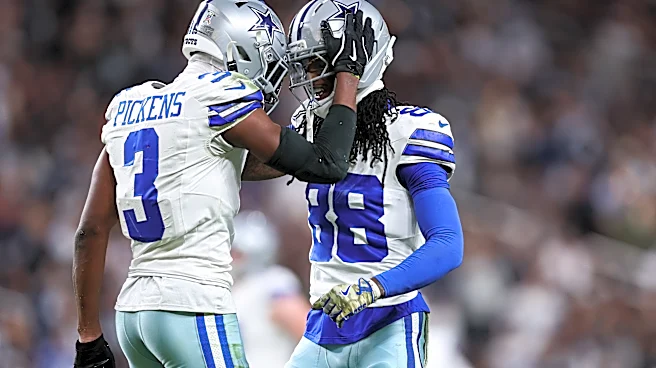
“Maan, did the Cowboys get lucky with George Pickens or what?”
Your answer will likely vary depending on whether you’re taking your information about Pickens from the press (“Drama! Volatile! Headache!”) or from a source like YPRR.
Few people realize that by the time Pickens was traded to Dallas, he already had two seasons with a >2.0 YPRR under his belt, made all the more impressive by the constraints he faced in terms of QB play and offensive scheme in Pittsburgh.
Pickens’ YPRR progression shows that he was always an elite talent trapped in a subpar environment. The moment he transitioned from a predictable, deep-decoy role in Pittsburgh to a multi-dimensional chess piece in Dallas, his metrics instantly aligned with the league’s elite.
body .sbnu-legacy-content-table td, body .sbnu-legacy-content-table th, body .sbnu-legacy-content-table { border: 1px solid #000 !important; border-collapse: collapse !important; } body .sbnu-legacy-content-table td, body .sbnu-legacy-content-table th { padding: 0px 6px !important; }| Season | Team | Receptions | Receiving Yards | Routes Run | YPRR | Utiliztion Profile |
| 2022 | PIT | 52 | 801 | 580 | 1.38 | Boundary “Go-Ball” Decoy |
| 2023 | PIT | 63 | 1,140 | 540 | 2.11 | Volatile Deep Threat (High YPC) |
| 2024 | PIT | 59 | 900 | 436 | 2.06 | Stagnant, Scheme-Limited Starter |
| 2025 | DAL | 93 | 1,429 | 609 | 2.35 | Elite WR1 (Expanded Route Tree) |
| Source: PFF.com | ||||||
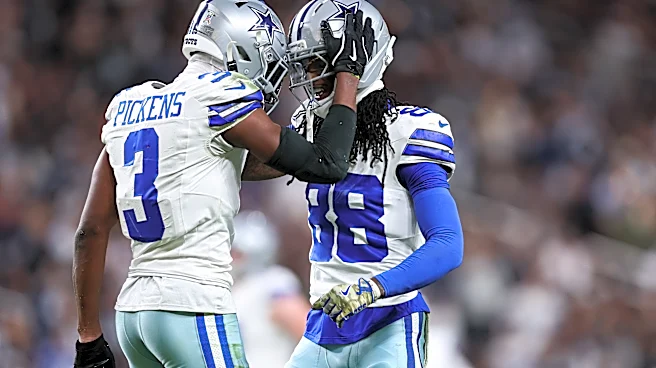
Following his trade to Dallas, Pickens’ YPRR improved to a career-high 2.35, placing him firmly in the upper echelon of NFL wide receivers and ranking him just one spot below Ceedee Lamb as the No. 7 WR in the NFL in 2025. Here’s what changed for Pickens with the move to Dallas.
- Diversified Route Tree: In Pittsburgh, Pickens was used almost exclusively as a vertical sideline threat. In Dallas, the Cowboys exploited his size and burst by moving him across the formation and feeding him on in-breaking intermediate routes and slants.
- Surging Yards After Catch (YAC): By catching passes on the move rather than purely in contested sideline situations, his YAC more than doubled versus 2024 to a career-high 479 yards. This extra yardage directly supercharged his YPRR number.
- Commanding High-Value Volume: When CeeDee Lamb missed time with a high ankle sprain, Pickens proved he could deliver as a true volume-driving WR1. His 609 routes and 1,429 yards prove that his 2.35 YPRR is no longer an efficiency fluke born of isolated deep shots, but rather a reflection of down-by-down dominance.
Overall, George Pickens’ YPRR progression highlights a player who transformed from a fluky deep-threat weapon in Pittsburgh into an elite, complete All-Pro receiver in Dallas.
Flashing Alpha: Ryan Flournoy
“Ryan Flournoy, I really think is taking the next step,” Schottenheimer said, per the DMN. “I think he has a chance to be a terrific receiver in this league.”
Ryan Flournoy’s metrics show an upward trajectory in both YPRR and YAC, but is there more to him than his ability to capitalize on spot-starts in a strong offense when injuries hit the depth chart?
body .sbnu-legacy-content-table td, body .sbnu-legacy-content-table th, body .sbnu-legacy-content-table { border: 1px solid #000 !important; border-collapse: collapse !important; } body .sbnu-legacy-content-table td, body .sbnu-legacy-content-table th { padding: 0px 6px !important; }| Season | Receptions | Receiving Yards | Routes Run | YPRR | Total YAC | YAC Per Rec | Efficiency Context |
| 2024 | 10 | 102 | 96 | 1.06 | 34 | 3.4 | Poor / Rotational (Rookie Year) |
| 2025 | 40 | 475 | 273 | 1.74 | 204 | 5.1 | Solid NFL Starter (Breakout Year) |
| Source: PFF.com, ProFootballReference.com | |||||||
Analyzing Flournoy’s numbers show a hyper-efficient role player who made a significant sophomore leap by maximizing limited opportunities behind superstars CeeDee Lamb and George Pickens in 2025:
- Solid WR Starter YPRR Baseline: Flournoy ran 273 total routes in 2025. Dividing his 475 yards by those routes yields a 1.74 YPRR. This places him comfortably in the “Solid NFL Starter” tier, and ranks him 27th out of 94 wide receivers with at least 250 routes run. For a late-round draft pick playing an ancillary role, this means he is actively winning his matchups and giving Dak Prescott a reliable option when targeted.
- Explosive YAC Improvement: Flournoy’s YAC per reception surged from 3.40 to 5.1 (for comparison, Pickens had 5.2, Lamb had 4.3 last year). His athletic testing at the NFL Scouting Combine (4.44-second 40-yard dash, 9.80 RAS-score) translated directly to the field. He isn’t just a possession receiver; he has the playmaking ability to create chunk plays after catching the ball in space.
- The “Small Sample” Explosiveness: Flournoy’s data is heavily buoyed by two massive 100-yard performances. In Week 5 against the Jets, he posted 6 catches for 114 yards. In Week 14 against Detroit, he rocked out with 9 catches for 115 yards and a touchdown. His combined YPRR in those two games was a staggering 3.95. When the game plan called on him to run a full route tree, his efficiency spiked into the elite tier, and while he will not be able to repeat those numbers in every game, the numbers do show some exciting upside for Cowboys fans.
Deep Alpha: Anthony Smith out of East Carolina
During his final college season at East Carolina University, Anthony Smith posted a 2.95 YPRR, which places him in the upper echelon of efficiency for the entire 2026 NFL Draft wide receiver class. When compared to the rest of the class, a 2.95 means he produced at an elite, near-first-round rate on a per-snap basis, but likely fell to the seventh round over concerns about his low volume of routes.
Smith only ran 356 pass routes in 2025, but boy did he produce. Smith ranked sixth in receiving yards (1,053), he caught 64 of his 100 targets, averaged 15.1 depth yards per target (11th most) and ranked eighth in deep target rate (31.0%).
The reason his route count was so low is a result of the specific offense and the role he played in it at ECU. Smith was not used as an every-down, possession receiver running short slants or hitch routes. He was routinely subbed out or left blocking on running plays, saving his energy for high-effort, vertical clear-out routes. Because his main job was to sprint 40 yards downfield to clear out coverages or catch deep bombs, he couldn’t physically sustain 40 to 50 routes per game.
And while all of this reads like a hyped-up draft profile from an over-optimistic Cowboys fan, the reality is that you can look at all of the above in two different ways
The optimistic view (2.95 YPRR) tells you that when ECU did throw him the ball, he was devastatingly efficient, translating his routes into a massive 1,053 yards. His 16.5 yards-per-catch average shows he didn’t need a high volume of routes to break a game open.
The skeptical view (356 routes) suggests that because he ran so few routes against a lower tier of collegiate competition (the AAC), it’s not clear that he can handle a full NFL route tree or sustain his efficiency over a grueling 17-game pro season against press-heavy cornerbacks.
Ultimately, his elite efficiency combined with limited volume made him a classic late-round “traits” gamble. Dallas drafted him and is betting that its coaching staff can expand those 356 routes into a complete NFL skillset.
But even if they can’t, there may still be an ECU-type role for Smith in Dallas as a situational deep-threat field stretcher who opens up underneath space for CeeDee Lamb and George Pickens.
Maxed Out Alpha: KaVontae Turpin
There’s been some discussion about Turpin’s efficacy at his primary job as a return specialist, but comparatively little discussion about why he’s getting WR snaps on top of that.
body .sbnu-legacy-content-table td, body .sbnu-legacy-content-table th, body .sbnu-legacy-content-table { border: 1px solid #000 !important; border-collapse: collapse !important; } body .sbnu-legacy-content-table td, body .sbnu-legacy-content-table th { padding: 0px 6px !important; }| Season | Receptions | Receiving Yards | Routes Run | YPRR | Total YAC | YAC Per Rec | aDOT |
| 2022 | 1 | 9 | 25 | 0.36 | 5 | 5.0 | 6.5 |
| 2023 | 12 | 127 | 83 | 1.53 | 39 | 3.3 | 9.1 |
| 2024 | 31 | 420 | 204 | 2.06 | 260 | 8.4 | 8.5 |
| 2025 | 26 | 396 | 240 | 1.65 | 214 | 8.2 | 8.8 |
| Source: PFF.com, ProFootballReference.com | |||||||
YPRR is clear about what the Cowboys have in Turpin: an explosive, hyper-efficient gadget player who maximizes highly concentrated opportunities. In 2024, Dallas used him carefully (204 routes), preserving his efficiency. In 2025, Dallas asked him to run more routes (240 routes) and this extra workload diluted his efficiency, even if his YAC and aDOT remained largely unchanged.
Ultimately, Turpin’s trajectory has leveled off into a very specific niche role: he’s probably not able to physically handle 500 routes a year due to his slight frame, but when given 150 to 200 routes, he operates at a top-15 NFL efficiency rate.
The Declining Alpha: Jake Ferguson
We pointed out above how YPRR is a ‘stable metric’ i.e. past performance is highly indicative of future performance. And that’s fine and well – until your YPRR starts dropping over multiple periods. And that’s where we are with Ferguson, because while his aggregate raw stats like total receptions and touchdowns surged as he earned more playing time, his per-route efficiency is on a four-year decline.
body .sbnu-legacy-content-table td, body .sbnu-legacy-content-table th, body .sbnu-legacy-content-table { border: 1px solid #000 !important; border-collapse: collapse !important; } body .sbnu-legacy-content-table td, body .sbnu-legacy-content-table th { padding: 0px 6px !important; }| Season | Receptions | Receiving Yards | TDs | Routes Run | YPRR | YAC Per Rec | Efficiency Context |
| 2022 | 19 | 174 | 2 | 105 | 1.66 | 6.4 | Above Average (Limited rookie sample) |
| 2023 | 71 | 761 | 5 | 522 | 1.46 | 6.0 | Average NFL Starter (Breakout year) |
| 2024 | 59 | 494 | 0 | 389 | 1.27 | 5.6 | Average NFL Starter (Dak Prescott injury) |
| 2025 | 82 | 600 | 8 | 498 | 1.20 | 3.8 | Career Low (High volume, low efficiency) |
| Source: PFF.com, ProFootballReference.com | |||||||
Part of the reason for the declining numbers is that his role has completely transformed from an explosive downfield tight end to a high-volume, short-area floor option. His yards per catch fell drastically from 10.7 yards in 2023 down to just 7.3 yards in 2025. Catching passes closer and closer to the line of scrimmage structurally caps how many yards a player can generate per route.
That “catch compression” may have also triggered an alarming drop in Yards after Catch (YAC), but what if that drop isn’t just a product of scheme deployment? Ferguson is only 27, so an age-related decline is unlikely. But he did struggle through some injuries last year, were they perhaps behind what some observers described as a lack of burst and explosiveness?
We know that Jason Witten never had a season in Dallas below 8.4 yards per catch. But we also know that comparison is the thief of joy, so I’ll think of Ferguson as what he is: a highly trusted, reliable weapon for Dak Prescott, especially in the red zone. But watch for sophomore tight end Brevyn Spann-Ford to step up and siphon away standard-down routes.
The Dark Horse Alpha: Brevyn Spann-Ford
In extremely limited action, Spann-Ford achieved 1.28 YPRR (9 receptions, 90 yards, 70 routes run), so it’s too early to project anything for him based on that, though his YPRR is already higher than Ferguson’s 2025 baseline.
Spann-Ford is the most prominent riser in the tight end room and a popular breakout candidate after minicamp. His massive 6-foot-7 frame will likely force Schottenheimer to give him substantial standard-down reps going forward and he faces no competition from Luke Schoonmaker (0.96 YPRR) at this point as Schoonmaker has settled in as a TE3 blocking specialist for his last year in Dallas.
It was never much of a secret what the 2026 receiver corps would look like, and the YPRR numbers not only confirm this but also point to some extra efficiency upside for 2026.
The Co-Alphas CeeDee Lamb & George Pickens project as perhaps the top-two wide receiver tandem in the NFL. Flournoy is on an excellent YPRR trajectory and will move beyond his niche as a hyper-efficient role player with more snaps. Turpin is also highly efficient but would likely benefit from a more rigorous snap count, both as a receiver and maybe even as a returner. There really isn’t much beyond that. Anthony Smith gets a nod as the fifth guy for his deep-threat ability and his draft pedigree, but there’s plenty of young guys who’ll challenge him for that role. And if efficiency is what you’re after, forget the name guys like Marquez Valdes-Scantling (0.52 YPRR), Jonathan Mingo (0.61 YPRR), Tyler Johnson (1.17 YPRR) or even Denzel Mims (1.13 YPRR – in 2022!).
At tight end, the Cowboys will stick with Ferguson as a short-area and red-zone option, but will likely look to give Spann-Ford more opportunities. And they are waiting with bated breath to see what UDFAs Michael Trigg and DJ Rogers can show in camp and in preseason.