





The Boston Celtics have wasted no time ramping up their pre-draft process, scheduling three additional workouts with potential draft candidates.
According to Hoopshype’s draft workout tracker, Boston has either already hosted or is set to host the following prospects for workouts in the coming days.

After providing a detailed breakdown of Boston’s first three scheduled pre-draft workouts, this article will take a closer look at the Celtics’ next wave of prospects invited in for evaluation.
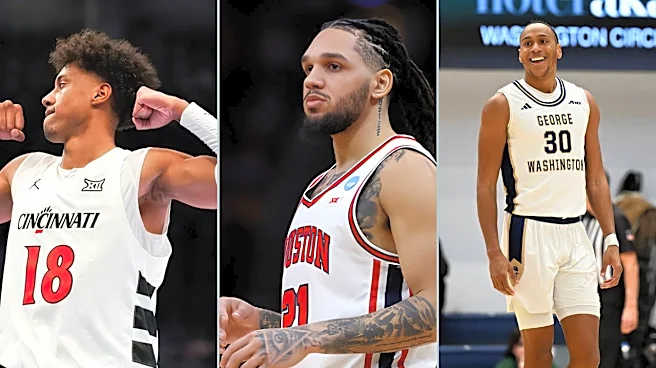
Baba Miller | 6’10.5” | Forward | Cincinnati | 22
13 pts | 10.3 rebs | 3.7 asts | 1.2 blks | 53/19/66 | 57.6 TS %

Baba Miller
is one of the more intriguing developmental forwards in this draft cycle because of his rare blend of size, mobility, and perimeter skill. Standing at 6-foot-10, the Spanish forward possesses the raw tools, versatility, and physical profile that NBA teams covet in today’s modern game. He grew up developing in Real Madrid’s youth system just like the most recent Celtics first round pick Hugo Gonzalez.
Miller spent his first two collegiate seasons at Florida State before transferring to Florida Atlantic, where he began to consistently flash the immense potential that once made him a highly regarded international prospect. His strong play there drew increased attention from scouts and ultimately paved the way for his move to Cincinnati, where he put together the most productive season of his collegiate career.
Offensively, Miller’s biggest appeal lies in his guard-like skill set despite nearly being seven feet tall. A former guard before a major growth spurt, he remains comfortable handling the ball in transition, initiating offense, and making advanced reads as a passer. Miller’s 3.7 assists per game and 23.3 AST% ranked in the 99th percentile for his position.
He also proved to be a viable playmaking option out of the post, routinely zipping passes to open teammates and facilitating offense from the interior. His effectiveness in this area has improved as his frame has gradually filled out, though there is still a lot of room for additional strength development. Miller thrives when attacking open space, frequently ripping and running after defensive rebounds and generating quick offense in transition. His 1.7 assist-to-turnover ratio ranked in the 97th percentile, though his 2.2 turnovers per game still raise some concerns about decision-making consistency. Even so, I remain very confident in his overall passing ability and feel for the game. With a likely reduction in on-ball responsibilities at the next level and NBA reps, there is reason to believe those turnover numbers should naturally decline. He also finishes efficiently around the basket, converting 71 percent of his attempts at the rim, 60 percent from two-point range overall and slammed home 58 dunks.
Defensively is where Miller projects most favorably at the NBA level. His length, lateral mobility, and instincts allow him to guard multiple positions effectively, ranging from wings to smaller bigs. He is disruptive in passing lanes, rotates well as a help defender, and provides weak-side rim protection thanks to his timing and recovery ability. Even though he’s not a huge stock percentages player, his impact was more than felt on court and through the advanced metrics. He ranked in the 96th percentile in Regularized Adjusted Plus Minus (RAPM) on the defensive side and opponent effective field goal percentage.
Miller also does a great job closing possessions on the glass posting a 27.7 defensive rebound parentage last season.
The biggest concern surrounding Miller remains his offensive consistency, particularly as a shooter. While flashes of perimeter scoring exist, his three-point shot and free-throw percentages have fluctuated throughout his collegiate career, leading some scouts to question whether he can become a reliable floor spacer. During his lone season at Florida Atlantic, he shot 34 percent from a three-point range on 114 attempts, a respectable mark for a player with his size. However, this past season he struggled from deep, shooting a career-low 19 percent from beyond the arc but converted a career-best 66 percent from the free-throw line on 149 attempts.
There is optimism with this organization in particular as the Celtics have a strong recent track record of helping players develop as shooters, with names such as Derrick White (before this year), Grant Williams, and Jordan Walsh all showing notable improvement after arriving in Boston just to name a few. Along with the shooting though, adding strength to his frame and tightening his decision-making under pressure are also viewed as developmental priorities.
Even with those concerns, Miller’s upside continues to intrigue NBA evaluators because players with his combination of size, athletic fluidity, defensive versatility, and playmaking instincts are difficult to find. If his shooting becomes even league average, he has the tools to develop into a valuable two-way rotation forward capable of fitting into multiple lineup constructions.
Emanuel Sharp | 6’2.75” | Guard | Houston | 22
15.5 pts | 3 rebs | 1.7 asts | 1.2 stls | 41/37/89 | 58.2 TS %

Emanuel Sharp is one of the most polished and impactful perimeter shooters in college basketball, operating as a high-level scoring guard for the Houston Cougars. Standing at just under 6-foot-3 and around 205 pounds, he brings a strong, compact frame, advanced off-ball instincts, and a reputation as one of the nation’s premier catch-and-shoot threats.
Offensively, Sharp’s game is built around elite shooting gravity. He consistently moves well without the ball, uses screens effectively, and punishes defenses that overcommit elsewhere. His jumper is quick, repeatable, and highly efficient, making him a constant threat from beyond the arc both in spot-up situations and in motion. He’s a smart high IQ ball player that knows how to weaponize his shooting gravity with relocations and slips. The shot is slightly off to the side, which reminds me of Kevin Martin. The elite touch can be reinforced by his career shooting averages of 37 percent from three and 87 percent from the line. Over his college career, he has steadily increased his scoring output, reaching 15.5 points per game in his most recent season.
Beyond the shooting Sharp brings more value than expected. While I never expect him to be a primary creator, he has shown improved comfort attacking closeouts and making simple reads within the flow of the offense. He doesn’t get many attempts at the rim, but when he does, he shows good quickness and he never seems to shy away from contact. He shot 67 percent at the rim last season on 50 shots. His playmaking ability isn’t anything to write home about, but I really value smart players who make sound decisions and don’t turn the ball over. Sharp’s 1.7 assists per game is low for a guard, but there is no doubt about his ability to make quick and correct decisions. He also has averaged less than one turnover per game for the last two seasons (99th percentile in turnover economy).
On defense, he is the hard-nosed, tough, ultra-competitive guard that all Houston perimeter players turn out to be regardless of size. His motor and feel for the game really flash on this end rather than the athleticism and stock rates. While he is not an elite lockdown defender, every trait I mentioned is what I believe can make him playable at that end at the next level. Being just under 6’3” does mean players will have the ability to shoot over him even if he plays solid defense though. His stocky build can help him in these situations, however leading to more jumpshots from taller opponents rather than easy backdowns. Sharp made the Big 12 All-Defensive team last season.
Rafael Castro | 6’9’’ | Center | George Washington | 23
15.5 pts | 9 rebs | 1.7 asts | 1.8 stls | 1.7 blks | 62.7/0/66 | 64.6 TS %

Rafael Castro is a senior big man for the George Washington Revolutionaries who has emerged as one of the more productive and versatile frontcourt players in the Atlantic 10. After beginning his collegiate career at Providence, where his role was limited, Castro transferred to George Washington and developed into a true focal point of the offense on both ends of the floor.
Castro’s selling point is as a rim-to-rim energy big who can be highly disruptive on the defensive end. Offensively, his game is largely built around finishing plays at the rim. He consistently scores in pick-and-roll situations as a roll man, where his soft hands and quick vertical burst make him a reliable target. He also takes advantage of his mobility, using his foot speed to rim run in transition and slip behind opposing bigs when rolling to the basket.
Castro posted strong efficiency numbers in these areas, registering 1.18 points per possession as a roll man and 1.56 points per possession in transition. While he is unlikely to project as a primary hub big at the next level, he can still be utilized effectively as a handoff passer and a stationary Delay facilitator at the top of the key, where he can keep the offense moving with simple, timely reads.
Defensively, Castro brings a blend of size, mobility, and activity that allowed him to be one of the best defensive playmakers in college basketball rather than a traditional anchor big. He can cover the ground quickly and rotate into plays out of nowhere as a help defender. One of Castro’s most impactful traits is his ability to protect the rim through timing rather than sheer size or vertical intimidation alone. He is a strong shot-contester who does a good job of meeting drivers early and altering shots at the point of attack. While he is not an elite one-on-one post stopper against bigger, stronger centers, he consistently competes, stays vertical, and uses his length to make finishing difficult for opposing bigs. Castro seems like someone who would thrive on a team that puts their center on opposing wings who can’t shoot which allows the five to roam and be athletic.
As far as the stock numbers go, Castro averaged 3.5 stocks per game, combining steals and blocks at a high volume for a frontcourt player. His 3.5 steal percentage ranks in the 98th percentile, underscoring his disruptive presence as a help defender and his instincts in jumping passing lanes and digging down on drives. He also posted a 7.9 block percentage, further highlighting his ability to protect the rim and contest shots at a strong rate. He also brings real value as a defensive rebounder and possession-ender. He pursues the ball with energy, boxes out consistently, and uses his mobility to chase down rebounds outside his immediate area.
The main limitation at the next level for Castro is that his frame can be tested against stronger interior scorers, especially in half-court post situations, where he can be nudged off balance or forced into early fouls. He also isn’t a high-volume rim deterrent in the traditional sense, meaning his impact is more about collective defense and disruption than outright paint domination. He also doesn’t stretch the floor, which is completely fine for his archetype, but he will have to provide real value at the things he does well to offset that.