

IMPORTANT DISCLAIMER: It’s preseason!
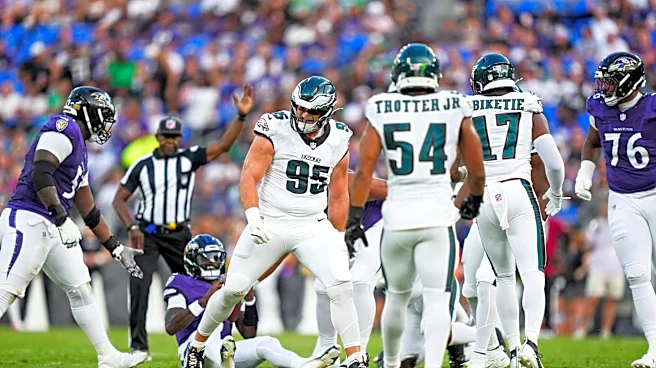
The Ravens finished with 440 yards, completed 30 of 37 passes, and possessed the ball for more than 41 minutes, but the Eagles rested almost every established starter and ran an extremely basic version of their defense. The Eagles’ inability to sustain drives on offense also left the defense on the field for 76 plays. That provided plenty of evaluation material, but it created a game that bore almost no resemblance to what the regular-season defense will look
like.
Defense
A.J. Epenesa’s debut looked exactly as I expected. He played 20 defensive snaps, recorded three tackles, and consistently handled the less glamorous parts of the position. He set a firm edge against the run, tackled the back on a screen, and correctly handled a Zone Read later in the game. There was not much pass-rush production, but his overall performance was dependable. I liked Epenesa when I watched him, and I think he’s a solid rotational option.
The Eagles also dropped him into coverage more frequently than I anticipated. He was beaten early on in the game, but I was impressed by his ability to stay relatively close to a tight end running vertically. Epenesa is a big defensive end, so he is never going to look entirely natural carrying players downfield. However, he moved better than expected and did not appear completely out of place. This rep demonstrates the reliability that stood out. Epenesa is too physical for the tight end at the point of attack and blows up the run.
Nothing makes me happier than watching Jeremiah Trotter Jr. play linebacker. He doesn’t have elite size or athleticism, but he processes the game so quickly that those limitations rarely keep him from making plays. Trotter consistently identifies blocking schemes, anticipates where the running lane will develop, and triggers downhill without hesitation. Many young linebackers wait until the picture becomes completely clear before committing, but Trotter trusts his eyes. That decisiveness allows him to beat blockers to their landmarks and make plays before the running back can build momentum. I am almost certain that he could start for several teams.
Jihaad Campbell also looked sharp during his limited action, especially in coverage. The contrast with Smael Mondon Jr. was noticeable. I thought he was far too hesitant fitting the run. The physical tools are appealing, especially as a pass rusher, but he did not play with the same decisiveness as Trotter or Campbell. I would not consider him a certainty to make the roster as the fourth linebacker.
Trotter’s mental processing also translates to his work as a blitzer. This is an outstanding rush for so many reasons. He times the snap well, attacks the protection before the running back can become set, and then avoids the block without losing sight of the quarterback. The finish is also impressive, as Tyler Huntley is a mobile quarterback.
Trotter still needs to improve in coverage, particularly when he is asked to carry more athletic players through space. However, his ability against the run and as a blitzer make me feel very confident in him as the 3rd linebacker on this team. Remember when this team did not have a single good linebacker? What a luxury we have…
Mac McWilliams had a busy evening. He played 65 defensive snaps (!), and whilst there were some encouraging moments, his performance was inconsistent. The Ravens repeatedly tested the Eagles’ inexperienced secondary, and McWilliams did not always process route combinations quickly enough. This rep is a good example. McWilliams is slow to recognize the switch release and lets himself get caught in the traffic created by the two receivers. Once he loses his positioning, the route breaks open downfield.
Luckily for McWilliams, Ty Robinson produces one of his best plays of the game. Robinson needed an encouraging performance after an underwhelming rookie season, and there were some positive signs. He recorded two tackles and a sack while showing some good athleticism and effort. His motor was noticeable throughout the game, even when he did not make the final play.
Robinson’s hand usage is the key to this rep. He catches the guard’s initial strike, knocks the hands away, and immediately transitions into a swim move. It is encouraging to see him using both hands together rather than attempting to win purely with his one-arm club move, which he relied on last year. The guard’s technique is terrible, which must be acknowledged, but Robinson still executes the move correctly and finishes the rush.
No other defensive tackle consistently flashed, so Robinson’s disruption stood out. He did commit a slightly stupid roughing-the-passer penalty on third down late in the fourth quarter, but I thought he looked OK overall. I’m still worried about defensive tackle depth against the run (outside of the big 3), as I don’t think Bryon Young or Gabe Hall looked great.
I didn’t need to include another clip of Trotter making a tackle, but why not? He diagnoses the run immediately, stays clean by avoiding the guard, and arrives at the football under control. This is what dependable linebacker play looks like.
The more interesting part of the clip is Michael Carter coming downhill from safety. I watched Carter closely because his transition from cornerback is one of the more intriguing defensive experiments this preseason. His movement skills looked comfortable enough in space, and he did not appear restricted when changing direction or playing from depth. The bigger concern was his willingness to attack the running game. Carter looked hesitant coming downhill for much of the game. That is understandable for a player learning a new position, because a safety has to process the run fit, route distribution, and potential play-action threat before committing. However, Fangio’s safeties cannot consistently wait for the play to reach them. They must be willing to close space and deliver contact from depth.
This is one of Carter’s better reps. He reads the play, accelerates downhill, and strikes the runner rather than arriving passively. I would still like to see him trigger earlier and play with more conviction throughout the game, but the improvement on this rep was a positive sign.
Kelee Ringo remains one of the most frustrating players on the roster. His physical talent is obvious, but his technique in off coverage has not progressed enough. He still looks too stiff when transitioning out of his pedal, frequently opens his hips before the receiver has committed, and creates unnecessary separation because his feet and upper body are not working together.
This rep contains several of those problems. Ringo gives away his leverage too early, ends up in a bad body position, and cannot recover once the receiver attacks his outside, forcing him to flip his hips. After several years in the league, this can no longer be dismissed as a young player requiring minor refinement. Ringo is a much more natural fit for a defense that allows him to play press-man coverage, use his size at the line of scrimmage, and run with receivers vertically. Fangio’s defense demands greater comfort playing off coverage, reading route distribution, and transitioning efficiently from depth. At this point, I would explore trading Ringo to a team that can use him differently. That is not because he lacks talent; it is because the Eagles are not consistently placing him in the type of coverage that maximizes it.
Of course, Ringo followed a bad coverage rep and a defensive pass-interference penalty by making the most impressive defensive play of the game. He’s talented, you can’t deny it! Ringo has excellent size, recovery speed, and the ball skills to punish quarterbacks when he is in position. On this interception, he reacts quickly, attacks the catch point, and finishes the play cleanly. Very few cornerbacks possess his combination of length and athleticism. Surely, there is an NFL team out there who would take a chance on him?
The interception does not erase the technical concerns, just as the poor reps do not eliminate his physical talent. Both things can be true. Ringo can make plays that many defensive backs cannot, but the Eagles’ coverage structure consistently asks him to perform the areas of the position in which he is least comfortable.
Maximus Pulley was one of the more encouraging players in the second half. He was active, willing to come downhill, and looked comfortable playing with the aggression required at safety. He also contributed on special teams, which will be essential if he is going to earn one of the final roster spots. Pulley is a dark horse to make the 53-man roster.
Andre Sam also had a solid performance at safety. He is a limited athlete, but he understands the structure of the defense and knows where he is supposed to be. That awareness allows him to play faster than his testing numbers might suggest. He looks like someone worth keeping on the practice squad if he does not make the roster.
Safety depth remains a question, hence why I watched it closely, but I thought this game provided some encouragement. It was one preseason game, but still, the young safeties looked functional.
Random note: it can be tough to analyze every player in these articles during preseason, because so many players play. If there’s someone you’d like me to focus on next week, let me know in the comments, and I’ll try my best!
Thank you for reading! I’d love to hear your thoughts, so feel free to comment below and ask any questions. If you enjoyed this piece, you can find more of my work and podcast here. If you would like to support me further, please check out my Patreon here! We are running a 50% sale until the end of Week 1!