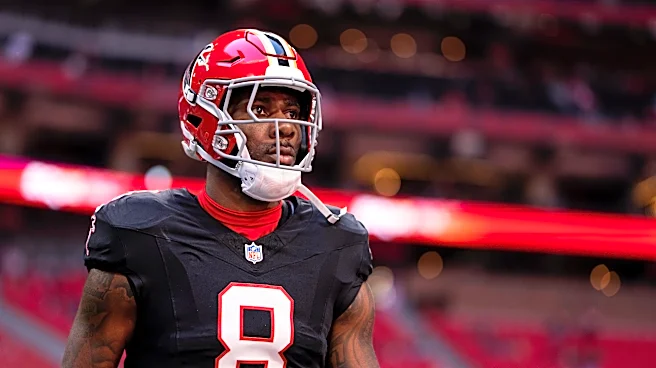





When the Atlanta Falcons made Kyle Pitts the NFL’s third-highest-paid tight end back in June, they bet that his rare athleticism would finally anchor a dynamic passing attack. Ten games into 2026, that investment isn’t aging well. Pitts is on pace for the least productive season of his career, masked only by a sudden spike in red-zone touchdowns.
Yet the uncomfortable truth is that Pitts’ red-zone surge isn’t elevating Atlanta’s offense. It’s cannibalizing Drake London and Bijan Robinson in an attack
that still doesn’t know how to maximize its highest-paid stars.
Pitts’ career-low pace between the 20s
Although once considered a good value, Pitts hasn’t come close to producing like one of the NFL’s top tight ends in 2026. Through 10 games, Pitts has caught 29 passes for 270 yards. That’s 86 fewer yards than his lowest 10-game output in previous years, and about 200 yards less than his 10-game average over that span. Pitts currently ranks 30th among tight ends in yards per route run according to PFF.
However, despite the low overall numbers, Pitts is having one of his best seasons in red-zone production. He currently leads the Falcons in red-zone targets (8), catches (6), yards (41), and receiving touchdowns (4). All four scores came over three weeks from Weeks 5 through 7. However, what has been a boon for Pitts has been a bane for his teammate Drake London. It’s hard to see London’s red-zone collapse as a coincidence, with just one catch on five red-zone targets so far this year. At this same point in 2025, London had six catches on 10 red-zone targets, and all six were scores. If you want to understand why London has only one touchdown catch this year, here is why.
Pitts and London are playing a zero-sum game
What is good for Pitts is bad for London, and vice versa, which gets at the heart of my major criticism of paying Pitts prematurely: neither player complements the other. The Falcons still haven’t figured out how to make both players thrive in the same offense, even after five seasons of sharing the field. Yes, Pitts is a singular talent at tight end, but that singularity doesn’t mesh with London because both players provide the same value as big slots in their offense. If one thrived between the 20s and the other inside the 20-yard line, that could become a worthwhile partnership. The problem is that London already thrived inside the 20. His 20 red-zone touchdowns over his first four seasons are tied for fifth-most among wideouts. With London sidelined, the Falcons’ red-zone efficiency has slid to 20th this year, down from ninth in 2025.
One wonders whether Pitts’ increased red-zone production was a three-week anomaly or something that can be sustained throughout the season. Six of his eight red-zone targets came in that previous three-week span, meaning he’s been targeted just twice in the Falcons’ other seven games. And with Michael Penix at the helm, can a pass-catching tight end really thrive?
Penix’s red-zone inaccuracy caps Pitts’ upside
Penix’s 44.2 percent red-zone completion rate is tied for the second-lowest in the NFL, barely edging out Jayden Daniels’ 44.1 percent. However, Josh Allen (44.2 percent) and Trevor Lawrence (45.5 percent) are among the top quarterbacks in 2026 who also haven’t been particularly efficient inside the 20-yard line. However, Allen compensates with his red-zone running, ranking third in the NFL with 10 red-zone rushing touchdowns. His teammate James Cook isn’t far behind him with nine red-zone rushing scores of his own, meaning the Bills can still punch it in through their ground game.
Lawrence’s Jaguars also counteract their 18th-ranked red-zone efficiency with one of the NFL’s most explosive offenses, leading the NFL with 12 scores from beyond 20 yards this year. For Atlanta, their four 20-plus-yard scores pale in comparison, and despite Bijan Robinson, they have been anything but dominant on the ground.
Throwing at the goal line sidelines Bijan
With Robinson, the Falcons can be a strong red-zone rushing attack, but they aren’t. Despite having one of the most run-heavy offenses, ranking 29th in pass-rate-over-expected, the Falcons flip to the 10th-highest pass rate inside the five-yard line. Bijan doesn’t get as many touches inside the five as many of his peers, where most rushing touchdowns are scored. His 32 red-zone carries rank 11th, but his nine carries inside the five rank 15th. And it’s not because teammate Brian Robinson vultures those carries, since the latter has just one touch inside the five this year.
Instead, it’s because the Falcons like to throw the ball the closer they get to the goal line. That tendency to lean on the pass has created more red-zone scoring opportunities for Pitts, but it’s coming at the expense of players like London and Robinson. Which once again underlines the lack of cohesion among the team’s highly paid trio.
The clock is ticking on Atlanta’s expensive trio
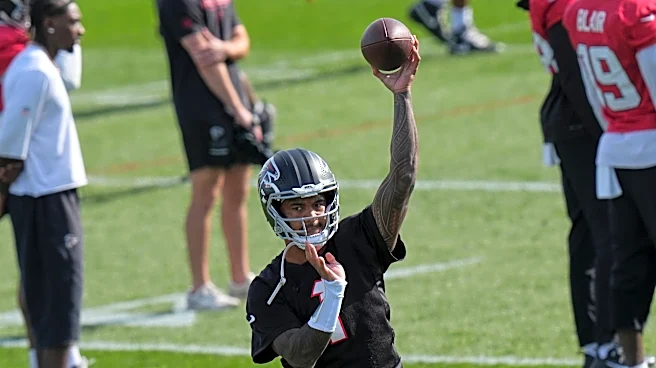
Atlanta still has seven games left in 2026 to prove their expensive trio can coexist. The structure of Pitts’ extension has an off-ramp after 2027, meaning there’s a ticking clock to make him, London, and Bijan work together. Until the Falcons stop cannibalizing their best red-zone playmakers and find steadier quarterback play to tie it all together, Pitts’ red-zone touchdowns will remain a mirage rather than proof of a smart investment.