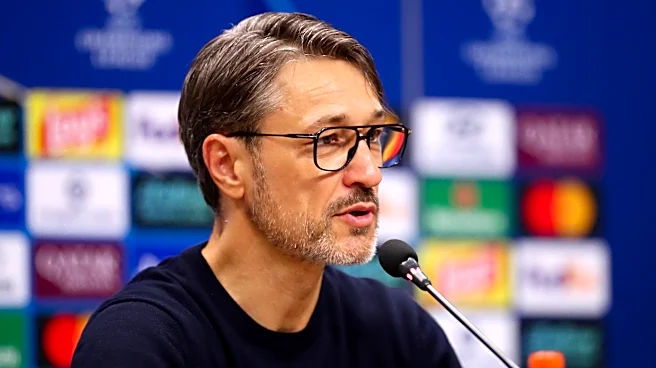



News broke on October thirteenth that Niko Kovač had signed a contract extension through June thirtieth, twenty twenty-nine. Now, I’m assuming it would be naïve to think anyone could be upset with the board’s decision, right? After all, in the twenty twenty-five–twenty-six season, Dortmund won twenty-two of their thirty-four league matches, conceded thirty-four goals and matched the club record of fifteen clean sheets. At the time of the announcement, Kovač also held the highest Bundesliga points-per-game
average of any Dortmund head coach: two point one five.
He took a team sitting in eleventh place into the Champions League, and the club’s leadership has praised the stability he has brought to Borussia Dortmund. Lars Ricken described the extension as “a clear sign of consistency and stability at Borussia Dortmund.” Sporting director Ole Book also sang his praises, saying, “Niko works with extreme meticulousness.” So why are some fans so frustrated by Kovač’s extension?
Dortmund started the Bundesliga season with a blistering four wins from four matches, heading into the international break at the top of the table. Yet the familiar frustrations soon returned. This team can deliver results without offering particularly enjoyable football.
Against Werder Bremen, Dortmund led two-nil before conceding in the eighty-eighth minute and again in the second minute of stoppage time to draw two-all. They followed that with a defeat to Bodø/Glimt, a goalless draw against Union Berlin and a narrow victory over Sabah.
These frustrations are nothing new. As many fans will remember, Dortmund surrendered a three-one lead at St. Pauli last season and conceded a ninety-seventh-minute equalizer at Hamburg. Results like these suggest that, while Borussia Dortmund may have found consistency, their style of play is consistently mediocre under Niko Kovač.

The Black and Yellows have found defensive stability that we arguably haven’t seen in years. In possession, however, there is often little to make supporters’ eyes light up. Dortmund’s modern identity was shaped by fast-paced football and young stars shining at the Westfalenstadion. As Jürgen Klopp once said, “Borussia Dortmund don’t just play for a result, Borussia Dortmund means an experience.”
Now, that experience too often involves watching Marcel Sabitzer deployed in a wide attacking role, Maxi Beier playing at left wing-back and praying that one of the more technically gifted players can produce something special within such a boring and pragmatic style of play.
Credit has to be given to Kovač for the structure he has brought to the club. But with his style of play and level of ambition, it may still be some time before Borussia Dortmund lift silverware that isn’t the Emirates Cup.
Players who have always played so freely, creatively and boldly are just a shadow of themselves under Niko Kovač. This concern extends beyond the current squad. To my eye, Karim Adeyemi has looked electric since joining Barcelona. Many factors can contribute to a player’s performances after a transfer, but it is impossible to ignore the fact that Niko Kovač suppresses what makes creative players so special to watch.
Kovač has demonstrated that he can stabilize Borussia Dortmund. Whether he can build an attack that gives supporters the same confidence remains an open question. With his future now secured through 2029, fans are entitled to ask what the next stage of that development should look like—and how long they should have to wait to see it.