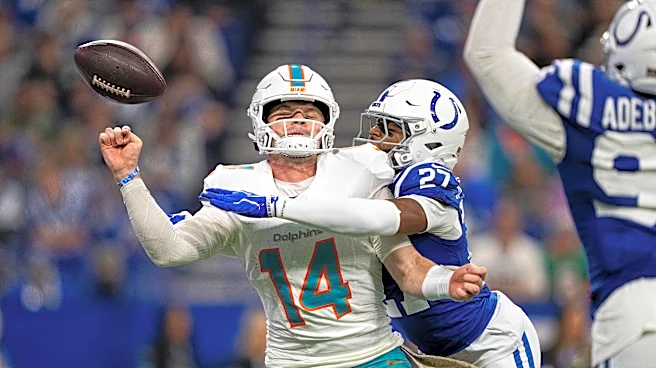


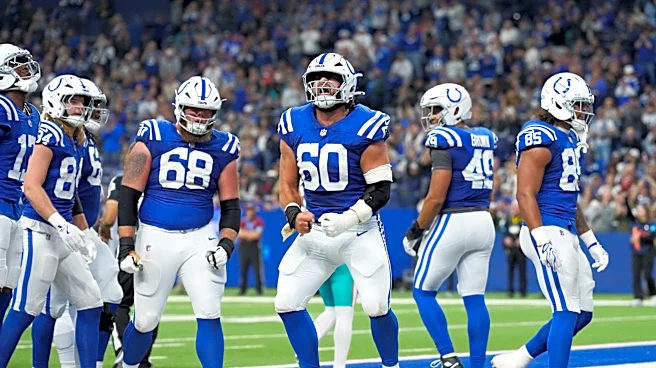
The Indianapolis Colts finally snapped their five-game losing streak Sunday, escaping with a 24-22 victory over the Miami Dolphins in a game that probably should never have been so close. Despite facing a 1-8 opponent starting a backup quarterback, Indianapolis needed a failed two-point conversion and a pair of missed Miami field goals to secure its third victory of the season. While a win is certainly welcome following several weeks of embarrassing performances, the offensive struggles that have plagued
this team throughout the past month remain as concerning as ever.
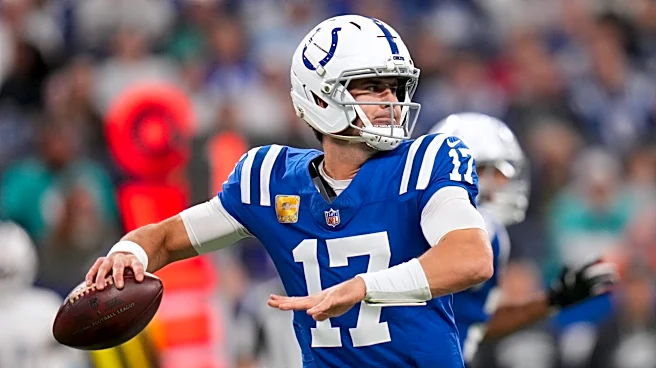
Daniel Jones completed just 11 of 22 passes for 108 yards, 1 touchdown and 2 interceptions, while the Colts managed only 10 offensive points through the first 59 minutes of the game, with their other 7 coming from a defensive touchdown and 3 from a field goal. Jones’ performance was considered the worst of any quarterback in the NFL this season, according to QBR. Baker Mayfield had a game without a completion that ranked higher than Jones’ performance.
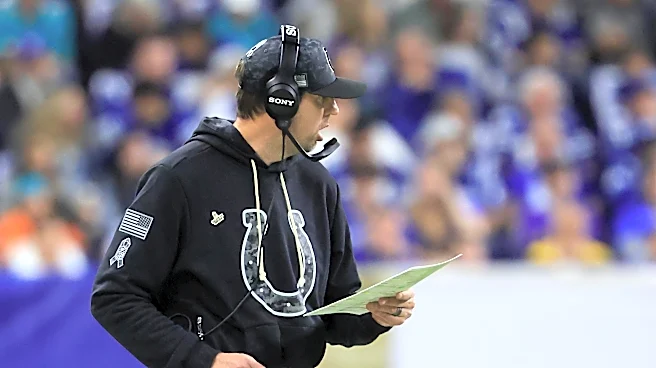
Indianapolis had 2 running backs averaging more than 5 yards per carry, one of the league’s most talented young tight ends and an opponent that has struggled defensively throughout the season, yet Shane Steichen once again failed to generate any sort of consistent passing attack.
The Colts have already traded several established offensive players and are operating with a significantly weakened receiving corps, so expecting this offense to resemble the unit that performed so well during stretches of 2025 would be unrealistic. However, that is precisely why the coaching staff needs to adjust. Steichen was hired in large part because of his reputation as an offensive innovator, someone capable of designing creative schemes and maximizing the talent available to him. Right now, I have serious questions about whether he is doing either of those things.
There are four areas in particular where I believe Steichen’s approach needs to change, and Sunday’s performance against Miami provided further evidence of those concerns.
Jonathan Taylor should be dominating the backfield
I want to make one thing clear before criticizing the running back rotation: Seth McGowan has been excellent in recent weeks. The rookie has demonstrated impressive explosiveness and physicality, and I genuinely believe he could become a very good rotational running back with legitimate starting potential down the road. His 77 rushing yards and touchdown on 12 carries against Miami were another encouraging sign that Indianapolis may have found a valuable contributor for the future.
However, Jonathan Taylor is still on this roster, and there is a substantial difference between being an encouraging young running back and being one of the best players at the position in football.
Taylor rushed for 83 yards on 16 carries Sunday, averaging 5.2 yards per attempt, while McGowan received 12 carries and averaged 6.4 yards. Those are excellent numbers for both players, but Taylor finished with just 57 percent of the carries between the 2 running backs, despite being the vastly more accomplished player. He also played approximately 68 percent of Indianapolis’ offensive snaps, a number I believe should be well above 80 percent whenever he is healthy and available.
The Colts made a conscious decision to retain Taylor at the trade deadline despite reportedly receiving offers involving second-round draft picks. Indianapolis apparently believes he is worth a first-round selection, and given his continued production, I can understand that valuation. However, if the organization believes Taylor is valuable enough to keep around during a rebuilding season, why isn’t it treating him like the centerpiece of its offense?
I understand the argument for limiting his workload, particularly when the Colts are sitting at 3-7 and have little realistic chance of making the playoffs. However, if protecting Taylor’s health and preserving his future trade value are the priorities, Indianapolis should seriously consider shutting him down for the remainder of the season rather than continuing to expose him to injuries while only giving him a portion of the backfield workload. If he is healthy, dressed and the coaching staff is genuinely trying to win football games, he should be receiving the overwhelming majority of the opportunities.
McGowan’s development is important, but it should not come at the expense of maximizing Taylor’s impact right now. There are ways to involve the rookie without consistently taking the team’s best offensive player off the field.
The Colts need to run the football significantly more
With Jones struggling as badly as he has over the past several weeks, I don’t understand why Indianapolis continues asking him to carry so much responsibility in the passing game. Against Miami, he threw the football 22 times, completing only half of his attempts while turning the ball over twice. Meanwhile, Taylor and McGowan combined for 160 rushing yards on 28 carries, averaging approximately 5.7 yards per attempt.
The running game was clearly the most productive part of the offense, yet the Colts continued putting Jones in situations where he was required to make difficult throws with an inexperienced receiving corps and a weakened offensive line.
At this point, I would build the entire offensive approach around limiting Jones’ responsibilities in the passing game and leaning heavily on the Colts’ productive backfield. Ideally, Indianapolis should be running the football on approximately 2/3 of its offensive plays, leaving the remaining 1/3 for passing situations. In a typical game featuring 60 offensive plays, that would mean roughly 40 rushing attempts and just 20 passes, a much more appropriate balance given the current limitations of the offense. Taylor should be receiving the overwhelming majority of those carries, potentially somewhere around 28 to 30, with McGowan handling the remaining opportunities. Obviously, game situations will sometimes force Indianapolis to throw more frequently, particularly when trailing, but the overall philosophy should be clear: take the ball out of Jones’ hands as much as possible and allow the team’s most productive offensive players to dictate the game.
Even if the Colts only manage 30 or 32 rushing attempts between their running backs, Taylor should still receive the overwhelming majority of those opportunities. There is simply no justification for consistently splitting carries almost evenly between an established All-Pro and a rookie, regardless of how promising McGowan has looked.
Running the football more frequently would also take pressure off Jones, shorten games and reduce the number of possessions where the offense is forced into obvious passing situations. Indianapolis does not have the personnel to consistently win games by asking Jones to throw 30 or 35 passes, particularly now that Josh Downs and Keenan Allen are gone.
The Colts retained their best offensive player at the deadline, and their backup running back is emerging as another productive option. Rather than continuing to rely on a passing attack that has become increasingly dysfunctional, Steichen should be building his game plans around those strengths.
And if the Colts intend to maximize their best players, there is another offensive weapon who should be receiving considerably more attention.
Tyler Warren’s usage is becoming indefensible
Of all the questionable decisions made by Steichen against Miami, the handling of Tyler Warren might have been the most frustrating.
The second-year tight end finished with just 2 receptions for 1 yard on 3 targets, with his first official catch not coming until the fourth quarter. 3 targets for the most talented receiving option currently available to Indianapolis, against a defense that has consistently struggled to contain tight ends, is extremely difficult to defend.
Miami entered the matchup among the NFL’s worst teams defending tight ends, surrendering approximately 6 receptions and nearly 60 receiving yards per game to the position. This should have been a favourable matchup for Warren, particularly considering how limited Indianapolis’ other receiving options have become following the trade deadline.
Instead, he was almost entirely absent from the passing attack.
Warren has the size, athleticism and versatility to create problems for defenses in several different ways. He can line up as a traditional tight end, operate from the slot, move around the formation and even take direct snaps in short-yardage situations. Indianapolis actually used him on a 3-yard rushing conversion in the first quarter, demonstrating that Steichen recognizes some of those possibilities, but those occasional touches are nowhere near enough.
The Colts should be treating Warren the way Arizona treats Trey McBride, making him the focal point of the passing attack and consistently designing opportunities to get him the football. That doesn’t mean forcing every throw in his direction, but there is no reason Warren shouldn’t be seeing 8 to 10 targets in games where Indianapolis lacks established receivers capable of consistently creating separation.
Short and intermediate routes, tight end screens, quick throws over the middle, lots of motion to get him the right matchups and occasional Wildcat looks should all be part of the conversation. Warren is one of the few offensive players capable of consistently making something happen with the ball in his hands, yet the coaching staff continues allowing entire quarters to pass without meaningfully involving him.
Making Warren the primary receiving option would also make Jones’ job considerably easier. Rather than requiring him to work through complex progressions or consistently find receivers winning one-on-one matchups downfield, Indianapolis could simplify the offense by designing quick throws to a player capable of creating favorable matchups against linebackers and safeties.
The Colts’ receiving corps is extremely weak right now, and that is unlikely to change much over the remainder of the season. Warren needs to carry a much larger share of the passing offense, and that responsibility needs to begin in the first quarter rather than appearing as an afterthought late in games.
Where is the offensive creativity?
Steichen’s reputation as an offensive mastermind is becoming increasingly difficult to reconcile with what Indianapolis has actually produced on the field.
Jones has looked uncomfortable in the pocket, frequently struggling when his first read isn’t available and appearing increasingly hesitant when asked to make difficult throws. His accuracy, decision-making and overall confidence have deteriorated considerably compared with his better performances in 2025 and earlier this season, yet the Colts continue operating an offense that often asks him to execute concepts he simply isn’t handling effectively right now.
According to NFL Next Gen Stats, Indianapolis has operated out of 11 personnel on approximately 59 percent of its offensive plays this season, meaning 1 running back, 1 tight end and 3 wide receivers. That is not an unusual formation in today’s NFL, but it becomes considerably less appealing when your receiving corps is primarily composed of backups and special teams contributors.
There is nothing inherently wrong with 11 personnel, and the Colts do use different formations and motion within their existing offense. However, the question is whether those looks are actually producing meaningful advantages for the players Indianapolis currently has available. When the receivers aren’t consistently getting open and the quarterback is struggling to progress through his reads, continuing to rely on familiar concepts without making substantial adjustments becomes difficult to justify.
Look at what Sean McVay has done with the Los Angeles Rams when injuries have significantly affected his receiving corps. When his receivers missed time due to injuries, McVay began leaning heavily into 13 personnel, featuring 3 tight ends, 1 running back and 1 wide receiver. Rather than attempting to run the exact same offense without his best receiving weapon, he adjusted his personnel groupings and created different problems for opposing defenses.
Why can’t Indianapolis take a similar approach?
The Colts have 2 productive running backs, a versatile tight end and a quarterback who desperately needs the offense simplified. Put Taylor and McGowan on the field together, who gives a crap. Use more 2- and 3-tight-end formations. Create additional opportunities for Warren through motion and misdirection, while incorporating direct snaps, screens and designed runs that force defenses to account for different possibilities.
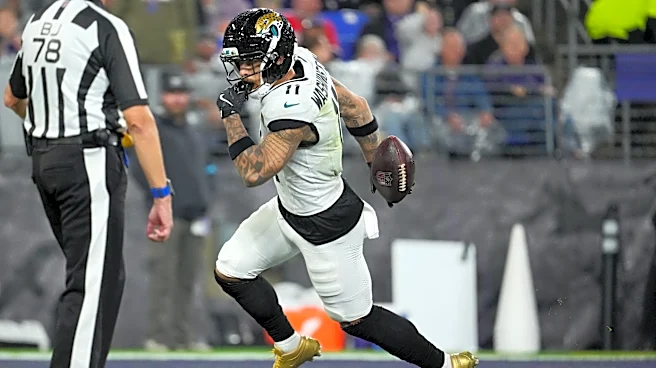
Even Miami, despite entering Sunday’s matchup with just 1 victory, managed to manufacture a touchdown through a 34-yard trick play in which Malik Washington threw a touchdown pass to Jalen Tolbert. It was a creative play that caught Indianapolis off guard and demonstrated how an offense with limited talent can still generate explosive production by presenting something unexpected.
The Colts don’t need to become a gimmick offense, but they desperately need to become less predictable. Their offensive line has experienced considerable injuries and turnover, making long-developing passing concepts increasingly difficult to execute. Even traditional play-action concepts become less effective when protection breaks down before the quarterback has time to locate his receivers.
At some point, Steichen needs to acknowledge that the offense he wants to run is not necessarily the offense his current personnel can execute. If he cannot develop a more effective approach with the talent available, it becomes increasingly difficult to justify his reputation as an offensive guru.
Why is Anthony Richardson not being used?
I have been calling for Indianapolis to develop a specialized Anthony Richardson package for years, including writing an article about it last year, and the continued refusal to explore that possibility is becoming one of my biggest frustrations with Steichen.
To be clear, I do not believe Richardson is suddenly going to save this team. He has struggled considerably as a passer and has not demonstrated enough consistency to suggest he is the long-term answer at quarterback. I have plenty of concerns about his development and ultimately believe Indianapolis will need to look elsewhere for its next franchise quarterback.
However, the current version of Jones is simply not playing well enough to justify refusing to consider alternatives.
Jones enjoyed several excellent performances during the 2025 season and showed some encouraging signs earlier this year, particularly against Kansas City and Houston. However, his play has deteriorated dramatically since then, and Sunday’s performance against Miami was another example of an offense that appears increasingly incapable of producing through the passing game.
If Steichen remains convinced that Jones gives Indianapolis its best chance to win, then at the very least, why not incorporate Richardson into a handful of designed packages every week?
Richardson remains one of the most physically gifted quarterbacks in football, possessing exceptional size, speed and the ability to generate explosive plays with his legs. Even if he struggles with traditional passing concepts, there is no reason he couldn’t be used in short-yardage situations, read-option packages, red-zone formations or occasional two-quarterback looks.
Defenses would have to account for the possibility of Richardson keeping the football, handing it to Taylor or McGowan, or throwing from a simplified passing concept. Those packages would not necessarily transform the offense, and they would need to be designed carefully to avoid becoming predictable, but they could at least introduce another dimension that Indianapolis currently lacks.
It could also provide Richardson with an opportunity to develop in a much more manageable role. Rather than asking him to handle an entire NFL offense, the coaching staff could give him 5 or 6 designed plays per week, gradually expanding his responsibilities if he demonstrates improvement. I have argued for this approach since early in his career, and it remains frustrating that Indianapolis has never seriously committed to developing him in that manner.
Minnesota recently demonstrated how quickly a team can respond when its quarterback situation becomes unacceptable. After Carson Wentz delivered a disastrous performance against Buffalo, completing just 8 of 25 passes for 81 yards and committing 3 turnovers, the Vikings acquired Kirk Cousins from Las Vegas the next day. Minnesota recognized that its current quarterback situation was not producing acceptable results and made a move to improve it.
Indianapolis may not have had the same opportunities available, particularly after deciding to retain Jones at the deadline, but Richardson is already on the roster. Steichen doesn’t even need to acquire another quarterback to begin experimenting with something different.
His continued unwillingness to incorporate Richardson into the offense is difficult to understand, particularly when the existing approach is producing such disappointing results. If Steichen continues refusing to make meaningful adjustments, it will contribute massively to the end of his tenure in Indianapolis.
Something needs to change
The Colts won Sunday, and after five consecutive defeats, that is certainly preferable to another embarrassing loss. However, escaping with a two-point victory at home against one of the NFL’s worst teams should not convince anyone that the offensive problems have suddenly disappeared.
Indianapolis has 2 running backs capable of producing significant yardage, one of the league’s most talented young tight ends and a quarterback whose current limitations should be painfully obvious to the coaching staff. Yet Taylor isn’t receiving the workload I believe he deserves, Warren is barely being targeted, Richardson remains unused and the offense continues struggling to generate anything resembling consistent production through the air.
I understand that Steichen is working with a weakened roster, and the recent trades have made an already difficult situation considerably worse. However, good offensive coaches are supposed to adapt to those circumstances rather than continuing to rely on an approach that no longer suits their personnel.
There is no guarantee that running the ball 40 times, making Warren the primary receiving option or introducing Richardson packages would suddenly transform Indianapolis into a productive offense. However, continuing down the current path has produced very little evidence that meaningful improvement is coming.
If the Colts genuinely intend to compete for victories over the remainder of the season, Steichen needs to make Taylor and Warren the unquestioned focal points of the offense, significantly reduce the burden placed on Jones and become far more willing to experiment with different personnel groupings and offensive concepts.
Steichen needs to start coaching like his job is on the line!