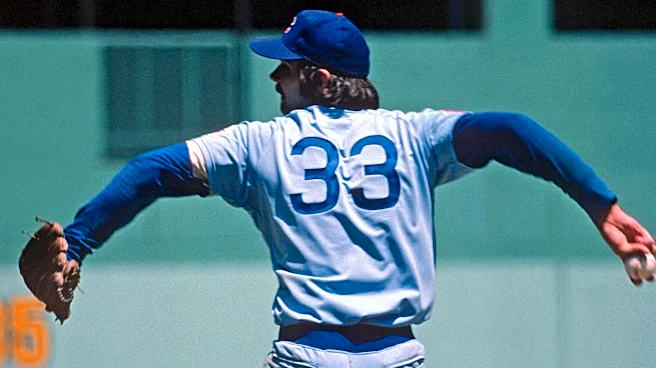



Bill Bonham was another in a long line of similar pitchers in the 1950s, 1960s and 1970s — a really hard-throwing right-hander who didn’t always know where the ball was going.
Three times he was drafted out of high school and junior college, and three times he didn’t sign. Then he went undrafted after his senior season at UCLA, and his SABR biography explains:
“I really didn’t have a great record with UCLA,” Bonham said. “Too, I think a lot of clubs thought I had a bad attitude.”
So the Cubs signed
him as an undrafted free agent in June 1970 for $2,000. Even by inflationary standards that’s not a lot of money today — the equivalent of about $17,000.
As was the case for many in the Cubs system at the time, they didn’t have the infrastructure to develop good pitchers. So Bonham made 18 appearances in the Cubs system in 1970 and 1971, striking out 81 batters in 50 innings, and was deemed ready for the majors.
At age 22 in 1971, he posted a 4.65 ERA in 33 appearances, all but two in relief, with a high walk rate (13.2 percent), and started 1972 at Triple-A Wichita, where he struck out 116 in 125 innings. That was a really good K rate for the time, and in 1973 he was with the Cubs to stay.
Used mostly in relief early on, Bonham was pressed into the Cubs rotation in late July 1973, while the team was fading, and stabilized things, a bit, peaking with an 8.1-inning, three-hit, nine-strikeout performance against the Dodgers Aug. 17 at Wrigley Field.
The 3.02 ERA and six saves, along with a 19.3 percent K rate (very good for the time), got him 4.3 bWAR at age 24. With the team rebuilding after ‘73, Bonham was given a full slot in the Cubs rotation in 1974, basically second starter behind Rick Reuschel, and hopes were high.
If you ignore Bonham’s W/L record, his 1974 season was quite successful: 3.86 ERA, 191 strikeouts (sixth in the NL) and 3.2 bWAR. On a 96-loss team, though, a pitcher like that is likely going to lose more than he wins and Bonham wound up 11-22. He is the last Cubs pitcher to lose 20 or more games in a season. Of that, Bonham said (from the SABR bio):
“When I pitched badly I lost,” said Bonham, “and when I pitched good, I lost some of those games, too. For a while, it seemed it didn’t make any difference how I pitched. I didn’t get much in the way of results. It’s an unsuccessful thing to lose that many games and it makes you feel like a failure. It’s tough to digest 20 losses. But I try to look at the other aspects. I got a lot of innings in. I picked up a lot of experience.
“When you lose 22, you’ve got something wrong. I have to change something, but I don’t really know what it is. I’m going to have to keep working hard until I find the answer.”
It mostly wasn’t his fault. Bonham ranked 45th of 52 qualified starters in the NL in 1974 in run support at 3.3 per start. Of his 10 complete games, five were losses: two 1-0 losses, a 2-0 loss and two 2-1 losses.
Another note on Bonham’s 1974 season: In the first game of a doubleheader July 31 at Wrigley Field against the Expos, he became just the third pitcher in franchise history to strikeout four in an inning. The opposing pitcher, Mike Torrez, was the guy who reached base after striking out, on a passed ball.
Bonham’s ERA went up nearly a run in 1975, to 4.71, as the Cubs staff was torched for a league-high 827 runs, 133 of those charged to Bonham, and he gave up the most earned runs in the NL at 120. Things didn’t get any better in 1976, but in ‘77 Bonham started 34 times and posted a relatively high ERA, 4.36, but still had a 3.7 bWAR season.
All that did was get him traded to the Reds after 1977 for Woodie Fryman and Bill Caudill. Fryman, a veteran starter, was pretty awful and didn’t last even two months with the Cubs before being traded to the Expos for Jerry White. Caudill had a couple decent years in Chicago before he was sent to the Yankees as a PTBNL in the deal that brought Pat Tabler to the Cubs.
As for Bonham, he had a couple decent years in Cincinnati but was done after 1980 at age 31 due to elbow issues. He also had shoulder surgery after the 1980 season, and then was involved, along with his teammate Tom Hume, in an event that made national news:
A month after the surgery, Bonham, his wife, and Hume and his wife were staying at the MGM Grand Hotel and Casino in Las Vegas, when the hotel was devastated by a fire.
The Bonhams and the Humes were in their rooms on the 24th floor when the fire broke out shortly after 7 A.M. After being awakened by shouts, “the Humes quickly aroused the Bonhams, who occupied an adjoining room, and the two couples headed for the fire exit stairway, aware they were 24 floors away from safety. As they descended, the smoke became denser. It became unbearable when they reached the 16th floor. All the guests who jammed the stairway then turned around and headed for the rooftop.”
About 1,000 people were rescued from the rooftop. The blaze, one of the worst hotel fires ever in the United States, claimed 85 lives, 75 from inhalation.
After his playing career, Bonham worked as a minor-league pitching instructor in the Astros organization for several seasons and later settled with his wife in southern California. He turned 78 in October.
Bill Bonham posted 14.6 bWAR in his seven seasons with the Cubs.