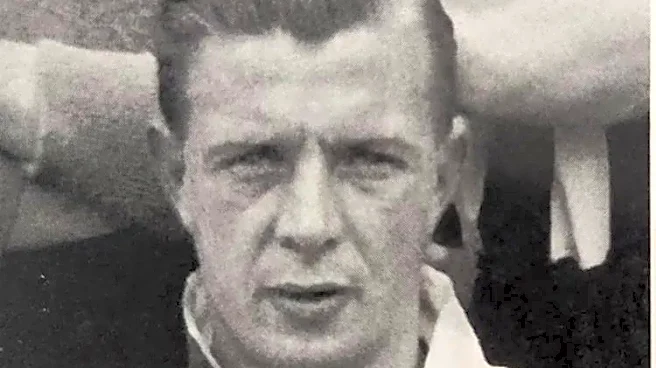



A derby victory against Newcastle United is a prized event in any Sunderland player’s career, and centre-forward Cliff Whitelum had good reason to remember this game.
At the start of the First World War in 1914, the Football League was not suspended, and many fans, footballers and officials had thought this an error. In hindsight, so did the Football League, and they were not about to make the same mistake again when World War II commenced in 1939. With the season just three games in, the Football League suspended all games.
Sunderland, like all other league clubs, suspended the contracts of all their players but retained their registrations.
Recognising a place for morale-boosting events (that could be fundraising opportunities as well), a regionalised competition played throughout England was organised within forty-eight days of the suspension of the league. Sunderland, along with Gateshead, Derby County, Ipswich Town and Aston Villa, at first declined to get involved. Initially, the belief at the club was that football was hardly the priority and all efforts needed to focus on defeating fascism.
It would be late March 1940 before Sunderland relented and played in some very local games.
In early June 1941, Sunderland’s board agreed to get involved in the Wartime League North and the League War Cup. The plan was to give younger players encouragement and experience, as well as utilising the experience and skill of established older players.
All teams participating could call upon guest players who may have been stationed in their area if they had enlisted/been called up. Raich Carter, as a for instance, guested for Huddersfield and Derby County during the war years (as well as playing for Sunderland when available).

The availability or otherwise of experienced players often saw wildly swinging results, with teams losing then winning heavily in the return fixture sometimes just days later.
Johnny Cochrane offered nineteen-year-old Cliff Whitelum a professional contract after a trial match for Sunderland in 1938. It had been a rapid rise for a young man who had played no football until aged sixteen years old. He was asked to help out in an emergency for a local Co-operative Sports Club team (he was working in the grocery department). His progress was nothing if not astounding; he was playing for Bentley Colliery Welfare when invited to trial at Sunderland.
His professional career was in its infancy when war was declared. He had only played two games at centre-forward in 1938/39 in the first team, but he had scored a number of goals and shown up well in reserve team games.
Whitelum enlisted in the Royal Artillery and, following basic training, was posted to the Coastal Defence Anti-Aircraft Battery at Grangetown for the duration of the war. This battery, like many in the area, was heavily engaged in the fight against the Luftwaffe, who were frequent and unwelcome visitors.
What this posting did facilitate was fairly regular games for Sunderland in their wartime football campaigns for the developing forward. It could be said that he spent the war shooting at Nazi bombers and shooting for goals!
The situation also allowed him to play alongside some very good experienced Sunderland players, including Bobby Gurney, Raich Carter, Len Duns, Eddie Burbanks, Jimmy Gorman, Alex Hastings and Fred Hall, to name but a few.
Cliff Whitelum, at twenty-four years old, arrived into the 1944/45 season with ninety-nine wartime appearances behind him, having scored a quite remarkable ninety goals.
The start of this campaign had seen Sunderland win four and draw one of their first five games. Two of these victories had been won by five goals to one against Middlesbrough and Leeds, with Whitelum scoring a brace in each of these games.
Last time out, Sunderland had defeated Newcastle at Roker Park by two goals to nil, both goals coming from the rampant Whitelum.
And so it was to St James’ Park for the return fixture in the War League North.
A crowd of 28,693 turned out to watch this contest, with Newcastle keen for revenge.
Both teams showed only one change from the previous game, so they would be reasonably familiar with each other heading into this contest.
Newcastle manager Stan Seymour had the experienced Bobby Cowell, Jimmy Gordon and Arsenal’s Eddie Carr guesting. They also had a bright young forward, who had been a Sunderland fan as a lad, called Jackie Milburn playing. Also playing in this game was a forward who had been an apprentice at Sunderland, Albert Stubbins. He had shown some promise when initially signed but had written into his contract that if his boyhood team came in for him, he could leave. That team was Newcastle, and in April 1937 he joined the Mags.
Despite his allegiances, Stubbins had actually guested for Sunderland in four previous wartime games, scoring two goals.
Manager Bill Murray had some experience playing with Johnny Spuhler, Jimmy Gorman, Alex Hastings and Alec Lockie. They also had right-half Harry Wallbanks guesting from Fulham and Fred Laidman, an inside-right from Bristol City.
A competitive, compelling first half saw Sunderland generally have the better of play and dominate possession for most of the half, but Newcastle had their moments.
With Spuhler and Walshaw on both wings causing a fair degree of consternation in the home defence, a neat passage of play saw Whitelum net the opener with a rocket of a shot on nine minutes.
At this point, Newcastle did well to stay in the game, with Sunderland’s front five, egged on by half-backs Wallbanks and Hastings, threatening to run riot without quite managing to do so.
Newcastle had a spell of pressure coming in towards the end of the half, instigated by the hard-working inside-left Eddie Carr and inside-right Jackie Milburn in tandem. Milburn netted on forty minutes to send the home team into the dressing room a bit chirpier than they should have been given the flow of the game.
Any thoughts Newcastle had on avenging the previous week’s defeat were quickly quashed upon resumption of the second half.
Whitelum scored within a minute of kick-off, with an almost identical goal to his first, as Sunderland proceeded to dominate the game. Ken Walshaw, stepping in off his wing, scored the Lads’ third goal to cap a very good performance.
Newcastle did rally at this point, with Stubbins escaping his marker for the only time in the game to miss a relatively easy chance. Milburn and Carr got on the end of two shooting opportunities that might have yielded a score if luck had been on their side.
All resistance appeared to end when the excellent Johnny Spuhler netted on eighty-four minutes. Whitelum completed his hat-trick two minutes later to complete the rout and move Sunderland to the top of the War League North.
Alec Lockie had man-marked Albert Stubbins out of the game in a very good performance at centre-half. Half-backs Hastings and Wallbanks had outclassed their opposite numbers to provide a good flow of possession and passes to their front five, who had all enjoyed their afternoon, but none more so than the rampant Cliff Whitelum.
Albert Stubbins did go on to have better days, and after a transfer to Liverpool in 1946, he went on to score seventy-five goals for the Reds. He became the idol of a young Liverpool fan called Paul McCartney, who featured Stubbins on the album cover of Sgt. Pepper’s Lonely Hearts Club Band.
On the same day as this game, with the war in Europe going in the Allies’ favour, Raich Carter scored a hat-trick for the British Services team, playing in Paris against France.
30,000 fans turned up to cheer both teams as Ted Drake got the other two goals.
Cliff Whitelum went on to score forty-two goals in thirty-six appearances in 1944/45. His wartime scoring record was 144 goals in 183 appearances.
The resumption of league football in 1946/47 brought new challenges and tighter defences to the free-scoring Whitelum. He finished joint-top scorer on seventeen goals alongside new signing Jackie Robinson, helping Sunderland to ninth position in the top tier.
After seven games and one goal in the 1947/48 season, Cliff Whitelum surprisingly left Sunderland for a record £9,000 fee to Sheffield United. The size of the fee offered and the emergence of Dickie Davis, a young forward who Murray signed just before the outbreak of the war, who had been guesting for Aston Villa and scored 74 goals in 60 games, probably triggered the transfer.
He made forty-three appearances, scoring a modest fourteen goals between 1947 and 1949 for the Blades, before moving to King’s Lynn, where a former Blades team-mate was player/manager. Whitelum went on to score 237 goals in a 218-game career at King’s Lynn, after which he signed for Stowmarket Town, where he scored 250 goals in his five seasons there before retiring.
Match Details
Division One
Date: 30.09.1944
Venue: St James’ Park
Attendance: 28,693
Newcastle 1 – 5 Sunderland
Goal scorers: Whitelum 9/46/86 minutes, Milburn 40 mins, Walshaw 61 minutes, Spuhler 84 mins.
Newcastle: Cumming; Harnby; Cowell; Gordon; Smith; Donaldson; Porter; Milburn; Stubbins; Carr; Woolett.
Sunderland: Heywood; Gorman; Eves; Wallbanks; Lockie; Hastings; Spuhler; Laidman; Whitelum; Bell; Walshaw.