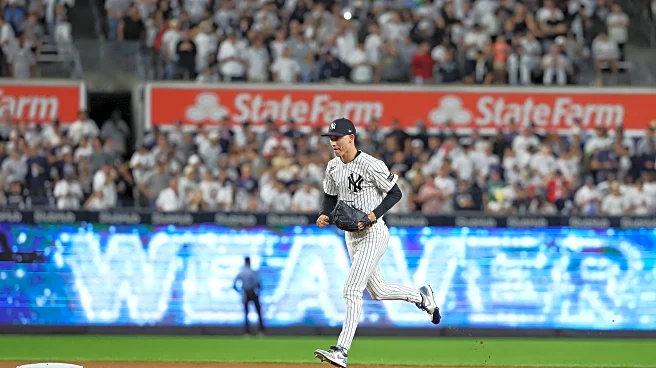

In the Mets’ quest to remake the bullpen after the utter disaster it was in 2024, they signed Devin Williams, former Yankees reliever who had a down season after years of excellence, looking to bring him
back to his former glory. And after that signing, and their 2024 signing of Clay Holmes, another former Yankees reliever who had a down season after years of excellence, they somehow found a way to sign a third former Yankees reliever coming off a down season. The Mets signed Luke Weaver to a two year contract worth $22 million.
While the Mets converted Holmes to a starter, their plans for Weaver are likely to keep him in the bullpen, adding another late inning option to their new-look bullpen. Weaver has spent the last few years primarily as the Yankees closer, but sometimes just a late-inning leverage reliever when Devin Williams was in the closer role. But his career has been a longer and more winding path than Williams.
Luke Weaver was selected in the first round by the St. Louis Cardinals in 2014, and made his major league debut for them in 2016. He spent three seasons with the Cardinals, primarily as a starter, before being traded to the Arizona Diamondbacks in 2019 as part of the package that brought Paul Goldschmidt to St. Louis. He then spent three and a half seasons in Arizona, primarily a starter in his first three seasons, but in 2022 transitioned to being primarily a reliever.
He was traded at the deadline in 2022 to the Kansas City Royals, and finished a mediocre season before being waived. In 2023 he played for both the Cincinnati Reds and the Seattle Mariners to little success before being picked up on waivers by the Yankees in September. In his first season with the Yankees, for the final month of 2023, he was used as a starter, but over his two full seasons in the Bronx he turned into one of the best relievers in the league.
Over the course of his time with the Yankees, he had a 3.22 ERA over 162 innings. He struck out 191 batters in less than three years while walking 49, with a WHIP of 0.994 and a 10.6 K/9. He had an ERA + of 127 and accrued 3.0 bWAR, which is the lion’s share of his career 3.5 bWAR. HIs time with the Yankees allowed him to redefine himself from a journeyman pitcher to an elite reliever.
His final season with the Yankees was his worst performance with New York, though still one of the best seasons of his career. He had a 3.62 ERA in 64.2 innings pitched across 64 games. He struck out 72, good for a K/9 of 10.0. He had a WHIP of 1.021 and a 113 ERA+, good for 0.8 bWAR. He was demoted from the closer job due to the addition of Devin Williams, though he became the closer during the season again with Williams’ volatile pitching costing him the job.
Weaver also missed three weeks due to a hamstring injury in June, and his performance in the second half of the season was noticeably worse, with the exception of a fantastic August. Perhaps he was pitching somewhat compromised from the injury. His underlying statistics pointed to a better season than the one on paper, with Weaver being in the 90th percentile of expected ERA and the 95th percentile of expected batting average. He was also in the 91st percentile of chase percentage and the 89th percentile of whiff percentage.
While Weaver took a small step back last season, his changing role and mid-season injury may have contributed to the underwhelming results (to Weaver’s standards). If the Mets pitching apparatus can return Weaver to the pitcher he has been very recently, he’ll be an incredible second option to Devin Williams. And even if he never returns to the heights he had in 2024, he’d still be a solid leverage option for a Mets bullpen that desperately could’ve used one last season.