


The NBA game forces players into boxes. They’re asked to play specific, and sometimes simple, roles to help the team. The best players can both fit into and transcend that box when they need to.
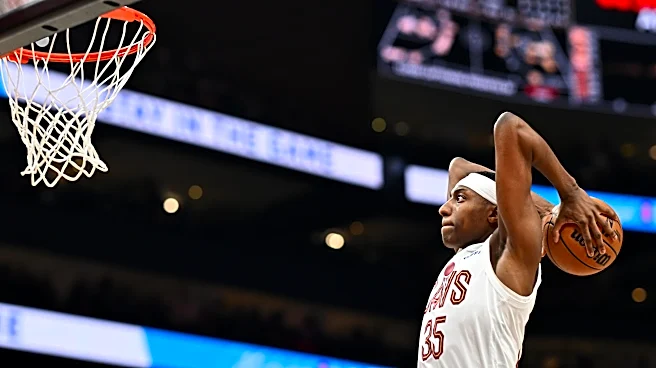
Nae’Qwan Tomlin’s unorthodox basketball upbringing has made him a unique player. He didn’t play in the AAU circuits or even in high school. Instead, his skills were developed through high-level pick-up games that reward all-around talent rather than someone who is just an expert at one or two things.
Most players
come into the league having already been forced into their mold. Tomlin didn’t, meaning he possesses skills that are uncommon for someone in his position. Those are seen most when he’s running in the open court or when attacking off the dribble if a defender closes out too hard.
That versatility is intriguing. Yet, it means little if you ultimately can’t fit into the box that the NBA puts you in. This is what Tomlin needs to figure out this season.
The simplest offensive role for him would be as a stretch four who operates mostly from the corner since he isn’t a pick-and-roll finisher. The Cavs tried him in that role last season, but he struggled to make a positive offensive impact once opponents stopped closing out to him, aside from being a strong offensive rebounder.
Support us and Let ‘Em Know with Homage!

Anything bought from the links helps support Fear the Sword. You can find the awesome Cavs’ Starter jacket HERE. Homage’s entire Cavs collection can be found HERE.
You can only attack closeouts if you’ve given your defender a reason to actually close out. Tomlin didn’t do that last season, as he went 26-for-107 (24%) on corner threes. That was the worst percentage for a power forward last season from that spot. That’s on pretty high volume as well, since over a third of his field-goal attempts came from the corner. It’s difficult to envision Tomlin as a valuable member of an NBA offense if this doesn’t drastically change.
Developing a corner three-point shot is easier said than done — especially for someone turning 26 this season. Even though Tomlin is younger than most in terms of basketball developmental years, he isn’t a young player waiting to mature physically. At 26, you typically are who you are.
Similar concerns are there defensively. Tomlin can nominally defend the three and the four, but last season he was often too slow to defend more athletic threes and wasn’t sturdy enough to hold his own in the paint against bulkier fours. This is partially why the Cavs were in the 37th percentile for defensive rebounding percentage when he was on the floor. Tomlin would be better served if he could guard at one of those positions well, as opposed to being in between both.
Tomlin is a jack of many trades, but a master of none. He isn’t a defensive specialist or a marksman. Those archetypes can work on their own, depending on how good a player is at their specialty. However, there isn’t often room on the court for someone who is merely passable at a lot of things. That is most useful if you can fit into a role first, and then expand your game from there.
Tomlin’s path to the league is nothing short of remarkable. His career has been an unquestioned success since the moment he signed his first NBA contract last season. Most players with his backstory don’t make it to this point. Yet, if he’s going to sign another contract or be more than the 13th man on a roster, it’ll be because he finds his role. And he’s running out of time to do so, considering this is the final year of his deal.
This is a make-or-break season for Tomlin.