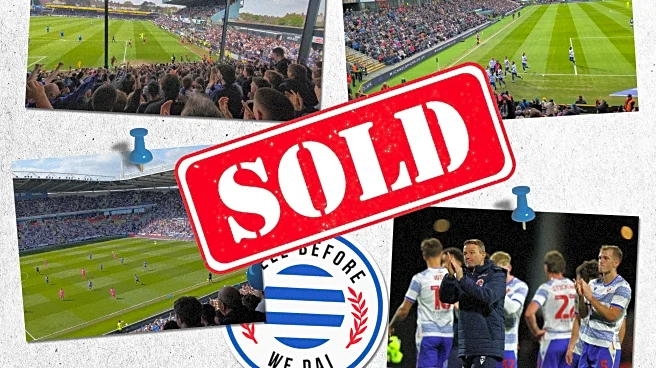




Was 2025 was a good year for Reading Football Club?
My head says yes. Undoubtedly yes. How could it not be when we were for so long fighting for the club’s survival and this year, at long last, won that fight? In that regard, 2025 wasn’t just a triumph in its own right, but also the final victory we were desperate to see in 2023 (the year Reading fell into the abyss) and 2024 (the year we failed to climb out of it
).My heart agrees… but with a caveat.
Undoubtedly it won’t miss the stress, anger and
fear that so defined the ‘Sell Before We Dai era’ of this club’s history, nor will it forget the sheer unbridled joy of reading the words: “Reading Football Club is pleased to announce that Redwood Holdings Limited have completed their takeover of the football club.”
That was about as good as I’ve felt as a Reading fan. Elation, relief, triumph, the feeling that everything is going to be OK – there’s no fully accurate way of conveying that mixture of emotions to a fan of any other club. I hope everyone yet to experience the existential dread of such a club crisis forever remains blissfully ignorant.
It goes without saying that the takeover was the most important thing of the year, and that I’ll always be grateful it happened, but at the same time I can’t ignore the dearth of excitement in the second half of 2025. If May’s takeover was a promise of much better things to come, the following seven months haven’t really lived up to that.
We’ve had far worse first halves of seasons before, of course, but fun has been in short supply. I can count on one hand the number of times in 2025/26 I’ve actually enjoyed a Reading game this season (Portsmouth away, Blackpool away, Luton Town at home, Plymouth Argyle away), and even some of those came with reservations. Instead it’s been an awfully meh, uninspiring campaign. How apt then that it takes two hands to tally the instances of Reading not playing particularly well and drawing 1-1.
Reading do at least end the year on a slight upturn. Two wins and a draw over the festive period have pushed the Royals up to a respectable 10th and, although the bizarrely congested nature of League One this season means we’re still only one bad set of results from the relegation places, the trajectory of performances and points is encouraging.
Regardless, as I look back on 2025 in its entirety, I can’t help but feel this year has been defined by a feeling of restlessness – although that’s meant different things at different times: predominantly off the pitch in the first half of the year and on the pitch in the second. It’s been less about anger or fear (which we know all too well in these parts), and more a sense of frustration that things aren’t going as well as they should be.
Let’s recap Reading’s 2025 then, starting with the gradual finale of the takeover saga, before I look at 2024/25’s playoff push, the summer months, and how 2025/26 has gone so far.
A drawn-out conclusion to a bitter takeover saga
Liens, exclusivity, EFL deadlines… hopefully this article’s the last time I ever have to write about these terms in any substantial way. And it was a restlessness to finally be free of the anxiety these terms created – constantly having to think about complex, worrying events off the pitch – that shaped so much of the first half of Reading fans’ 2025.
The year started with one of the many exclusivities of Reading’s takeover saga. Paul Taylor was reportedly in negotiations to buy the club… until a few weeks later it was confirmed by the club that he wasn’t. Royals fans had seen exclusivities come and go before of course (and would do again), so when we reached 500 days without a sale in early February, it felt like the Dai Yongge era would never end.

Fast-forward to late February and the newest contender, Robert Platek, stepped forward. And this is where the takeover battle really went up a few gears.
With rival prospective owner Rob Couhig supposedly the blocker to a sale due to retaining securities dating back to his attempt to buy the club in 2024 (when he also loaned Reading around £5m), Reading went to court on March 21 to clear the way.
Not only did that court case not result in an immediate clearance, but we also learned Dai had been disqualified as Reading owner by the EFL and was given a deadline of April 4 to sell the club. Reading soon made a proposal to Couhig to facilitate a sale, which was subsequently rejected, before Platek had enough and walked away from negotiations on April 9.
That left Couhig as the last man standing. He’d hardly been subtle about retaining an interest in buying the club, not least in the immediate aftermath of the March 21 court date, taking to the media on numerous occasions to outline his position.
Fans were divided in their view of Couhig though, with a TTE poll on April 2 suggesting around 46% were negatively inclined towards him. But if he couldn’t get a deal done, who could?
Fortunately the EFL had agreed an extension to their deadline (to April 22), recognising that “these matters are further complicated by the structure of assets held across different companies, and various competing security interests”. Although that date wasn’t adhered to, the EFL recognised progress made on the sale, granting an extension to May 5, which gave time for Reading to announce a deal in principle on the morning of the final game of the season.
Cue one of the most wonderful days in Reading’s recent history. After an eternity of waiting, Loyal Royals had their special day of collective celebration, basking in the fact that the Dai era was now essentially over. What I’d give to be able to relive that day.
Reading fans wouldn’t be denied one final bit of waiting though, having to hang on a little longer for final confirmation of a takeover. (Let’s ignore the fact that the EFL’s last extension – publicly announced, anyway – only went until May 12.) But at long last, on May 14, the almost-700-day fight to oust Dai was finally won.
Every Royals fan will surely remember where they were and how they felt on May 14, 2025: Reading Football Club’s very own Independence Day. As for myself, I had a celebratory tipple in my local in Herne Hill (a pint of Aspall never tasted so good), while Ben did likewise in The Butchers Arms, Tilehurst.
The celebrations weren’t solely limited to Reading fans though. What really added to the sense of universal delight was just how much current and former players (collated by RFC Latest on Twitter), as well as opposition fans, joined in.
If you ever need cheering up on a down day, just look through the replies to the official announcement of the takeover: such a heartwarming outpouring of love from fans of Reading, Plymouth Argyle, Coventry City, Wrexham, Bolton Wanderers, Derby County, Sheffield Wednesday, Port Vale… I could go on. Even Portsmouth supporters!
A stubbornly persistent playoff push
A surprisingly good first half of the year on the pitch had only made Reading fans feel even more restless for a change in ownership. If such a hard-working, likeable group of players could punch well above their weight when the club was falling apart around them, what could be achieved with the restoration of a bare minimum of normality?
January was a rocky month though, for sure. A New Year’s Day win at Cambridge United lifted the Royals to fifth – the second and final time we’d be that high in the table in 2024/25 – but one point in the next four games pushed the club down to 10th. Add in the sale of talisman striker Sam Smith and Reading appeared to only be going in one direction.

But that’s when Reading fought back. Despite everything happening off the pitch, losing a key player in January and Ruben Selles in December, Noel Hunt found a way to relentlessly grind out results across the final stretch of the season and take the battle for sixth place to the final day.
An 11-match unbeaten run from the beginning of February was built on a solid defence (five clean sheets, one goal conceded six times) and the sudden ability to do something which had for so long proven elusive. Yep, Reading were now being awarded penalties, and they’d contribute six points in the closing months of the campaign.
Scoring goals in open play was another matter though, with Reading noticeably worse going forwards in the second half of 2024/25 than the first. Was it down to the manager, personnel or a mixture of the two? Whatever the truth of the matter, the Royals’ inability to put away low-ranking sides (drawing against Shrewsbury Town, Exeter City and Crawley Town) led to a real feeling in early March that the playoff challenge was falling away.
Yeah… about that. Out of nowhere, Reading summoned up their best home performance of the season to outplay and see off high-flying Wrexham, who’d go on to be promoted automatically at the end of the season. Though the Royals dropped points at home to Stevenage a few days later in mid-March and lost the unbeaten run at Blackpool on April 1, beating Wrexham reignited Reading’s season.
Back-to-back wins against Wycombe Wanderers and Shrewsbury Town after that defeat at Bloomfield Road returned the Royals to the top six, setting up a showdown with Orient in the final weeks. It was nail-biting stuff, Reading stalling against Northampton Town (0-0) and losing at home to Lincoln City (1-0), but another brace of away victories (5-1 at Mansfield Town, 2-0 at Bristol Rovers) took the battle to the final day.

Orient took a 2-0 lead in the first half, eventually running out 4-1 winners, and you could tell in real time that events going against us in West Yorkshire was having its own impact in Berkshire. Each goal going in added to the anxiety of the SCL support, which increasingly knocked back those on the pitch.
The Royals needed a final-day playoff favour from Huddersfield Town (ironic for a number of reasons)… which never came close to being delivered.
While Reading never really got going against Barnsley, only managing a couple of consolation goals in a 4-2 defeat, disappointment rapidly evaporated for two reasons.
On the pitch, the Royals had more than done their part, with 75 points not only a hugely commendable tally for a club battered by ownership chaos, but also typically good enough for a top-six finish. Orient’s imperious run of six consecutive wins at the end of the season was impossible to overcome.
And events off the pitch more than made up for disappointment on it. The final day of 2024/25 was when Reading’s against-all-odds playoff push came to an end, but who cares? We’d got our club back.
A summer rebuild
After celebration day came the start of a long, arduous rebuild. And if anything this year really illustrated the theme of restlessness in the fanbase, it was the amount of time Reading took to put a new-look squad together over the summer. This was when supporters were desperate to see the club kick on in a new era, when their excitement about the future could be fully indulged.
But as the summer progressed, there was a growing sense of frustration due to the lack of business being done, of fans’ patience being tested.

Only five first-team signings were made before the pre-season training trip to Ireland in mid-July, with four joining after the start of the season. Similarly, although Reading’s retained list was released soon after the takeover was confirmed, it wasn’t until late June and early July that most deals were announced, with the Kelvin Ehibhatiomhan contract saga dragging on until July 24.
Though it felt to me at the time that some of the supporter sentiment slipped too quickly into impatience – and that there was in fact a virtue in patience over the summer rebuild – Couhig had probably gone a bit too far himself in talking up Reading’s summer transfer prospects.
Either way, frustration and restlessness were certainly settling into the fanbase – not helped by Reading failing to score in the final three pre-season friendlies with fans present (the last of which was a 4-0 mauling at home to Portsmouth).
At the end of the window though I felt Reading had overall managed a solid, albeit not spectacular, summer of recruitment. The Royals had put together a squad capable of competing for the top six, with a good mix of individual ability and experience, even if they’d had to wait longer than they’d have liked for some signings. That was all very much on paper though – the reality would be very different, as I’ll come back to.
It was all change behind the scenes too. The new ownership also brought with it a new CEO (Joe Jacobson), new investors (Ross Kestin, Rick Catania) and a whole host of revamps and improvements off the pitch: changes to the matchday experience, a beefed-up media team (led by Phil Catchpole) and loads more. Plus, a wonderful afternoon at Bearwood made it crystal clear just how keen Couhig was to win over Loyal Royals.
Although Reading had gone through a huge amount of change over the summer, it was still mid-reboot as the 2025/26 season dawned in early August.
This season so far
While it certainly wouldn’t be right to say Reading have had a good season so far, simply summing it up as ‘middling’ or ‘bad’ feels wide of the mark too. Rather, the Royals’ 2025/26 has varied between those last two descriptions, consistently been stodgy and flat, and has stubbornly refused to click into gear.
As I mentioned higher up, that’s not down to the lack of individual ability on paper. Reading have been able to get at least a dozen appearances each out of Charlie Savage, Lewis Wing, Kamari Doyle, Joel Pereira, Derrick Williams, Finley Burns, Paddy Lane, Andy Yiadom, Jack Marriott and Paudie O’Connor – all of whom have proven before this season that they bring quality at this level.

Coaching that group of individuals into a tactically coherent, effective and fit collective has been another matter though.
A lack of clear identity and threat in possession was a worrying hallmark of Noel Hunt’s 14 league games in charge which wouldn’t budge.
Having failed to get enough joy out of the 4-3-3 structure he inherited from Ruben Selles in December 2024, Hunt eventually adjusted to 4-2-3-1 to improve the balance of the team. Neither that nor time on the training ground yielded a noticeable uplift in performances and results.
I personally was in the Hunt Out camp from the 3-2 loss at Barnsley in mid-September: the poor collective nature of that performance – despite the preceding two weeks’ break – looked like a clear indication that things weren’t going to get better without a change in management. Subsequent results weren’t terrible (two wins, four draws and a loss in Hunt’s remaining seven), but the Cardiff City game (ironically the sole defeat) was the only good example of Reading looking a convincing threat going forwards. Hunt’s Royals were too reliant on goals from long range and/or Jack Marriott.
Following a familiarly poor stalemate with Doncaster Rovers, Couhig acted quickly to remove Hunt, replace him with Leam Richardson and hire a couple of coaches within a matter of days. And before long, the new gaffer was further backed with the signings of Randell Williams and Andy Rinomhota on free transfers.
Reading have fared more favourably under Richardson, looking better coached and generating goals more freely (three goals against Blackpool and Luton, and four against Plymouth, are the Royals’ best league goalscoring performances of the season). Results have been good too: four wins, two draws and two losses from Richardson’s eight league matches, although his debut (a 3-2 FA Cup reverse to Carlisle United) couldn’t have gone much worse.
But we’re yet to decisively click into gear. Performances have been inconsistent not only game to game, but also within matches, largely due to poor fitness and game management. The Plymouth game was a great case in point, with Reading struggling to control much of the second half despite being three goals and one player up on the hosts.
As we end the year, there’s a tangible sense – you guessed it – of restlessness for the Richardson era to fully take off.
Conclusion
The bottom line is that this club is undoubtedly in a better place than it was 12 months ago. Obviously. And although restlessness has been a tangible theme throughout 2025 and the second half of the year wasn’t as enjoyable as we’d have liked, Reading Football Club is now in a position to rebuild, grow and properly kick on.
That process won’t be quick or easy – the last seven months or so have made that clear. After all, we’re no longer a recently relegated Championship club that only needs to make a few adjustments in order to get promoted – there’s a lot of work to do, a lot of damage to be undone, much of which goes back well before the last couple of years. Hopefully 2026 is when that’ll be done.
Onwards, upwards and up the ‘Ding.