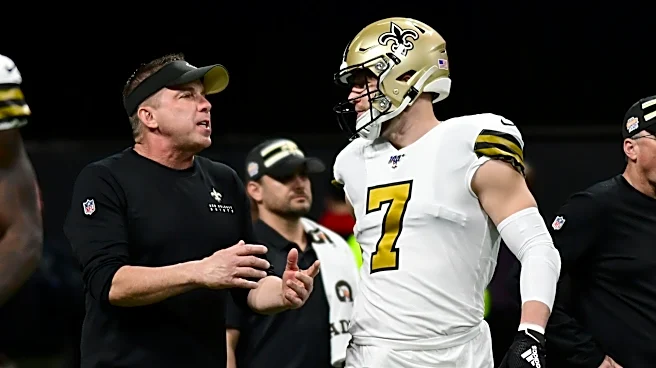


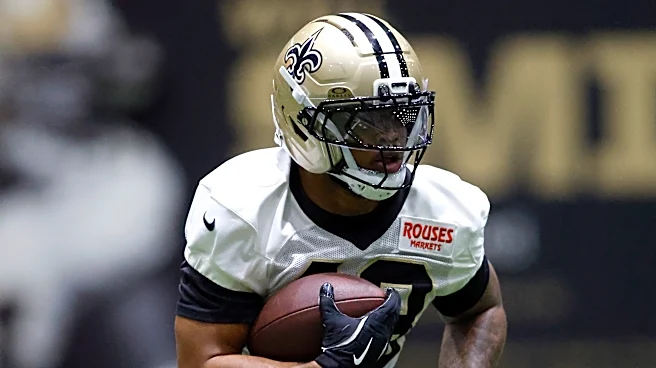
Buffalo Bills new head coach Joe Brady has described himself as a “Sean Payton disciple”.
One of the foundational pieces of a Sean Payton offense has been usage of running backs in the passing game.
Now that we have the two main points out of the way, let’s elaborate.
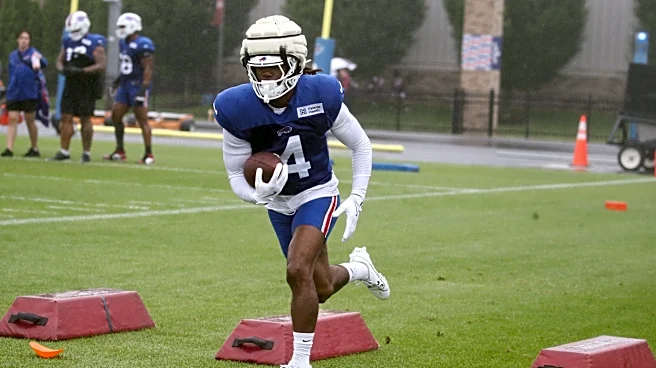
Alaina Getzenberg, Buffalo Bills beat reporter for ESPN, noted recently that the team’s running backs have been more involved in the passing game throughout training camp compared to camps under the previous coaching regime.
Apart from the obvious points-per-reception fantasy football implications for running backs James Cook, Ty Johnson, and Ray Davis (who have all seen degrees of success as pass catchers in their careers), this shift also naturally begs the follow up question: how many targets will the Bills runners get in 2026? Is there even a noteworthy and statistically significant shift coming or is this more of a “oh that was a fun idea” moment that passes and becomes the turkey burgers of the 2026 training camp: a fun story for a moment, but ultimately forgotten when the real games start getting played.
Let’s establish exactly what we mean by the statement “one of the foundational pieces of a Sean Payton offense has been usage of running backs in the passing game”. What is “foundational”? Since 2013, offenses under current Denver Broncos and former New Orleans Saints head coach Sean Payton have ranked inside the top eight in running back target share every single year:
2013 – 32% running back target share (rounded to the nearest full percentage point), 1st in the NFL
2014 – 26%, 4th
2015 – 24%, 6th
2016 – 25%, 1st
2017 – 32%, 1st
2018 – 28%, 2nd
2019 – 28%, 4th
2020 – 27th, 3rd
2021 – 28%, 1st
2023 – 32%%, 1st
2024 – 21%, 6th
2025 – 20%, 8th
Ironically enough, a Sean Payton offense being eighth in the league in running back target share was low enough relative to established expectations that it generated conversation around the changes that might be made to the offensive structure under new play-caller and former Buffalo Bills backup quarterback Davis Webb.
Are those numbers even representative of a significant increase relative to the Buffalo Bills’ historic rates? Not last year. In 2025, the Bills running back target share was 18.4%, 12th in the NFL and less than two percentage points behind the Broncos. If the Bills go from “2025 Buffalo” to “2025 Broncos”-level of running back involvement in the pass game, none of us will even notice. But in 2024, the Bills were almost a full five percentage points behind the Broncos in this measures stat (16.6 to 21.4). 2023? The delta was over 15 points (25.8 to 32.1). 2021 represented a 12.9 point delta (between the Bills and the Saints). 2020 was a 14.6 point spread (13.5 to 28.1).
I’ll spare you the remainder of the years but suffice it to say, you have to go all the way back to 2013 and 2014 to find years where the Bills were at the top of the league in running back target share, which logically trends given that two of their most dynamic offense weapons were running backs (Fred Jackson and C.J. Spiller).
Here’s the thing: passing the ball to your running back doesn’t necessarily mean your passing offensive will be good. In fact, most of the time it’s essentially a net neutral play for the offense; better than taking a sack or throwing an incompletion, but nothing that moves the offense forward in a meaningful way. The Bills, however, have been an outlier in that department. They averaged an EPA per pass of 0.228, 2nd in the NFL and a good chunk ahead of the third-place Atlanta Falcons (0.216 EPA per pass attempt). For reference, the league median in this metric was 0.003 last year. Over the last four seasons, it’s actually a negative number (-0.040).
The Bills threw the ball 495 times in 2025 (535 called pass plays). This represented an almost exact 50/50 run/pass ratio (50.55%/49.45%). If former head coach Sean McDermott did in fact have an impact on that and the team heads toward a league average run/pass split (56/43 last year), the Bills should have about 606 called pass plays. Assuming a 92.5% throw rate on those called plays, that would leave 561 pass attempts. If the Joe Brady offense lands the Bills at about a 28% running back target share, that means 157 running back targets may be in store for the Bills, up from 92 last year. That would represent a statistically significant increase and could change the way the offense flows for the team in their first year under a new head coach since 2017.
Ultimately, this could all just be another example of a training camp narrative that doesn’t bear fruit come week one. But the premise is fair, the process is good, and it’s certainly something worth keeping an eye on in the early parts of the 2026 season.
…and that’s the way the cookie crumbles. I’m Bruce Nolan with Buffalo Rumblings. You can find me on Twitter and Instagram @BruceExclusive and look for new episodes of “The Bruce Exclusive” every Thursday on the Rumblings Cast Network — see more in my LinkTree!