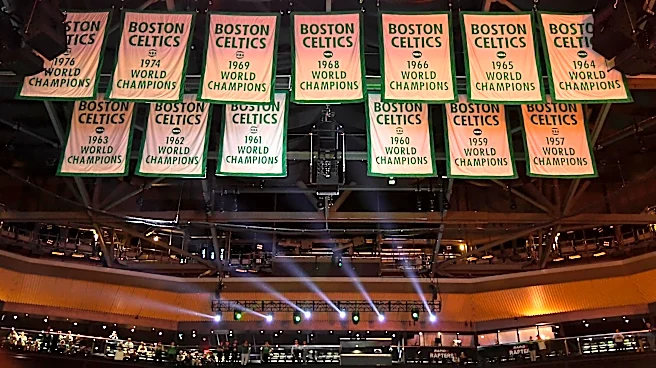



NBA history spans 80 seasons, and as CelticsBlog readers well know, the Boston Celtics have won a league-high 18 championships. This month, we are recapping each of those title years.
After the Celtics won their thirteenth title in 1976, the team sort of fell apart. The merger between the ABA and the NBA brought new talent into the league, and in any case, championship success was difficult for any team to sustain
in the 1970s, a decade in which eight different teams won titles (only the New York Knicks and Boston Celtics won more than a single title). Havlicek was past his prime, and the Celtics were basically a one-man team, relying on the tough-as-nails but undersized Dave Cowens to carry them at both ends of the court. A young Cedric Maxwell had been drafted in 1977, but he was still coming into his own as a player.
The Celtics lost in the second round of the playoffs in 1977, coming off a pedestrian 44-38 record, and they fell even farther the following season, one in which Tommy Heinsohn was replaced as coach by Satch Sanders, who was himself replaced by Dave Cowens the following season, all to ultimately disastrous results. Boston’s 29-53 record in 1978/79 was the worst of the Red Auerbach era.
The unsettled coaching situation and on-court struggles were accompanied by front-office turmoil.
Red had stockpiled three first round picks in the 1979 draft, with the goal of rebuilding the Celtics, but Boston’s new owner, John Y. Brown had other ideas. On February 12, 1979, he traded Tom Barker and those three picks to the New York Knicks for Bob McAdoo.
An incensed Red gave Brown an ultimatum. Either you go or I do.
The threat had teeth. Red had been approached by the Knicks and had an offer in hand to take over basketball operations for the franchise.
Brown backed down almost immediately.
The Celtics had been passed from owner to owner since Walter Brown’s death in 1964—John Y. Brown’s consortium was the eighth in 14 years—and the one constant through all those changes was Red Auerbach.
Brown knew that if he kept the Celtics, he’d probably be burned in effigy on the Boston Common—in fact, that would probably be the most anodyne outcome of forcing Red out—plus he had acquired a sudden urge to run for governor in his home state of Kentucky.
By the end of March, Brown was ready to close on a deal proposed by minority owner Harry Mangurian, and the Celtics were back in the hands of ownership that was willing to leave the basketball decisions in the hands of the most capable guy in league history when it came to those things.
Now Red may have lost those three picks in the 1979 draft, but things turned out alright in the end.
In 1978, Red drafted Larry Bird, despite knowing that he had no intention of leaving school before the end of the 1979 season. It was a calculated risk. The catch was that the Celtics had to sign Bird to a contract before the 1979 draft, otherwise he could re-enter it, and the odds were that he would be picked before Boston had a chance to grab him—and as it turned out, the team ended up with no first round picks in that draft in any event. “I knew this was my shot at him,” Red would tell John Feinstein years later, “I was thinking long term.”
The team also hired Bill Fitch as head coach; Fitch was Red’s first hire from outside the Celtics family, and his coaching pedigree was far from elite. Fitch was in his ninth season with the Cleveland Cavaliers, who had hired him out of the college ranks in their first season. His cumulative record was 304-434 for a less-than-impressive .411 winning percentage. But there was something about him that Red liked.
The combination of rookie Larry Bird and an experienced hand on the bench galvanized the Celtics, who went from 29-53 to 61-21 in the 1979/80 season. The Celtics lost to the Sixers in the Eastern Conference Finals, and the Sixers, in turn, lost to the Los Angeles Lakers, as Magic Johnson’s rookie season ended in a Finals championship.
1979/80 was Dave Cowens’ final year with the team, leaving the Celtics in need of front court talent, but Red, who had all his 1979 first round picks traded out from under him, figured out a way to land a pair of low post Hall of Famers with his picks in the first round of the 1980 draft.
The Celtics had gotten involved in a goofy situation with Detroit. They signed M.L. Carr, which meant that the Pistons were owed compensation, but instead of sending Detroit a draft pick—the usual procedure—the Celtics arranged to send them Bob McAdoo—a Hall-of-Famer who just never fit in with the Celtics. However, since McAdoo was more valuable than a draft pick, the Pistons agreed to send Boston two picks in the 1980 draft.
This was not a good deal for Detroit.
The Pistons ended up with the worst record in the NBA in 1979/80, and a coin flip gave them the first pick overall.
At the time, there was a clear consensus that the best player coming out of the draft was a center, Joe Barry Carroll from Purdue.
Red, however, saw things a bit differently. He wasn’t as impressed by Carroll as the rest of the league was. He didn’t want Carroll, he wanted Minnesota’s Kevin McHale.
Now the Golden State Warriors had the third pick in the draft, and they had a center Auerbach liked, Robert Parish, so Red reached out to Al Attles—who was Golden State’s coach and GM, and offered both of his picks in the first round for the Warriors’ number three pick. And, since the Warriors were going to be drafting Joe Barry Carroll, they probably didn’t need Robert Parish anymore, so maybe they could send him along as part of the trade as well.
One can only imagine Al Attles’ glee at the thought of getting the player he wanted and another pick in exchange for, essentially, a backup center, provided Carroll lived up to expectations, and this is the thing about so many of Red’s masterpiece trades—it almost always seemed, from a certain perspective, that Red was getting ripped off. Like when he traded two future Hall-of-Famers for a center who couldn’t really score, but who would win eleven championships nonetheless.
Thus, on June 10, 1980, the Celtics added Kevin McHale and Robert Parish to Larry Bird and formed one of the most impressive front courts in NBA history.
Joe Barry Carroll? Well, suffice to say that Globe columnist Ray Fitzgerald was not wrong when he mentioned concerns about Carroll’s motivation the day after the Celtics traded their number one pick to the Warriors.
This is where things stood at the start of the 1980/81 season…
The Regular Season

The Celtics cruised to a 62-20 record, marking a one game improvement from the previous season. They racked up winning streaks of 12 and 13 games bracketing a single loss for a stretch of 25-1 play in the middle of the season. Apart from a somewhat surprising three game losing streak that straddled the All-Star break in January and February, the Celtics never lost two games in a row.
The rookie Kevin McHale appeared in all 82 games, but started just one, making him the latest sixth man in the Celtics’ long tradition. His contributions were just a slim indication of the player he’d become, as he averaged ten points on 53.5% shooting from the field and just 67.9% from the line.
In his second year, Larry Bird finished second in MVP voting and made first team All-NBA. Nate “Tiny” Archibald gave the Celtics standout play from the point guard spot, and the Celtics ended the season with five players averaging double figures. Bird, who played power forward in his early years in the league, led the team in rebounds at almost 11 per game, a total that topped Robert Parish’s 9.5 per game. Although remembered mostly for his offense these days, Bird was an extremely capable two-way player before injuries limited his role to a primarily offensive one.
Boston had the league’s best record, but they weren’t at the top of the league in any statistical category. Their best stat was a defensive one, where opponent points per game, at 104, was good for second in the league.
The Celtics did all this with a rather young team. Bird was in his second year, McHale was a rookie, Parish had four years’ experience coming into the season and Cedric Maxwell had three. Tiny Archibald was the team’s only real veteran, with nine years in the league.
Eastern Playoffs
The Eastern Conference looked to be a meat grinder. The Celtics were tied for the best record with the Philadelphia 76ers, and the Milwaukee Bucks, coached by old friend Don Nelson, weren’t far behind with a 60-22 record.
The NBA had expanded the playoffs to three rounds in 1975, with the two division champs getting byes from the best-of-three opening round. This meant that Boston, which held the tiebreaker over Philly, got to take a breather while waiting for their second round opponent to be decided.
In that first round, the Chicago Bulls, who finished with a 45-37 record made quick work of the higher seeded Knicks, sweeping New York 2-0. This set them up to face Boston.
Things did not go well for Chicago. They lost in four. Boston’s average margin of victory was 8.25 points as they finished +33 for the series. Larry Bird led all players in points, rebounds, assists, and steals, with a 23.5/13/7.3/3.0 stat line.

The Eastern Conference Finals were a rematch from the previous year. Once again it was the Sixers and the Celtics—a rivalry from this era that is sometimes lost beneath the Lakers/Celtics rivalry. The Celtics and Sixers faced off four times in the playoffs during the Bird era—more times than the Celtics matched up against the Lakers, albeit for lower stakes.
Boston’s series against Philly was an absolute classic.
The teams had finished the season with identical records, so the matchup figured to be close and entertaining, and the first game seemed to deliver on both counts.
In game one, the Celtics had rallied from a ten point deficit and were clinging to a one point lead with less than four seconds left when Billy Cunningham drew up a play for Sixers rookie Andrew Toney that sent him baseline. He got past Cedric Maxwell who felt that it was better to foul him than give him two easy points from a layup.
Toney stepped to the line and delivered the equalizer and the game winner in succession. Final score? 105-104, Philly. The Sixers had seized home court and put the Celtics in a 1-0 hole.
The man who would, with justice, become known as the “Boston Strangler” had introduced himself to the Garden with an exclamation point.
Game two went Boston’s way without much drama as the C’s tallied a 19 point victory, 118-99. Toney led all scorers with 35, but Bird was a close second with 34.
Game three went to Philly, putting the Celtics in a 2-1 hole with the next game being another road contest.
Game four looked to be all Philly as well; the home team had an 18 point lead in the second half, forcing the Celtics to claw their way back into the game. They were down four points, 107-103, when they turned their defense up to maximum. They caused a 24 second violation, which was followed by a bucket from Tiny Archibald that gave them a real shot. The score was 107-105 Philly with just over a minute remaining. The score stayed there until there were eight seconds left in the game. The Celtics nabbed a rebound off a miss by Bobby Jones, and while Bill Fitch signaled in vain for a time out, Archibald began to push the ball up court. Jones reacted to his miss by running the length of the court, figuring that Archibald would send the ball into Bird who was standing near the opposite basket.
His instincts were correct, and Jones snatched the pass before Bird could get his hands on it, sealing the victory and putting the Celtics up against the wall.
Boston wasn’t facing just one ‘must-win’ game. They were looking at three of them.
A team that had struggled mightily against the Sixers in three of the first four games would need to figure out how to beat Philly not just once, but three times in a row.
It’s not much of a spoiler to say that they did. After all, this is a column about a championship season, not an exit from the Eastern Conference Finals.
But those games… Oh, those games… The Celtics won three in a row by a total of five points. Each victory was by just about the thinnest margin possible.

Over those three games, Larry Bird scored 80 points and hauled in 38 rebounds. He dished out 14 assists, and logged ten steals. He was turnover prone in the first two of these three games, but in the decisive game seven, he logged five steals and only one turnover.
In game five, the Sixers had a six point lead with just over a minute and a half left in the game, but they failed to score the rest of the way as Boston went on a 7-0 run that featured a block by Parish, a layup and a hustle play that secured a loose ball from Bird, and three clutch free throws by M.L. Carr. Philly, on the other hand, couldn’t handle the pressure from Boston’s defense, as they missed multiple chances to put the game—and the series—away.
Game six, in Philly, was another two point affair.
Once again, Philly seemed on the brink of closing out the series. They had a 17 point lead in the first half in an environment that was beyond hostile to the Celtics.
Decades before the ‘Malice in the Palace,’ Cedric Maxwell was charged by a fan with a pointed object of some sort in the third quarter; retaliation by Maxwell, Archibald and Chris Ford took them five rows deep into the Spectrum crowd. Nobody was ejected. Nobody was suspended. It was a different time.
Somehow, somehow, the Celtics turned that deficit into a fourth quarter lead. As the clock wound down, Andrew Toney found himself up against Kevin McHale with the game on the line. McHale was trying to lure Toney into shooting the ball because the alternative was having Toney dump the ball into Darryl Dawkins, and McHale didn’t have high hopes of stopping the massive Sixers center.
McHale succeeded in luring Toney into a shot that he leaped up to contest, and he ever so slightly “ticked” the ball, pushing it off target and into his hands. “I was hoping somebody would foul me,” McHale said after the game, but the Sixers opted to let a bit more time run down before fouling Tiny Archibald, who sealed the Celtics victory with a pair of free throws.
The series was tied 3-3 and headed back to Boston for a decisive game 7.
Once again, the Celtics found themselves in a hole.
With 5:24 left in the game, Philadelphia had a 89-82 lead.
Bear in mind that the final score of this game was 91-90
The Celtics held the Sixers to just one point—and no field goals—over almost five and a half minutes of absolute desperate, must-win basketball.
It’s one thing to clamp down on a team during a regular season game when there’s not much on the line, but here, for both teams, everything was on the line.
The Celtics forced five turnovers—of which three were steals by Larry Bird—and the Sixers missed all six field goals they attempted during that span.
“Inspired, determined—maniacal” was how Bob Ryan described the Celtics’ defense to close out the game and the series.
With a minute to go, Bird gave the Celtics the game winner, capping a 9-0 run. He’d come out of a scrum under the basket with the ball, “I wanted the ball in my hands,” he said after the game, “that’s the only place in the world I wanted it.” He ran it coast-to-coast, delivering a layup that sealed the game.
The Sixers, who outshot the Celtics 48.8% to 38.2%, sent the Celtics to the line 35 times during the game, where Boston’s abysmal shooting nonetheless gave them a more than sufficient margin, as they made 22 free throws against just 12 by the Sixers.

The Western Playoffs
On the opposite coast, there was an open rebellion in Los Angeles. The defending champs were chafing under coach Paul Westhead, and although they did well enough in the regular season, winning 54 games, they were bounced in the first round of the playoffs by the Houston Rockets, who finished the season with just a 42-40 record.
The Rockets proceeded to knock off 52-win San Antonio in the second round of the playoffs, which set them up to face the Kansas City Kings. The Western Conference produced not one but two Cinderella teams that year, as the Kings, who finished the season with a sub .500 record (40-42) knocked off the Suns, who were the number one seed in the West, in seven games in the semis.
This was almost certainly the weakest Western Conference Final matchup in history, as the teams were a combined .500 for the season.
The Rockets prevailed in a gentleman’s sweep; they were never seriously challenged by the Kings, who wouldn’t breathe this rarefied postseason air for another two decades.
The Finals
This contest was somewhat anticlimactic. The series went six games largely due to the play of Houston’s Hall-of-Fame bound center, Moses Malone.
But there was no real contest here. Maybe you could chalk up one or both of the Celtics’ losses to fatigue from having to battle back from a 3-1 deficit to the Sixers.
In this era, the Finals started just two days after the Eastern Conference Finals ended.
The series was in no way as close as the 4-2 win total might suggest. The Celtics won games by margins of 23 and 29 points, while the largest margin of victory the Rockets could manage was a five point gap in game four.
Today, Larry Bird’s play in the Finals gets a bit of scrutiny, and it’s true that the Legend did struggle to score, and if he had performed better, it’s unlikely that the series would have gone six games, as Boston’s losses were by a total of seven points, as opposed to a cumulative 66 point margin of victory across all four wins.
But that’s not the whole story. Bird led all Celtics with 92 rebounds and dang near nabbed as many as Malone—who grabbed 94 for the Rockets.
Bird also led all players with 42 assists for the series, a total that was nine more than Tiny Archibald for the Celtics, and 17 more than the Rocket’s leader in the category. His 14 steals also led both teams.
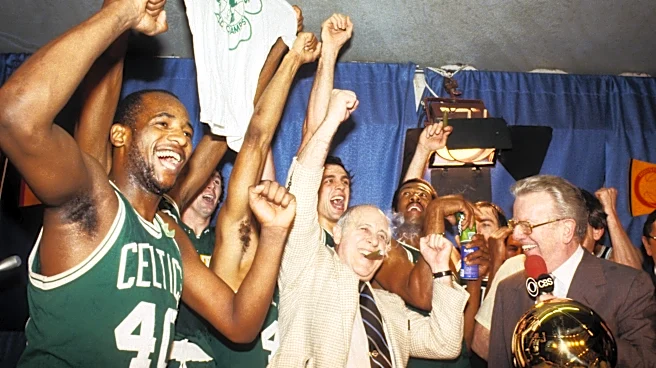
Even though Cedric Maxwell won the Finals MVP, it was clear that Larry Bird had arrived, and along with him, another Celtics dynasty.

Turning Point
The turning point was M.L. Carr’s clutch free throws at the end of game five of the Eastern Conference Finals. Carr capped a furious comeback that kept the Celtics alive and set up two more games that were, at least to Celtics fans, classic examples of the grit and resolve of their team. I wouldn’t want to speculate on how Sixers fans view those three games that they failed to finish.
It Wasn’t Over Until
Larry Bird scored the game seven winner against Philly and introduced himself to the big time with an epic performance that featured three steals in the final five minutes of the game to go along with a game high 23 points, eleven rebounds and five assists.
Tune in tomorrow for the matchup everyone was waiting for: Bird vs. Magic.