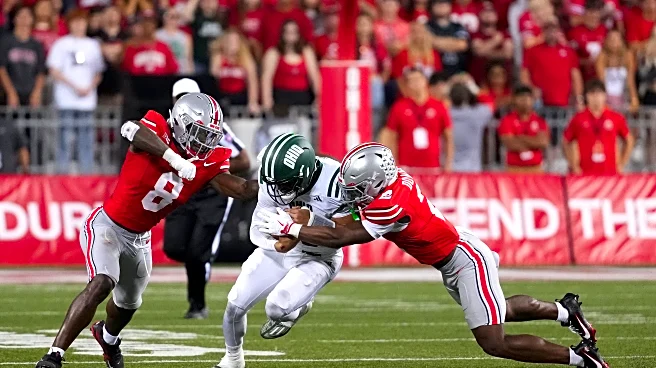


Ohio State has long been a pipeline to the first round of the NFL Draft. This year, it has a chance to do something rarer and far more difficult: Put four Buckeyes inside the top 10.
It is an outcome that would normally sound hyperbolic. Top-10 selections are shaped by positional value, team need, and risk tolerance as much as pure talent. But when you line up the Buckeyes’ draft-eligible stars, the case becomes harder to dismiss.
Ohio State does not just have elite players. It has elite players at positions
that can tilt games, reshape defenses, and dictate draft boards.
Caleb Downs, Arvelle Reese, Carnell Tate, and Sonny Styles each bring a different profile. Together, they form one of the strongest top end draft groups college football has produced in years.
Caleb Downs: generational safety, modern evaluation problem
There is no ambiguity about Caleb Downs as a football player. Over the past three seasons, he has been the gold standard for safety play in college football. Range, instincts, tackling reliability, processing speed, Downs checks every box evaluators look for, and then some.
The only real question surrounding his draft stock has nothing to do with his tape and everything to do with positional economics. Safeties historically slide on draft night, not because they lack impact, but because NFL teams have been slower to value them at the same level as edge rushers or quarterbacks.
Even that resistance is beginning to soften. Recent examples around the league have shown just how transformative an elite safety can be when deployed correctly, like Nick Emmanwori with the Seahawks. The rise of hybrid defenders and coverage versatile back ends has made players like Downs less luxury and more necessity.
His ability to erase explosive plays, rotate post-snap, and function as both a coverage defender and run enforcer makes him scheme-proof.
Downs may not go as high as his raw talent deserves, but a top-ten selection still feels likely. If a team drafting early wants a defensive cornerstone with immediate All-Pro upside, there may not be a safer bet in this class.
Arvelle Reese: the draft’s most dangerous chess piece
There may be no Buckeye whose rise feels more jarring than Arvelle Reese. What would have been a shocking projection before the season has quietly become routine conversation around the NFL.
Reese’s 2025 season was not just productive, it was overwhelming. He won Big Ten Linebacker of the Year honors and consistently took over games with his length, explosiveness, and physicality. At 6’4, 243 pounds, he does not fit neatly into traditional linebacker boxes, and that is precisely what makes him so valuable.
NFL teams increasingly see Reese as more than an off-ball linebacker. His skill set screams edge-capable hybrid, someone who can rush on passing downs, drop into coverage, and stress protections from multiple alignments. His burst off the line, closing speed, and ability to convert power to disruption give him legitimate pass-rush upside at the next level.
In a league obsessed with creating matchup problems, Reese is a nightmare. He is the type of defender coordinators build packages around rather than slot into roles. That versatility, combined with elite production, is why Reese has legitimate top-three buzz and why he may ultimately be the first Buckeye off the board.
Carnell Tate: WRU’s next elite receiver
Ohio State’s reputation as Wide Receiver U did not materialize overnight, and Carnell Tate is the next natural extension of that lineage.
Tate’s statistical arc tells a clear story. A strong 2024 season with 52 catches for 733 yards and four touchdowns laid the foundation. In 2025, he elevated his game to another level, finishing with 51 receptions for 875 yards and nine touchdowns.
What separates Tate from many productive college receivers is how translatable his game is. His deep-route pacing, spatial awareness, and understanding of leverage are already NFL-level. He wins with stride efficiency rather than pure speed, tracks the ball naturally downfield, and consistently finishes through contact.
Concerns elsewhere in this receiver class only strengthen Tate’s case. Injury questions surrounding other top prospects have pushed teams to value reliability and polish, and Tate offers both. He looks every bit like a future WR1, and there is a realistic path for him to be the first wide receiver selected, and comfortably inside the top ten.
Sonny Styles: redefining the off-ball linebacker ceiling
Sonny Styles presents a familiar draft debate with an unfamiliar answer. Off-ball linebackers rarely go early, but Styles is not your typical off-ball linebacker.
His background as a safety shows up everywhere on tape. He processes route concepts quickly, closes throwing windows in coverage, and moves with a fluidity that most linebackers simply do not possess. Against the run, he brings range and physicality without sacrificing discipline.
What makes Styles so appealing to NFL evaluators is flexibility. He can function as a traditional second-level defender, slide into sub-packages as a coverage piece, or rotate into hybrid roles that blur positional lines. In a league built on disguise and matchup hunting, that versatility matters.
The question teams will wrestle with is not whether Styles can play, but how early they are willing to invest in an off-ball defender. For some organizations, especially those prioritizing defensive adaptability, the answer may be sooner than expected.
The bigger picture
Kayden McDonald will almost certainly hear his name called in the first round as well, but the top-ten conversation belongs to these four.
What makes this moment notable is not just the number, but the diversity of elite talent. A safety, a hybrid linebacker, a wide receiver, and a coverage-savvy linebacker climbing boards simultaneously speaks to Ohio State’s ability to develop players across the spectrum of modern football.
Four Buckeyes in the top ten is not an anomaly, it is a reflection of how the game is changing, and how Ohio State continues to stay ahead of it.