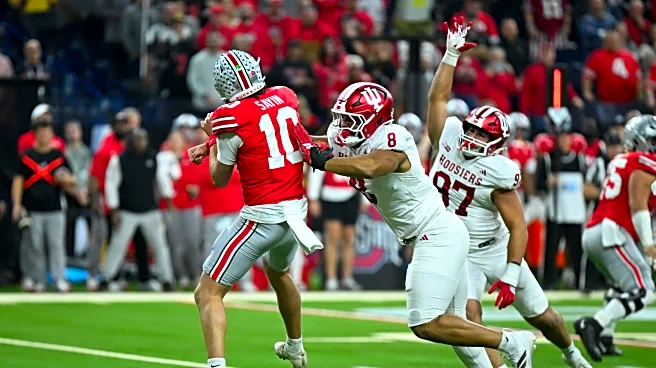




Don’t get me wrong, the Hoosiers have had an amazing offense this year. They even got a Heisman trophy out of it. They’re very good.
But the unit that drives this team is the defense. The Hoosiers are putting out some all-time great metrics there.
They’re only giving up 10.8 points per game, which beats out every single one of Nick Saban’s Alabama teams outside of the 2011 squad in terms of a raw scoring metric. You want some other metrics to see how they stack up to other teams this year? Check out this graph:

See that logo cut off on the far right? That’s Indiana. They are causing so much more Havoc (TFLs, Sacks, PBUs, fumbles, interceptions) than everyone else. Only Texas Tech and Oklahoma are in the same league as them.
At the same time, they’re also one of the best in the country in PPA, an analytical model. for “Predicted Points Added”
Essentially… They’re just really good.
Defensive coordinator Bryant Haines also came with Coach Cignetti from James Madison, and he’s a young up-and-comer DC who’s spent his whole career with Cignetti so far. This is a cool article about his rise in coaching.
“He’s not a coach that wants you to be a robot,” Tucker-Dorsey said. “You have an ultimate job description, and he’s going to tell you a way he thinks you should accomplish it, but he has no problem with you doing it differently as long as you accomplish that same goal.
“I wasn’t a traditional backer and it really helped me be great in his system. He allowed me to be me.”
There’s not a whole lot out there about what scheme he runs or any real coaching philosophies – he’s too new still. But I thought this was an interesting quote about how he wants his defense to freelance a bit. Still, here’s a quick breakdown from Addicted to Quack from the Oregon game earlier this year:
The most schematically interesting aspect of DC Haines’ squad in 2025 is that it switches cleanly from a 4-down to a 3-down front, which was not the structure last year. In 2024, there was a variety of body types on the edges and they customized their 4-2-5 situationally by swapping around stand-up ends, heavy fist-down ends, and very light speed rushers. This year the personnel groups are very tight, and mostly comprise the same body types within them — just three main defensive tackles, three very similar ends, and three linebackers — and the change-up comes in converting the same end from fist down in even surface to an OLB off the edge or dropping into coverage in odd surface with a nose over the center, and also by frequently pulling the nickel, going back to four DBs, and using the SAM (who was last year’s backup WILL) as a versatile pressure player.
What really stands out to me one watching Indiana is just how dominant their interior defensive line is. Tyrique Tucker, Mario Landio, Hosea Wheeler, and Dominique Ratcliff all rotate quite a bit with each other, and all seem interchangeably powerful. You may not know who it is on any given play, but they will be getting into the backfield and causing chaos.
But the real danger has been defensive end Stephen Daley. He’s an odd size for an end at 6’1” 275, and he has been an absolute menace with 19 tackles for loss this season. He’s flanked by edge rusher Mikail Kamara. The two have combined for an absurd 89 pressures. But while they are the flushers, they aren’t the closers. That goes to the linebackers Rolijah Hardy and Isaiah Jones, who are often lurking on a delayed blitz.
The secondary from Indiana is a bit of an incomplete grade for me. They’ve been good, no doubt. But the Hoosier defense front has been so good that I’m not sure just how much the secondary has been challenged. D’Angelo Ponds is a 5’9” ball of energy that did his best to go toe-to-toe with Ohio State’s Jeremiah Smith and mostly held his own.
Interestingly, the Hoosiers have played a base defense with only 4 DBs just as much as they’ve been in nickel… And they tend to really like using a Bear front with three down linemen and two edge players all on the line. They play to stack the box, disrupt the edges, and wall off the interior. And even with that, their two safeties have both played up in the box 30-40% of the time each.
Bear fronts and a lot of single high coverage – It’s a strategy built to swamp the Big Ten offenses out there, but one that allows for some open areas down the field. The Hoosiers defense is actually a bit below average in giving up explosive plays on passing downs. They still have good overall rates of success on those passing downs… But when they bust, it tends to be big.
What does this mean for Alabama?
Honestly, who really knows. Analytically, the IU defense is a similar, but slightly better version of Oklahoma – and Alabama put up a lot of yards with no points against the Sooner one game, then did worse the second time on a per-play basis, but torched the Sooners with a few downfield passes.
In theory, I’d expect Alabama’s offensive output to look fairly similar to that one (27 points – maybe minus 3 since the Hoosiers are a bit better).
Schematically, though, I do wonder if the Hoosier defense is more geared toward stopping the Big Ten, and less geared toward stopping Alabama’s pro-ish Air Raid. They aren’t a big disguise team like Oklahoma, and Ty Simpson’s struggles against heavy disguise defenses. Will Alabama be able to run the ball? Almost assuredly not. Will they be able to get chunk downfield passes? Most likely.
And a major point here that hasn’t gotten much media attention is that defensive end Stephen Daley, who I believe was the most impactful rusher on the team (and would often be lining up against Wilkin Formby and Michael Carroll…. *Shivers*…) is going to miss the game after suffering a freak leg injury while celebrating the win over Ohio State.
Let’s go with 24 points for the Tide.
For those of you keeping track, I basically just called this game a wash after studying both of Indiana’s units.
Logically, I think this should be a very even matchup. Alabama has some advantages and Indiana has some advantages. I expect both defenses to generally have the upper hand over the offenses. The Hoosiers will be more consistent, but Alabama likely more explosive.
My heart, though, just keeps worrying that Bad Bama shows up, while Indiana hasn’t had a “Bad” version yet. They’re just consistent. And I can’t bring myself outright to predict an Alabama win.
So, sure. Let’s go with a cop out prediction of saying we go to overtime at 24-24, and from there it’s just a coin flip of fate.