

Commanders links
Articles
Last Man Standig (paywall)
Building front to back: The Commanders’ bet on defensive speed over secondary personnel
[W]hen the draft concluded, Washington hadn’t selected a single defensive back.
Not early. Not late. Not at all.
Washington didn’t forget about the secondary. It deprioritized it.
If there’s a single stat that explains Washington’s approach — not just in the draft, but this entire offseason — it’s this:
The Commanders averaged 5.1 seconds from snap to tackle last season — the third-slowest mark in the NFL, behind only the Bengals and Cowboys, according to TruMedia.
That number
shows up everywhere on tape. Opposing offenses extended too many plays. Receivers running free into open space. Too much space between the first contact and the whistle.
Fixing that wasn’t about adding another corner or an agile safety for the new defensive scheme under first-time coordinator Daronte Jones.
It was about creating a faster, more aggressive pass rush, the kind that shortens coverage time, simplifies reads and reduces exposure on the back end.
That suggests the Commanders either didn’t view the available defensive backs as upgrades relative to their slots, or assessed their own roster more favorably than the perception.
But zoom out.
Washington invested heavily in speed and disruption along the front seven. It signed edge defenders Odafe Oweh (4.36 40-yard time at the 2021 Scouting Combine) and K’Lavon Chaisson to lead the pass rush, and Tim Settle to bolster the interior line.
At linebacker, Styles (4.46) and Leo Chenal (4.53) bring the sideline-to-sideline range the defense lacked. All the newcomers complement aggressive holdovers in Dorance Armstrong and Frankie Luvu, plus last season’s tackle rotation.
To be clear, Washington didn’t ignore the secondary this offseason.
Nick Cross was added for range and physicality.
Depth corners Amik Robertson and Ahkello Witherspoon bring experience and versatility to the mix behind Mike Sainristil and Trey Amos.
Cross (4.34) and Robertson (4.45) join Amos, Sainristil and Quan Martin as defensive backs with sub-4.5 speed.
In this system, the secondary doesn’t need elite individual performers as much as it needs cohesion and communication. That’s the theory.
If the pass rush doesn’t consistently affect the quarterback, the burden shifts back to the secondary
The needs were evident. But not enough to move Washington off a classic football axiom. Building the front helps the back more than the other way around.
Commanders Roundtable
Five Best Moves of Washington Commanders 2026 Offseason So Far
Free agent signing of TE Chig Okonkwo
With one of the most pressing questions centered around upgrading the skill players for quarterback Jayden Daniels, the signing of tight end Chig Okonkwo continues to trend as easily the most pivotal move on offense. The athletic receiving threat has put an emphasis on growing as a blocker since college, yet his big play ability adds the element needed to address the biggest concern at the position. While veteran Terry McLaurin will play a feature role in the passing attack, projecting Okonkwo as second on the team in both targets and catches may not be a stretch, even if another wide receiver jumps in the fold.
Sports Illustrated
These Undrafted Wide Receivers Could Embarrass NFL Teams That Passed
Washington Commanders: Chris Hilton Jr., WR, LSU
Chris Hilton Jr. made pre-draft history by attending four major collegiate all-star games, including the East-West Shrine and Senior Bowl. Hilton is a speedy 4.41 wide receiver who averaged 19 yards per catch during his career. The Washington Commanders will have to sort through why he only registered 41 catches in five seasons. The Commanders drafted receiver Antonio Williams in the second round, but there appears to be room for contention on the back end of the depth chart.
Hogs Haven
Breaking down of how Peters and the front office handled Washington’s draft capital
Round 1, Pick 7: Sonny Styles, LB (Ohio State)
I’ll be direct: I am not a fan of this selection. Styles was on my “buyer beware” list, though not for a lack of physical talent. He is an elite athlete who showed impressive growth after transitioning to linebacker, but the red flag is glaring—he only has two years of experience at the position.
In the NFL, that lack of “football IQ” at the second level is a major concern. I worry about how he’ll handle elite play-callers designed to deceive him, or how he’ll shed blocks against NFL-sized offensive linemen in the run game. At Ohio State, his role was relatively simplified; this jump to the pros will be a massive transition.
While I believe he can become a quality starter, the “generational” or “revolutionary” labels being thrown around by the media and the fanbase feel premature. To me, his ceiling looks more like Tremaine Edmunds than Fred Warner. That is a very good player, but in my opinion, it wasn’t enough to justify passing on a talent like Caleb Downs.
Round 5, Pick 147: Joshua Josephs, EDGE (Tennessee)
This is my favorite pick of the draft. While he slipped to the fifth round due to character concerns, he landed in the perfect situation. Josephs fits the exact profile that Dan Quinn and Daronte Jones covet: long, athletic defenders with an explosive first step.
In my eyes, Josephs had the best “get off” in the entire class. If you turn on the tape from his games against Georgia and Alabama, you see an absolute unit wreaking havoc in the backfield. The primary knock on him is consistency, but joining this specific rotation allows him the time to refine his game.
Washington is finally adopting a “basketball team” approach to the pass rush—building a deep rotation of diverse, high-quality rushers rather than overpaying for a single elite star. This is a sustainable way to build an edge room.
Commanders Roundtable
QB Athan Kaliakmanis Explains What Sticks Out about Commanders
Kaliakmanis got a chance to “talk to everybody, I shook hands with everybody” during his top-30 visit while sitting down with the offensive staff, cementing his belief that he “wanted to be a Commander.”
“What I loved was how everybody’s connected, everyone’s together,” Kaliakmanis said. “And I felt that when I went into that building.”
Kaliakmanis now arrives with a chance to prove himself as an agile quarterback with a strong arm, a trait he was able to put on film after having two of the most underrated receivers in the country to throw to in KJ Duff and Ian Strong. [Sam] Hartman, meanwhile, will look to hold off the seventh round pick despite being passed over for Josh Johnson at the end of the 2025 season, yet Kaliakmanis also arrives as a system fit with a chance to impress enough for a chance to grow into a backup role in 2027.
For now, the incoming rookie quarterback is looking to learn from the veteran experience ahead of him.
“Being in my position, I think being able to become the best player that I could possibly can and just get incrementally better every single day. That’s what I’m going to show up and I’m going to do.”
Hogs Haven
How will Joshua Josephs impact Commanders pass rush as a rookie?
Josephs is only 242 pounds. That’s pretty light, even for a standup edge rusher. Draft analysts say he’ll need to bulk up some and add strength, which doesn’t often happen in a compacted offseason between the draft and training camp.
While he has the talent to be a quality NFL player, some technical development is required to help him consistently beat pass protectors. I mean, he was a Day 3 pick for a reason. That’s why Josephs should have a lower bar entering his rookie season. His crazy-massive wingspan suggests he should be good at batting passes and keeping blockers off him, but he’ll need a bigger pass-rush arsenal at this level.
He should see steady action – special teams participation is a given – that increases as the season goes on, with 3-5 sacks as a realistic first-year bar.
Bleacher Report
Ranking Every NFL Defense After the 2026 Draft
30. Washington Commanders
The Washington Commanders were terrible defensively—the team was dead last in yards allowed, 28th against the pass, 30th against the run and 27th in scoring defense.
It’s difficult to imagine that defense being markedly better in 2026.
It’s not that the team didn’t make efforts to improve in free agency and the draft. The edge-rushers were overhauled with the addition of Odafe Oweh and K’Lavon Chaisson. Safety Nick Cross was signed to shore up the back end of the defense. The team spent the seventh overall pick on Ohio State’s Sonny Styles, who will replace the great Bobby Wagner at off-ball linebacker.
But questions remain at all three levels of the defense. Oweh and Chaisson have one 10-sack season between them. Styles is wildly talented but unproven. And while Amik Robertson and Ahkello Witherspoon were signed in free agency, the cornerback corps is shaky on a good day.
The Commanders may be better defensively in 2026. But that doesn’t make them good.
Podcasts & videos
Antonio Williams Versatility is INSANE | Film Breakdown & Analysis
Commanders UDFA: UTSA Robert Henry Jr. vs. Texas A&M | 16 Carries, 177 Yards & 2 TDs | 8/30/25
NFC East links
Blogging the Boys
Where the Cowboys’ new-look defense ranks after the draft
In a recent article for Bleacher Report, it was predicted the Cowboys’ defense will still struggle this year, ranking Dallas 26th among all defensive units in the NFL. Here is what he had to say about the Cowboys’ new-look defense.
The Dallas Cowboys were abysmal defensively a year ago. Only one NFC team allowed more yards per game than the Cowboys last season, and Dallas was the only team in the league that allowed more than 30 points per game.
To be fair, the Cowboys were aggressive in both free agency and the draft trying to fix that leaky defense. There are a pair of new edge-rushers in Dallas in veteran Rashan Gary and first-round rookie Malachi Lawrence. The Cowboys quietly strengthened the linebacker room with a draft day trade for Dee Winters, who topped 100 total tackles and started all 17 games for the San Francisco 49ers last year. Ohio State safety Caleb Downs is a movable chess piece who was a gift with the 11th overall pick. If Lawrence is a quick study, the front four in Big D could actually be pretty solid. But there are just too many potential issues behind them—both against the run and in coverage.
Hope the Dallas offense is ready for some shootouts.
Hogs Haven
NFC Beast- Draft Recap and Division Prediction
Reviewing the 2026 NFL Draft in its entirety, it is safe to say that all four teams in the NFC East had good drafts. I’d argue that the NFC East dominated the draft compared to other divisions. It would be a novel getting into each pick from all NFC East teams, but I want to showcase some of my favorite picks from each team and predict how the NFC East teams’ records will play out.
In my opinion, the NFC East is building itself back to being the dominating division it was in the 90’s when 3 out of the 4 teams won the Super Bowl 4 years in a row. To keep things interesting for my record predictions I will assume each team will split division wins and losses. This would make for a very interesting playoff ranking that could be decided in the last weeks of the season.
Eagles 2026 Record prediction: I can see the Eagles being anywhere from 11-6 to 9-8. With the NFC East becoming increasingly more competitive and the Eagles not looking as dominate as they did when they won the Super Bowl, there could be some surprise losses for Philly if they don’t clean up sloppy play from last year. FanDuel has their win/loss at 10.5 wins.
Bleacher Report
One Sentence Describing Every NFL Team’s Potential Nightmare 2026 Season Scenario
Dallas Cowboys: Major changes don’t fix a defensive unit that surrendered a league-high 30.1 points per game last season, and Dallas misses the playoffs for a third year in a row, continuing to waste the offense’s window.
New York Giants: More tape on Jaxson Dart leads to a sophomore slump for the 2025 first-round pick, leaving the Giants in a tough spot following a fourth consecutive non-playoff season.
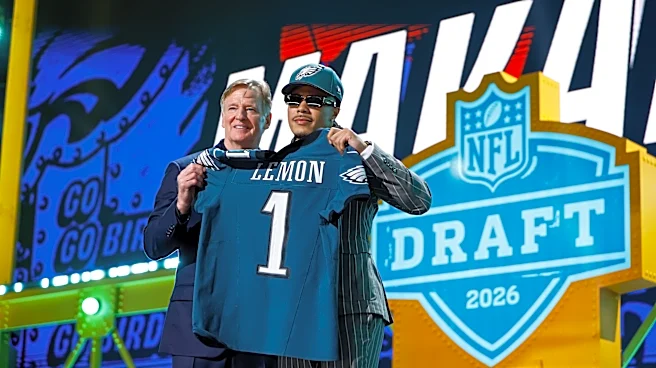
Philadelphia Eagles: Saquon Barkley continues to decline, exposing Jalen Hurts, who struggles mightily with Makai Lemon learning the ropes as A.J. Brown’s de facto replacement.
Washington Commanders: Jayden Daniels pulls a C.J. Stroud with back-to-back disappointing seasons following an Offensive Rookie of the Year campaign as the Commanders fall well short of the playoffs again.
NFL league links
Articles
ESPN
Chiefs’ Patrick Mahomes on track to participate in first OTAs
Andy Reid said Saturday quarterback Patrick Mahomes is on track to participate alongside his teammates, even if it’s in a limited capacity.
Mahomes is continuing to progress well in his rehab after he had surgery in December to repair a torn ACL and LCL in his left knee, according to Reid. The Chiefs are scheduled to have their first three OTAs May 26-28.
He is in a good position to be able to do some things,” Reid said of Mahomes. “If he can do some things, [he’ll do it]. Phase 2 [of the offseason program], remember, there’s no contact and there’s no offense versus defense. It’s Phase 3 that you get into that. … He’s in a position where he can do everything, I think.”
Pro Football Talk
Fernando Mendoza learning to play from under center for the first time in the NFL
Raiders rookie quarterback Fernando Mendoza was in the shotgun for almost every snap he took in college. That won’t be the case in the NFL, and when he took the practice field for the first time at rookie minicamp, that was a major adjustment.
“It’s the added footwork. Instead of being back there in shotgun, you really have to get back to make sure you get depth,” Mendoza said. “Still be on time, still decipher the defense. And with that, it’s really having an emphasis on those first two steps, on securing the snap and getting out out of there and powerful with having quick feet.”
Mendoza said he has heard plenty about making that adjustment from head coach Klint Kubiak, offensive coordinator Andrew Janocko and quarterbacks coach Mike Sullivan.
Discussion topics
EinPressWire
Dallas County Jury Returns $140 Million Verdict in Davis v. NCAA
A Dallas County jury returned a verdict of 30 million dollars this morning in the case of Davis v. NCAA, in the District Court of Dallas County, Texas. The compensatory verdict follows a six-year proceeding. J.T. Davis, who played football for SMU in the 1950s, died after an almost two-decades long battle with CTE dementia.
His wife Karol Davis quit her job to care for J.T., suffered a stroke, and passed away before the trial. J.T.’s son, John Mark Davis testified at trial about the toll CTE took on his father. “Players like my dad should have been warned about the risks of playing college football, and the NCAA should have done more to study the issue,” said John Mark Davis.
According to evidence introduced by plaintiffs at trial, plaintiffs alleged that NCAA leadership was aware of the long-term consequences of repetitive head trauma, including CTE, and did not warn players such as Mr. Davis. Plaintiffs further alleged that the NCAA did not follow a provision of its own constitution requiring it to study sports. Trial exhibits introduced by plaintiffs included internal NCAA documents which, plaintiffs argued, indicated that NCAA medical experts had information dating back to the 1930s regarding progressive neurodegenerative disease in college football players.
At trial, the NCAA argued that there is a lack of evidence that CTE is caused by repeated head hits and disputed that CTE causes symptoms. The NCAA stated that CTE is a “hypothetical” disease. Plaintiffs introduced internal communications attributed to former NCAA Chief Medical Officer Dr. Brian Hainline that, plaintiffs argued, addressed CTE-related clinical symptoms and the risk profile of college football players.
On Monday, April 27, Dallas County jurors added 110 million dollars in punitive damages in an attempt to force the NCAA to tell the truth about CTE.