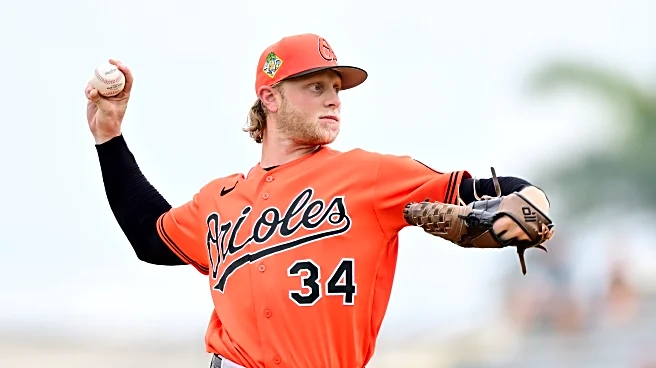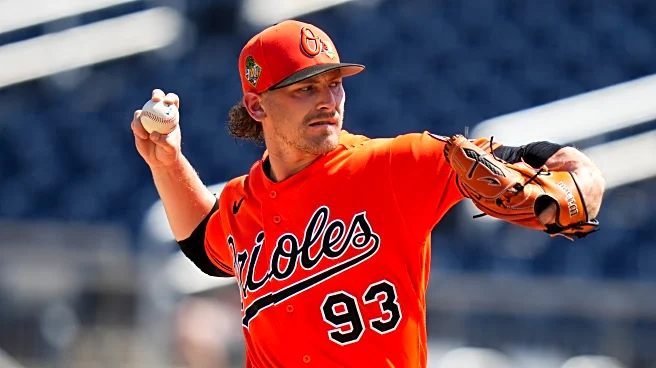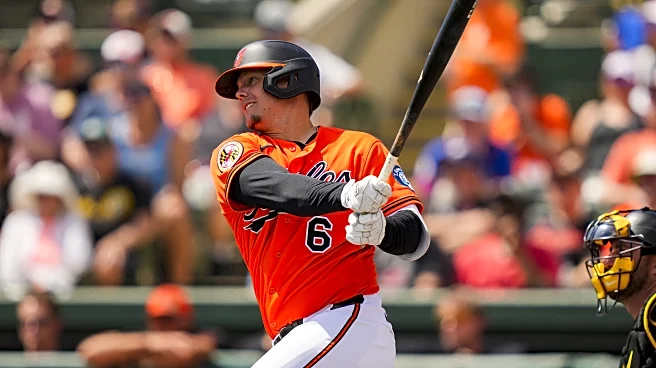

Five years ago, the only thing that mattered in the Orioles organization was the farm system. Would the team be able to develop a core that could compete, year in and year out? After the team stumbled a year ago, this question remains unanswered. With how Mike Elias has used his farm system lately, the role the prospects will play could be to supplement (or, in time, replace) the current core of players or they might be traded for more established major leaguers.
We have already seen both of these
in action for the 2026 roster. The two top prospects below, Samuel Basallo and Dylan Beavers, are ticketed for the Opening Day roster, with the Orioles having hope that they will compete for the AL Rookie of the Year award and qualify the team for a bonus draft pick. Several other prospects who might have otherwise made this list were traded for Shane Baz, and one was even included in the deal for Blaze Alexander.
My two big questions for the farm this year: Can they finally look like they’re going to develop some successful major league pitchers? Can the top of the 2024 draft class revive from its severe misfortunes of a year ago?
This ranking is a composite made up of five different prospect lists. Four of the lists are from mainstream national publications: Baseball America, Baseball Prospectus, The Athletic, and MLB Pipeline. One list is local, coming from the Orioles prospect enthusiasts of the On The Verge podcast and Substack. As has been the case for a few years, FanGraphs has not produced an Orioles list in time for inclusion in this ranking.
The composite list takes each ranking on the separate lists and averages them together. The ranking below is the direct result of that average. The #1 prospect – Samuel Basallo unanimously, for a second year in a row – is a 1, #2 is a 2, all the way down to 20. Anyone not ranked 1-20 gets a 26 for the purpose of this average. Baseball Prospectus’s list this year is only 15 names, so for that one I have made anyone not ranked 1-15 at 26.
There’s been a good bit of turnover since last year’s list. The top 10 from a year ago has seen one prospect graduation (Coby Mayo), one trade (Michael Forret), and three guys who sank because they stunk (Vance Honeycutt, Chayce McDermott, Griff O’Ferrall). As you’ll see, some new arrivals have debuted highly, while others who’ve been around for a couple of years have worked their way closer to the top.
More turnover is coming, since we can count on Basallo and Beavers at a minimum to graduate from prospect status soon after the season begins. I think that trades will impact this list one way or another as the season goes along as well.
#1 – C Samuel Basallo
- Likely starting level: MLB
- Age (on July 1, 2026): 21
- How he got here: International amateur signing, January 2021
- Where he ranked last year: #1
- Chances of seeing him on the Orioles this year: As close t0 100% as anything in this world
- What’s his deal? (from Baseball America)
Basallo boasts elite bat speed and generates significant power to all fields thanks to his advanced bat-to-ball skills. As he continues to mature and gain experience at the plate against higher-level pitching, he is improving at swinging at pitches he can drive rather than ones his contact ability will allow him to get to. … His flexibility and mobility are good for a catcher of his 6-foot-4, 250-pound dimensions. Basallo’s progress toward mastering the mental and game-calling side of the position, and his consistency in his receiving, will determine his viability at the position.
#2 – OF Dylan Beavers
- Likely starting level: MLB
- Age (on July 1, 2026): 24
- How he got here: 2022 draft (CBA round)
- Where he ranked last year: #6
- Chances of seeing him on the Orioles this year: See previous entry
- What’s his deal? (from MLB Pipeline)
Beavers really figured things out this past year. He cut down his swing-and-miss and did a lot more damage with fastballs compared to his 2024 campaign. He also was much more impactful in zone … Beavers runs very well and has shown he can be a very efficient basestealer … He has the chance to fit the profile of an athletic run-producing right fielder with a strong arm well.
#3 – OF Nate George
- Likely starting level: High-A Frederick
- Age (on July 1, 2026): 20
- How he got here: 2024 draft (16th round)
- Where he ranked last year: Unranked
- Chances of seeing him on the Orioles this year: Zero
- What’s his deal? (from Baseball Prospectus)
George will stick in center field and offers an above-average, hit-over-power offensive projection. He flashes power potential though, and his bat speed beats out his actual present exits, as he can be content to work the opposite field, or stay back on offspeed and try to send it back up-the-middle. Those are already impressive tools to see in a 19-year-old prospect’s belt … average power will come for George as he both gets stronger and swings with more intent.
#4 – C/OF/? Ike Irish
- Likely starting level: High-A Frederick
- Age (on July 1, 2026): 22
- How he got here: 2025 draft (1st round)
- Where he ranked last year: Not in system yet
- Chances of seeing him on the Orioles this year: Zero
- What’s his deal? (from BA)
Irish controls the strike zone well, has good bat speed and feel for the barrel and rips line drives to all fields when he’s at his best. He uses his whole body and keeps the bat in the zone well. That profile makes him a potentially above-average hitter with above-average power … The Orioles plan to have him catch while rotating in at first base and right—where his plus arm shines—but he’ll need to improve his blocking and framing as he develops in pro ball to have a future at the position.
#5 – RHP Trey Gibson
- Likely starting level: Triple-A Norfolk
- Age (on July 1, 2026): 24
- How he got here: Undrafted free agent, 2023
- Where he ranked last year: #15
- Chances of seeing him on the Orioles this year: 50/50; more optimistic people would give you a higher number
- What’s his deal? (from BP)
The 6-foot-5 righty shows a bunch of different looks to batters but mostly works off his four-seam and sinker, both of which sit in the mid-90s. He gets good extension on his fastballs, and while his four-seam is pretty generic, his sinker does show good sink and armside movement … Gibson has a a deep repertoire and while nothing may be out and out plus, he should be able to navigate a lineup of lefties and righties multiple times.
#6 – SS Wehiwa Aloy
- Likely starting level: High-A Frederick
- Age (on July 1, 2026): 22
- How he got here: 2025 draft (compensation pick after 1st round)
- Where he ranked last year: Not in system yet
- Chances of seeing him on the Orioles this year: Zero
- What’s his deal? (from On The Verge)
Questions about the hit tool may have left some teams docking him a bit, but there’s strong belief that Aloy’s hit tool can progress with better pitch recognition. He’s a large, physical presence who has all the tools necessary to stick at shortstop as he develops the power to hit 20+ home runs a season as one of the better shortstop defenders, if all development goes well, of course. That’s an uber attractive profile, even if he’s a .240 or so hitter.
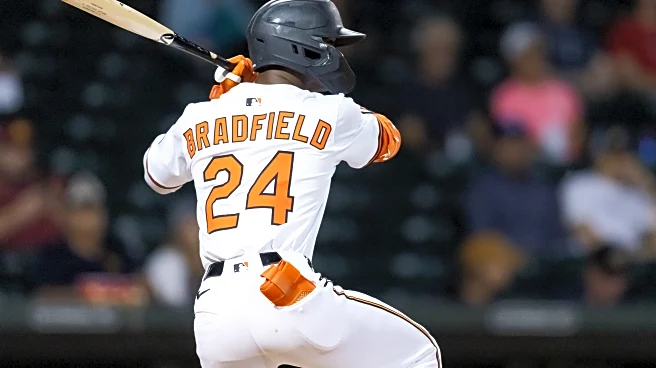
#7 – OF Enrique Bradfield Jr.
- Likely starting level: Triple-A Norfolk
- Age (on July 1, 2026): 24
- How he got here: 2023 draft (1st round)
- Where he ranked last year: #3
- Chances of seeing him on the Orioles this year: 40%
- What’s his deal? (from Pipeline)
Bradfield’s carrying tool is his 80-grade speed, a game-changing tool that instills nightmares in pitchers and catchers alike. It colors him as a kind of throwback table-setter, with excellent contact skills, little pop, and a penchant for laying down bunts and legging out infield hits. … He doesn’t drive the ball with much authority, but he can be an impact offensive player if he consistently hits line drives and continues to slash his ground-ball rate.
#8 – RHP Esteban Mejia
- Likely starting level: Low-A Delmarva
- Age (on July 1, 2026): 19
- How he got here: International amateur signing, January 2024
- Where he ranked last year: Unranked
- Chances of seeing him on the Orioles this year: Zero
- What’s his deal? (from BP)
Mejia has about the best arm speed of any 18-year-old pitcher you will find. The fastball shape and command is inconsistent, and he throws both a sinker and four-seam at present, but there’s the potential for a ride and run four-seam from a lower release slot. That would miss plenty of bats at higher levels—the pure velocity will suffice at the complex and A-ball ones—but Mejia isn’t a mere velocity merchant at present either … he has a rather advanced change-up for a teenager that throws 100 mph, a power pitch that can dive below bats.
#9 – LHP Luis De León
- Likely starting level: Double-A Chesapeake
- Age (on July 1, 2026): 23
- How he got here: International amateur signing, December 2021
- Where he ranked last year: #11
- Chances of seeing him on the Orioles this year: 10%
- What’s his deal? (from BA)
De León’s raw stuff has always been among the best in the Orioles’ system. He boasts a four-seam fastball and two-seamer in the 95-98 mph range that yields a ton of weak, grounded contact. … De León’s command has always been inconsistent, but he has good zone rates with his fastball, suggesting it’s a trait that can continue to improve. Even in the zone, De Leon is hard to square up. He didn’t allow a home run in 87.1 innings in 2025.
De León would have ranked higher on this list except he was left off of Baseball Prospectus’s top 15 list, an outlier among these other rankings. The BP writer who left off De León said “he’s always been very relieverish, so he’s not quite fourth starter enough or close enough as a pen arm.”
#10 – LHP Boston Bateman
- Likely starting level: High-A Frederick
- Age (on July 1, 2026): 20
- How he got here: O’Hearn/Laureano trade with Padres, July 2025
- Where he ranked last year: Not in system yet
- Chances of seeing him on the Orioles this year: Zero
- What’s his deal? (from Pipeline)
Bateman’s stuff befits the enormous high-makeup package it comes in. His fastball can live in the low-to-mid-90s and touched 98 mph during his debut, part of a four-pitch mix that features a pair of breaking balls. … he is seen as having the aptitude to tackle his developmental needs and potentially add pitches to that mix with time. … He still has work to do overall to get to average control, though if he gets there, he’ll look like a mid-rotation starter given his ability and pitch mix.
#11 – RHP Nestor German
- Likely starting level: Triple-A Norfolk
- Age (on July 1, 2026): 24
- How he got here: 2023 draft (11th round)
- Where he ranked last year: #8
- Chances of seeing him on the Orioles this year: 45%
- What’s his deal? (from BP)
Another Orioles pitching development success story … German wasn’t particularly good (at Seattle University) … He’s missed plenty of bats in the pros though. … German’s four-pitch mix makes him a likely starter.
#12 – RHP Braxton Bragg
- Likely starting level: Double-A Chesapeake (injured list)
- Age (on July 1, 2026): 25
- How he got here: 2023 draft (8th round)
- Where he ranked last year: Unranked
- Chances of seeing him on the Orioles this year: Zero
- What’s his deal? (from BA)
Bragg added a couple ticks of fastball velocity and a new changeup and was promoted out of High-A Aberdeen to Double-A Chesapeake after just three dominant starts. He ended up with a 1.68 ERA and 11.75 strikeouts per nine with a 1.000 WHIP in 59 minor league innings before requiring Tommy John surgery. … Bragg’s kick-changeup, a new addition in 2025, is at least above-average and flashes plus. That’s another bat-misser added to a mix that also includes an above-average sweeper and cutter.
#13 – IF Aron Estrada
- Likely starting level: Double-A Chesapeake
- Age (on July 1, 2026): 21
- How he got here: International amateur signing, January 2022
- Where he ranked last year: Honorable mention
- Chances of seeing him on the Orioles this year: 2%
- What’s his deal? (from On The Verge)
Estrada has shown strong bat-to-ball skills (since his pro debut) … added strength, muscle, and bat speed have brought out more power in his game … With a near 80% contact rate, the ability to steal bases at a high clip, and growing power, or at least more impact on his contact to drive more balls into the gaps, Estrada has emerged as a prospect of note … The groundball rates have improved, but are still high, and he doesn’t have a firm defensive home.
#14 – LHP Joseph Dzierwa
- Likely starting level: Low-A Delmarva
- Age (on July 1, 2026): 22
- How he got here: 2025 draft (2nd round)
- Where he ranked last year: Not in system yet
- Chances of seeing him on the Orioles this year: Zero
- What’s his deal? (from Pipeline)
Dzierwa showed real ability to limit walks in college and can pinpoint his entire arsenal wherever he wants, pounding the strike zone and also working the edges well. In terms of total package, it’s a lot to work with. His foundation of size, two potentially plus pitches and command gives him one of the highest floors in the Orioles system as an almost surefire starter, with the development of a reliable breaking pitch determining whether that’s in the middle or the back-end of a big league rotation.
#15 – RHP Juaron Watts-Brown
- Likely starting level: Double-A Chesapeake
- Age (on July 1, 2026): 24
- How he got here: Domínguez trade with Blue Jays, July 2025
- Where he ranked last year: Not in system yet
- Chances of seeing him on the Orioles this year: 1%
- What’s his deal? (from BA)
Watts-Brown can pitch in the big leagues in some capacity simply because of his slider, but a starter’s role depends on improving his fastball, be it a different shape or adding velocity, to help him get deep into games at the highest level.
#16 – RHP Levi Wells
- Likely starting level: Triple-A Norfolk
- Age (on July 1, 2026): 24
- How he got here: 2023 draft (4th round)
- Where he ranked last year: Unranked
- Chances of seeing him on the Orioles this year: 20%
- What’s his deal? (from BP)
Wells is currently a starter, but his best fit is in the pen, where he can air out his upper-90s fastball and roll out a cutter and sweeper behind it. This may or may not come in 2026 though, as he’s likely earned a shot to prove the control and command won’t make him another future fourth starter.
#17 – OF Jordan Sanchez
- Likely starting level: Low-A Delmarva
- Age (on July 1, 2026): 20
- How he got here: International amateur signing, December 2023
- Where he ranked last year: Unranked
- Chances of seeing him on the Orioles this year: Zero
- What’s his deal? (from Pipeline)
The bat is the carrying tool for Sanchez, a left-handed-hitting outfielder with tremendous raw pop … When Sanchez connects, he hits the ball hard and rarely puts it on the ground. But there is real swing-and-miss alongside the exit velocity and on-base ability, with Sanchez running a 25 percent career strikeout rate in the low Minors. … He needs to refine his approach and prove he can hit advanced pitching as he climbs the system.
#18 – OF Thomas Sosa
- Likely starting level: Double-A Chesapeake
- Age (on July 1, 2026): 21
- How he got here: International amateur signing, January 2022
- Where he ranked last year: Honorable mention
- Chances of seeing him on the Orioles this year: Zero
- What’s his deal? (from BA)
Sosa has the makings of a prototypical slugging corner outfielder thanks to his hard contact ability. … His swing decisions and the swing-and-miss in his game will influence how much of his plus raw power Sosa can get to in a game, and he may end up a below-average hitter as a result. Defensively, Sosa has played some center field but profiles more as a right fielder thanks to average speed and a plus arm.
#19 – RHP JT Quinn
- Likely starting level: Low-A Delmarva
- Age (on July 1, 2026): 22
- How he got here: 2025 draft (2nd round)
- Where he ranked last year: Not in system yet
- Chances of seeing him on the Orioles this year: Zero
- What’s his deal? (from Pipeline)
Quinn is a 6-foot-6 power righty. … He has a much better grip on his fastball command (compared to off-speed pitches) as he’s able to run that pitch past hitters up in the zone or throw it with downhill plane toward the bottom of the zone to induce ground balls. … Quinn also operates exclusively from the stretch — all of which gives him the look of a power reliever who would be best running his raw stuff wild in short sprints.
#20 – RHP Anthony Nunez
- Likely starting level: Triple-A Norfolk
- Age (on July 1, 2026): 24
- How he got here: Mullins trade with Mets, July 2025
- Where he ranked last year: Not in system yet
- Chances of seeing him on the Orioles this year: 95%
- What’s his deal? (from BA)
Nunez’s pitch mix is the type one would draw up when designing a modern pitcher … His control is good enough for a high-leverage role—he closed games at Double-A and Triple-A—but he needs to dial in the strike zone in 2026 to ensure that is the case. … Nunez could be the next (unheralded pitcher) they put into a high-leverage role in relief.
Honorable mentions
These players appeared on at least one of the lists but did not have sufficient support to crack the composite top 20. July 1 age is in parenthesis.
RHP Chayce McDermott (27) (from BP)
McDermott can touch 99 and has a suite of swing-and-miss secondaries he can deploy. His change has been one of his better ones too, so he can handle multi-inning work with multiple lefties. The walks are still a problem in the pen, but if the stuff plays up a bit, he could settle into a useful relief role.
C/1B Ethan Anderson (22) (from BA)
Anderson has the potential to be an average hitter thanks to his combination of plate discipline and contact skills … He’s still growing into his ability to impact the ball in-game, which might ultimately limit his offensive upside and keep him from having more than fringe-average game power. That profile will mean he’ll have to continue what was meaningful improvement behind the plate
RHP Tyson Neighbors (23) (from Pipeline)
The 6-foot-2 Neighbors looks like a potentially electric closer who could move quickly. … Neighbors is energetic and fiery on the mound, having long grown comfortable pitching in high-leverage situations. He doesn’t issue too many walks for a relief prospect and trusts his stuff enough to work it outside the zone, where it gets whiffs.
SS Wilfri De La Cruz (18) (from BA)
De La Cruz has an attractive offensive profile for several reasons: his swing decisions and lack of whiffs with elevated contact from both sides of the plate give him a chance for an average hit tool moving forward. … He is also an above-average runner who can be an average defender at shortstop but would fit fine at third base if he outgrows short, given his plus arm.
C Andrew Tess (19) (from On The Verge)
With a strong eye at the plate (17.6% BB rate last season), sneaky speed (18 stolen bases), and a good bit of raw power in the bat, Tess’s offensive performance as an 18-year-old, first-year pro catcher was eye opening and a fun setup for a potential breakout in 2026.
OF Stiven Martinez (19) (from Pipeline)
Martinez shows better on-base ability and can hit the ball harder than most players his age. At 6-foot-4 and nearly 200 pounds, he’s strong and athletic and capable of producing 90th percentile exit velocities as high as 108 mph, which hint at a chance at plus raw power. Martinez generates similar hard-hit metrics as Samuel Basallo did at his age and can drive the ball to all fields.
SS Colin Yeaman (22) (from Pipeline)
Yeaman brings a strong track record of hitting to the Orioles organization. He’s adept at finding the barrel, doesn’t chase and draws walks. He can really punish fastballs, and he puts up good in-zone contact numbers … He’s a fringy runner who likely won’t be a basestealing threat at the next level.
C/1B Creed Willems (23) (from On The Verge)
While the bat struggled through the first few years of his career, Willems has dedicated himself to his craft and is coming off a 118 wRC+ season at Double-A during his age 21/22 season. The power has never been in question (50 HR last three seasons), but the significant drop in strikeouts as he’s moved up the ladder has been comforting.