



It’s January 2, and I’m sitting in front of my computer with a Salad And Go coffee in hand. Yeah, I like their cold brew. I’m a price-for-value paid guy, and they win that race every time.
An idea has hit me that is ambitious. It is messy. It is absolutely going to take time. Probably the type of thing that belongs in the Suns’ offseason or tucked neatly into the All-Star break when the calendar finally exhales. So that’s the plan. Start it now. Let it breathe. Revisit it through the first few weeks
of 2026. Poke at it. Argue with myself. Change my mind. Repeat.
The subject is the Phoenix Suns All-Time Pyramid.
So what is the Phoenix Suns All-Time Pyramid? Think Bill Simmons and the Book of Basketball. Think his Hall of Fame logic. Now drop that framework into the 58-year history of the Phoenix Suns. This is about identifying the 21 best players to ever wear a Phoenix uniform out of the 453 who have donned the purple and orange and arranging them into a six-level pyramid.
Why a pyramid? Because it forces clarity and allows movement. Players are not locked into a rigid ranking. They live in tiers. And if you know anything about SunsRank, you already know how I feel about tiers. And it makes for a nice-looking graphic.

Let’s start with the levels.
- The Face of the Franchise
- MVP Royalty
- Franchise Pillars
- Era-Defining Stars
- All-Star Impact
- Core Contributors
I think these work. As I’ve gone through my list over the past month and a half, building tiers and defining what it takes to be in each one, this is where I’ve landed. You might have a different version with different differentiators and different criteria. I look forward to hearing how you would have navigated this process. This is how I’ve navigated mine.
As I started digging into who the 21 best players actually were, I already knew I was going to run headfirst into some baseline rules. Think of them less as hard laws and more as gatekeepers. Each tier has its own bouncer. Some rules help you qualify. Others quietly escort you out the door.
It is not mandatory to have a clean statistical cutoff for every tier, but thresholds matter. Sometimes, they are the difference between getting in and being left out. Take Tier 3 of the Suns Pyramid, the ‘Franchise Pillars’. Every player in that tier lives in the Ring of Honor. More importantly, every one of them spent over a decade in Phoenix. 10+ years is the line if you want to make it into tier three. If you do not cross it, you do not get through.
But it’s not necessarily exclusive, because a player in my top two tiers (I bet you can guess who that is) wasn’t in Phoenix for 10+ years. So the tiers themselves might be gatekeepers, but it isn’t that clean. There can be exceptions to the rule if the braintrust determines it to be so. And since I am the braintrust, I’m granting a special exemption.
Another rule has to be crystal clear from the jump. This is not a lifetime achievement award for famous names passing through town. This is about impact in a Suns uniform. It’s about what you did here and how much you moved the needle while wearing purple and orange.
Gale Goodrich is a quality example. He was a five-time All-Star, NBA champion, and Hall of Famer. Quite the impressive resume for Mr. Goodrich. He also played just two seasons in Phoenix from 1968 to 1970. He made an All-Star team here, but his real imprint on the league was stamped in Los Angeles. Same conversation with Shaq. Fifteen-time All-Star. Four championships. Two scoring titles. Fourteen-time All-NBA. A walking monument to dominance. He also spent two seasons in Phoenix. One All-Star appearance. A memorable stretch, sure, but not a defining one.
And that is the point. This pyramid is not grading careers. It is grading Suns chapters. Time spent matters. Impact matters. The totality of what you did elsewhere does not.
So no, Gale Goodrich is not making the Phoenix Suns All-Time Pyramid. Neither is Shaq. Not because they were not great. Because this is about Phoenix. And only Phoenix.
To be in Tier 5 or above, you need to be an All-Star, and a multi-time All-Star at that. There have been some fun role players in Phoenix, and there’s plenty of room for them in Tier 6, but to be considered one of the greatest ever, you need to have represented Phoenix in an All-Star Game, thus serving as an ambassador of the city abroad.
You want another rule? Fine. Let’s make it a petty one. Kevin Durant played 145 games in a Suns uniform. So here it is, officially, unscientifically, and with a straight face. The KD Rule. To be eligible for the Suns Pyramid, you must have appeared in 146 or more games with the franchise. Why 146? Because that is one more than Kevin Durant. That is the line. That is the bar. Cross it and we can talk. Fall one game short and you are a footnote. Shaq played in 103 games, so he fell victim to the KD Rule as well.
Is it petty? Absolutely. Is it arbitrary? Without question. Is it also perfectly on brand for a project like this? 100%.
It’s harder than it sounds. I am not even sure why I landed on 21 players instead of 15, which would be clean and orderly and way easier to explain. But once you factor in that there are already 12 players sitting in the Ring of Honor, 15 does not leave much oxygen in the room. And honestly, I want oxygen. I want friction.
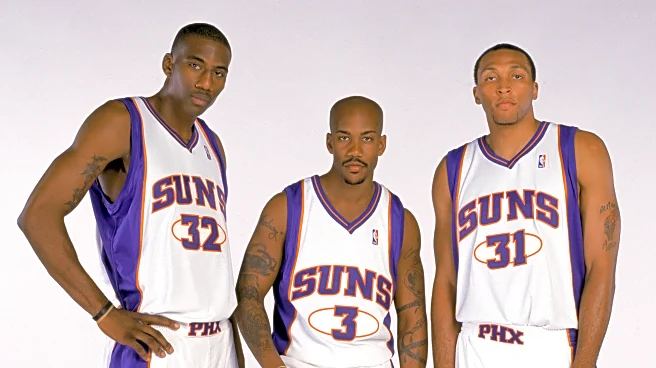
That is the point of this whole thing. I want debate. I want the back and forth. I want this to be a community exercise where people can argue tiers, move guys up or down, and make the case for who belongs or who got snubbed entirely. I know my biases are going to show. I’m not a big Deandre Ayton guy. I love Stephon Marbury. Will they make the pyramid? You’ll have to read to find out.
This is subjective by design. It is also fluid, for these things evolve. Maybe one day a player like Collin Gillespie works his way up the list. That sounds wild now, and maybe it stays that way. Time is the real author here. All I am doing is putting the framework on the page.
So that is the plan. That is the goal. With the All-Star break as the runway, we have the time to let this breathe. To roll it out slowly, one layer at a time. No need to rush it, no dumping it all in one day.
I will start by laying out the six levels of the Phoenix Suns All-Time Pyramid. From there, you can probably guess where I am headed with certain players. That part is unavoidable. But there is real debate to be had, especially in the bottom three levels.
Starting tomorrow, we will begin unveiling each level. Let this journey begin.