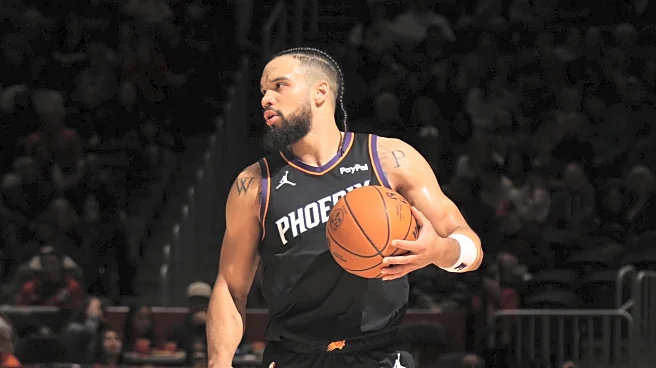

Arriving this summer with the heavy task of replacing Kevin Durant, the Canadian — long criticized around the NBA for his style and his loud mouth — is somehow nailing the assignment. Sure, it’s less lethal
and less flashy than the Slim Reaper, but his impact on the game, the locker room, and the team’s culture is undeniable. I said it, I hoped for it: that he would take a step forward.
And after 32 games, 26 of which he has played in, we can safely say we’re watching the best version of Dillon Brooks we’ve ever seen.
What do the statistical trends show?
In an offensive role with far more responsibility, Dillon Brooks is posting a career‑high Usage Rate at 27.2%, a +10% jump compared to his last two seasons in Houston. And he’s having his biggest volume season ever: over 17 field‑goal attempts per game, including 7.2 from three.
Typically, when usage increases, efficiency decreases. But for Dillon, that’s…not really the case. Well, not entirely. His overall efficiency has reached a new peak with 57 TS% and 97 TS+. It’s below league average, but for a guy taking 15+ shots a night, that’s honestly not bad.
Where he’s really exploded is inside the arc: 55% on two‑pointers this season compared to 49% for his career. Free throws and threes follow the classic rule — more shots, less efficiency — but again, nothing catastrophic. The paradox is that he’s actually better on “bad shots”: 46% midrange frequency for 50% accuracy (90th and 78th percentile in the NBA). Meanwhile, he’s finishing at 73% in the restricted area…but only goes there 15% of the time.
So what’s causing these changes?
First, his new role.
He’s no longer a secondary option or a guy waiting in the corner or at 45°. He’s a primary ball‑handler, right next to Devin Booker. I’m not teaching you anything here: Dillon Brooks is our second offensive option this season. You may applaud this analysis: more usage means more shots. Very good Pano.

Then, there’s the guy who left, the greatest midrange shooter in NBA history. Kevin Durant in Phoenix was taking 55% of his shots from midrange and hitting 52% of them. And on top of that, our offensive style has radically changed: less isolation, less static sets, less star‑system basketball. More ball movement, more motion offense, more good‑quality threes, and a better rim frequency, something we had lost since Ayton left.
Put all of that together, and Dillon ends up inheriting the spots KD left behind. And it’s not just a visual impression or a narrative bias: the Suns’ 2025‑26 season confirms this exact redistribution of responsibilities.
With Durant gone, Phoenix lost its midrange metronome, the guy who could create a clean shot at any moment. And even though the offense has modernized with more movement, more drive‑and‑kick, more spacing, the system still naturally produces possessions where someone has to punish the defense in the in‑between areas. Those shots don’t disappear. They just change hands. And the hand taking them now belongs to Dillon Brooks.
In short, Brooks didn’t replace Durant’s talent, but he replaced his function. And in the Suns’ 25‑26 offensive context, that’s exactly what the team needed.
And defensively, where does Dillon Brooks stand?
If his offense surprises, his defense reassures. And more than that: it structures the team.
Since he arrived, Phoenix has regained something it hadn’t really had since Mikal Bridges: a wing who takes the opponent’s best perimeter player every single night without ever backing down.
His “matchup difficulty” and “defensive positional versatility” scores say it all: 99th and 97th percentile this season. Behind the provocative persona hides one of the most versatile defenders in the league, with a defensive task list as long as a Christmas Eve grocery list.

Looking at his 25 main matchups this season (based on possessions defended), Dillon Brooks has battled stars like LeBron James, Trey Murphy, Anthony Edwards, James Harden, SGA, and even Amen Thompson; players with wildly different profiles and roles. It highlights his defensive versatility and his reputation as a guy who refuses no challenge, whether it’s a slasher, a creator, or the MVP of the league.
What stands out the most isn’t just his individual level — which is no longer up for debate — but the contagious effect he has on the group. The Suns defend harder, longer, and more collectively. Rotations are sharper, closeouts more aggressive, communication louder. Brooks is a constant reminder that this team wants to win through effort, discipline, and physicality.
Dillon Brooks isn’t just having the best season of his career. He’s having the season that redefines who he is, and who the Suns want to be. At almost 30 years old, players don’t “progress” in the traditional sense anymore. The evolution comes from details, from role changes, from decision‑making. And Dillon Brooks chose to put himself at the service of the collective.
Because what represents him best isn’t his game, his trash‑talk, or even his defense — it’s his ability to change the culture of a team.