






For all of the mythical greats that litter the history of Yankees Baseball, there is also a healthy list of characters, people who may not have been legends, but who nonetheless who have defined the franchise’s path over more than a century. Near the top of that illustrious list for the Bombers stands Billy Martin.
When the weight of one’s name far outweighs any on the field contributions they made, it’s likely that something either went really right, or really wrong. In the case of Billy Martin,
it was a little bit of both. A decent player in his own right, and an enigmatic manager who left it all on the field, Martin made a significant mark on the Yankees, particularly during his days as a manager — and conflicts with both owner George Steinbrenner and superstar Reggie Jackson. Between a preposterous number of hirings and firings, World Series wins, and moments of controversy, his time with the Yankees could certainly be described as memorable. The story of the Yankees could not be told without him.
Alfred Manuel “Billy” Martin, Jr.
Born: May 16, 1928 (Berkley, CA)
Died: December 25, 1989 (Johnson City, NY)
Yankees Tenure: 1950-57 (Player), 1975-78, 1979, 1983, 1985, 1988 (Manager)
Born in the late 1920s in California, Billy Martin was primarily raised by his mother and grandmother following his parents’ split. It was a tough childhood, but sports were a refuge. He made his first mark on professional baseball with Oakland in the Pacific Coast League, before being sent to the Yankees in 1949. By the time the 1950 season rolled around, Martin had made it to the big leagues, where he was reunited with his former skipper in Oakland, Casey Stengel.
Martin would stick around for a while, and although he wasn’t ultimately known for his talents on the field, he remained a part of Major League Baseball for the better part of four decades — with his most significant moments coming with the Yankees.
In his playing days, Martin began in a part-time role, playing in less than 100 combined games in the 1950 and ‘51 championship seasons. A pinch-running cameo in ’51 stood as his only playoff experience. But, in ‘52, Stengel gave the kid—who he was quite fond of—a larger opportunity, and would quickly become a regular contributor for the club. After 400 solid plate appearances and 2.6 fWAR in that ‘52 campaign, Martin had his first memorable postseason series, hitting just his fifth career homer against Brooklyn in a Game 2 win and then bailing out the Yankees’ infield in Game 7 with a heads-up catch on a bases-loaded popup in the seventh by Jackie Robinson that no one wanted to claim.
In 1953, Martin established himself with perhaps the best season of his career. He played in a career-high 149 games, hit a high-water mark with 15 homers while working out to a roughly league-average producer with the bat. As the Yankees won their fifth consecutive championship, Martin had one of the all-time best series performances by setting a then-record for hits with 12 (including two homers), capped by a walk-off single up the middle against Clem Labine in the Game 6 clincher, scoring Bauer.
Despite reaching his peak as a player, the Yankees’ second baseman would miss the majority of the next two seasons due to military service.
Martin returned for full-time play in the 1956 season, and was able to enjoy mostly the same level of production. Although he played in just 120 games in that return season, Martin was rewarded with his first and only All-Star selection, and he later homered twice in the Subway Series against Brooklyn, avenging a rare championship loss in ’55. After a troubling start to the 1957 season, Martin was shipped off to the Kansas City Athletics. General manager George Weiss didn’t like the way he caroused around the City with the likes of star pals Mickey Mantle and Whitey Ford, and when the “Copacabana Incident” led a fight at a nightclub, Weiss was seemingly quick to scapegoat Martin — even though Bauer was reportedly one of the instigators. While the heartbroken Martin’s playing days were over in New York, his story within the organization’s history had barely begun.
After a handful of seasons bouncing around six different clubs, Billy Martin’s time as a big-league player came to a finish after the 1961 campaign. Despite this, Martin would never stray far from the game, working initially as a scout and eventually as a coach for his final team, the Twins, throughout the 1960s. At the end of that decade, Martin got his first taste of managing a team. In a sign of things to come, he won 97 games and a surprising division title for Minnesota, but he was also dismissed anyway following a fight with one of the team’s pitchers.
In 1971, Martin was given the helm of the Tigers, who had won a World Series just a couple years prior but quickly stumbled under .500. Martin oversaw an improvement to 91 wins, and then an AL East crown in ’72 before wearing out his welcome with management the following year. Given a 105-loss Rangers club, Martin turned them around to 84 victories, a 27-win improvement that earned him his first of four Associated Press AL Manager of the Year honors. (The modern BBWAA edition was not introduced until 1983.)
Martin feuded with the Rangers’ front office in ’75 and was fired in July with them under .500. It was a blessing in disguise, as his beloved Yankees came calling.
Unsurprising to anyone who noted the five distinct stints of managing for Martin with the Yankees, “smooth sailing” would not be the phrase to describe his time managing the Yankees. While his time in the position always brought news, both good and bad, it was hard to deny his success, especially early on. In 1976, his second season managing the Yankees, they won the American League pennant, and a year later, they captured the lone World Series win of his managerial career.

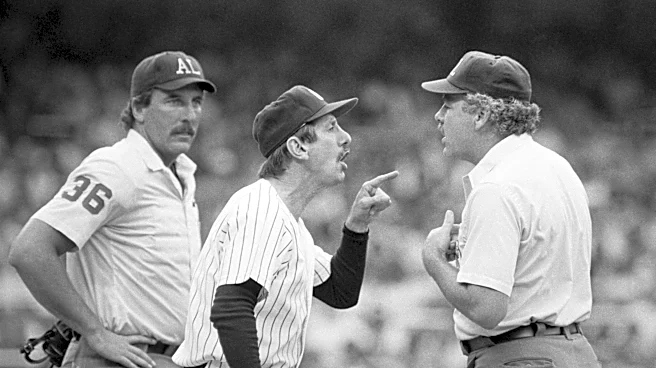
Martin’s ways as a manager were perhaps never as apparent as they were in his relationship with Reggie Jackson. A star for the team in the late ‘70s, Jackson had more than one public confrontation with Martin, including one that would lead to Martin’s (first) firing in 1978.
As would become a bit of a trend in the later part of his managerial career, Billy Martin was re-hired by the club to finish out the 1979 season, before beginning a three-year run managing the Athletics that began the following season.
Unable to stay away for long, Martin was hired and fired multiple times before the 1980s were over, though he was still largely successful. He won 91 games in his third stint as manager in 1983, and returned to match that number in a fourth in ‘85. His ever-evolving relationship with George Steinbrenner and the Yankees had its final chapter in a 1988 stretch as manager, his last period managing a big league club.
Having been known for issues with a short temper and a drinking problem, Martin unfortunately passed away unexpectedly in 1989 in a car accident near his home on Christmas in 1989. Despite all of his flaws, it was undeniably a loss for the Yankees and their rich history.
Billy Martin played a solid role and performed when it mattered in his playing days, and after that, cemented himself as one of the more memorable characters in Yankees’ history as their manager. All of the good and the bad considered, Martin certainly made his mark on the historic franchise, and helped to produce everything from the highly successful to the highly memorable. His would-be 98th birthday is an excellent chance to look back on the unmistakable mark he made on the Yankees and their history.
See more of the “Yankees Birthday of the Day” series here.