

The addition of a quality veteran starting pitcher in the form of right-hander Kevin Gausman may be the final move in what has been a fast paced re-tooling effort this offseason. Detroit Tigers’ president of baseball operations Scott Harris has demphasized on shoring up weaknesses rather than pursuing a lot of top shelf talent. Nothing is going to replace the loss of Tarik Skubal, but by addressing the holes in the roster that sank them in 2026, the Tigers may be in a better position to weather the kind
of storms that blew them well off course. The rest will depend on their young players improving.
Emilio Pagán is a quality high leverage relief addition, but not terribly exciting. He’s basically taking the space of Kenley Jansen as a, hopefully, more stable veteran closer. It doesn’t hurt that Pagán has already made clear that he’s not concerned with save chances and will pitch whenever they need him either. Luis Gil and Ha-Seong Kim are talented but come with huge question marks as the reclamation projects for the year. Harris, ever a Jed Hoyer disciple, loves a cheap bounceback candidate with injury and aging concerns. Someday one of them has to work out, right?
There wasn’t much to be excited about, but Kevin Gausman is bit bigger addition. Fortifying the starting rotation with a good pitcher with proven durability gives the Tigers a lot of options to convert their younger, less experienced starters into relievers, as least in 2027. The Gausman signing addresses the rotation and bullpen both. It hasn’t been a thrilling offseason and Harris remains very shy of making a big move that could turn into a big mistake, but some weak points in the roster have been fortified and they’ve built in more roster flexibility. They are still probably a big bat and another high leverage arm from really looking like a really legit contender in 2027, but if their young talent continues to develop they won’t need that much help.
The trick will be managing this roster optimally in 2027. Particularly the pitching staff. To actually bring their best 13 pitchers to bear on their major league opponents, rather than having struggling arms at the major league level that they can’t option while the Triple-A Toledo Mud Hens enjoy a stacked roster, they have to be quicker to jettison struggling veterans in favor of younger options. That type of scenario has been an issue for them in the past.
Here is the current complete 40-man roster with option status attached, plus RHP Luis Gil, SS Ha-Seong Kim, and RHP Kevin Gausman, all signed in the last few days to major league contracts. Three players still need to be DFA’d to make space for those three when their contracts become official following their physicals.
For argument’s sake, let’s assume Tsung-Tse Cheng, Brenan Hanifee, and Beau Brieske will be the three designated for assignment to get down to 40 players. The Tigers have no money committed to those three, and at this point they’re pretty easily DFA’d.
Signing Ha-Seong Kim makes Cheng entirely expendable as he’s out of options, and the Tigers have John Peck and Peyton Graham on the roster to fill in at shortstop if McGonigle, Kim, and Báez aren’t enough. They even got Trey Sweeney back on a minor league deal after designating him.
You could posit a DFA of de Jesus instead of Brieske or Hanifee, perhaps, but de Jesus has options. Brieske doesn’t. There aren’t many other choices available without releasing a player on a major league deal like Waguespack, Finnegan, or Báez, where the Tigers would just eat their 2026 salary.
On the position player side, there’s no issue here. Javy Báez or Zach McKinstry may have to be DFA’d at some point to let younger players take those spots, but it’s up to the young players to push that duo off the roster. Meadows, Carpenter, and Pérez could use a bit of Triple-A time to get back in the groove after missing much of the 2026 season, but they all have options available. Younger players like John Peck, Ben Malgeri, and Brett Callahan are knocking at the major league door after debuts of varying success in 2026, but a little more seasoning at Triple-A won’t hurt them.
On the pitching side, things are trickier when you start composing a 13-man pitching staff.
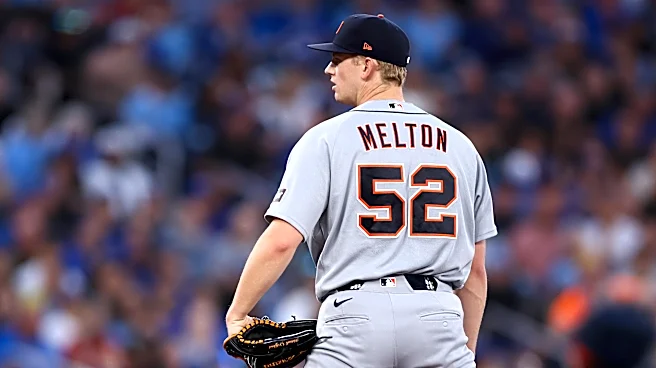
Framber Valdez, Kevin Gausman, and Troy Melton are your top three starters. The Tigers don’t have to start Melton, but we’ll take the long-term extension as a certain sign that they believe in him as a starter.
In the bullpen, you have Will Vest, Emilio Pagán, Drew Anderson, Jacob Waguespack, Luis Gil, and Kyle Finnegan, none of whom can be optioned. Gil and Anderson may compete for the final two rotation spots instead, but we’ll just pencil them in the bullpen for the moment. So, without releasing someone the 26-man roster has room for four more pitchers, two in the pen and two in the rotation. Let’s assume they’ll take at least two lefties in the bullpen, and we’ll go with Holton and Sommers. So now we have just the two rotation spots left available.
Again, just for argument’s sake, let’s bump Hanifee and Brieske off the roster for Gil and Gausman when their contracts are announced. To fill the two remaining spots in the rotation, here are your options.
Jackson Jobe
Keider Montero
River Ryan
Reese Olson
Brant Hurter
Ty Madden
Andrew Sears
Enmanuel de Jesus
Everyone in that group can be optioned, but you can only add two of them to the 26-man active roster at a time without jettisoning pitchers who don’t have options. You begin to see the potential difficulties here. Are the Tigers really going to put six of those eight pitchers in Triple-A while they try Finnegan, Waguespack, and Gil? How long will the Tigers take to adjust if players are guaranteed deals stuggle, and where is the depth remaining in the minors once moves like that are made?
There’s a fair chance that several talented pitchers will be in the minor leagues unless the Tigers are willing to eat some free agent contracts and pivot quickly if their veteran relievers struggle. And that’s really the rub here. Part of the reason that putting together a deep, homegrown group is such a good thing, as the Tigers have on the position player side, is that you have a lot of flexibility if someone struggles. That’s only helpful if you have useful prospects or Triple-A depth. The Tigers lack of pitching prospects right now creates a problem that they have to bridge in 2027 until a good crop of young pitchers nears the major leagues in 2028.
Managing all this will be a unique challenge, and we’ve seen the Tigers fail to cut bait in time on several occasions in the Harris era. With the additions of Gausman, Pagán, and Gil, the Tigers have built up a reasonably formidable and deep group of pitchers here. The trick is figuring out how to deploy this group to best effect. As we say every offseason, injuries make a lot of a team’s final roster decisions for them. It’s an extremely rare case when a team actually has “too much” pitching by the time the regular season actually gets underway, so this will presumably look less tricky to manage by the time Opening Day rolls around.
My current best guess at how this all shakes out on Opening Day is as follows, with Finnegan, Gil, and Waguespack on a short leash to start the year.
Rotation- Valdez, Gausman, Melton, Montero, Jobe
Bullpen- Vest, Pagán, Gil, Waguespack, Anderson, Sommers, Holton, Finnegan
That leaves two of the Tigers most talented pitchers, River Ryan and Reese Olson, starting the year in the minor leagues along with a talented left-hander in Brant Hurter, with all three coming off injured seasons. That’s not ideal, and so we’re already faced with releasing two of Finnegan, Waguespack, and Gil before the season even starts. It’s easy enough to release any of those three, but now the depth we’re talking about is used up, and they don’t really have a lot of relief options to backfill into the 40-man roster at Toledo. Again, spring injuries will sort some of this out, but they’ll face tough choices if those pitchers without options are struggling.
The Tigers should at least have pretty good southpaw depth for the bullpen in Triple-A with Hurter, Enmanuel de Jesus, and Andrew Sears. They also signed LHP Jake Miller, a talented but injury plagued prospect, to a minor league deal after designating him last week.
All in all, that’s a deep pitching staff to work with, even if no one can actually replace Tarik Skubal’s impact in leading the rotation. But there is plenty of uncertainty to go with the potential, and the flexibility just isn’t very good. The Tigers were undone by their supporting cast in 2025-2026, and without any long-term commitments, Harris has managed to build in more options. It’s just another group of risky, older players who could rapidly become anchors on the Tigers’ performance if they struggle and management doesn’t pivot fast enough.
We’d love another impact bat and a reliever like Bryan Abreu to really tie the whole thing together, but there isn’t much available in free agency, and the signing of Kim probably says Harris is done with the infield. We can dream of a trade, but in four years we’ve yet to see Harris swap prospects for good major league talent.
Management of this roster by Harris and AJ Hinch is going to be crucial. They have plenty of talent but fewer sure things than the top tier teams around the league. It’s also a somewhat ill-fitting group in terms of contracts and option status. Gausman and Pagán are nice additions, and Kim and Gil are nice fliers to take. How much production they can squeeze from this tangled but talented supporting cast may be the difference between a memorable season and another dud.