


Jan 26 (Reuters) - The deaths of Italian Alpine skiers Matteo Franzoso and Matilde Lorenzi in the space of less than a year forced the sport to take a long, hard look at its safety procedures in the run-up to the 2026 Winter Olympics.
Both skiers died as the result of injuries sustained in training crashes and the International Ski and Snowboard Federation (FIS) say nothing is off the table in their push to make skiing safer both during and outside World Cup racedays.
"We had a couple of tragic accidents.
The one of Franzoso ... brought up new questions," Urs Lehmann, appointed last year as FIS CEO, told Reuters in an interview in December.
"That was the moment when we questioned the whole system."
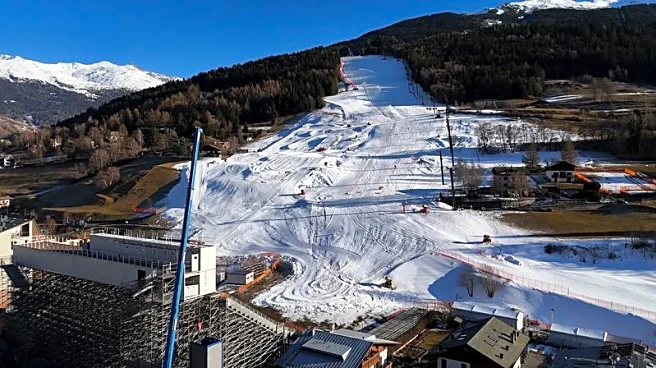
The safety debate is sharpened by the upcoming Milano Cortina Games, where the men's races will take place on Bormio's hair-raising Stelvio course where downhillers can hit 150 kph.
Regarded as one of the toughest tracks on the circuit, it was the site of a December 2023 crash that sidelined Austrian world champion Marco Schwarz for a year.
Under Swiss Lehmann, a downhill world champion in 1993, the FIS has launched a comprehensive plan to overhaul safety which started with a survey of its around 140 member federations to map gaps in their structures.
"We want to see: do you have a dedicated person in charge for safety? Do you have a module in your coach education programme dedicated to safety?... Then share best practice and set standards," Lehmann said.
FIS WANTS TO EXTEND USE OF AIRBAGS
One immediate change Lehmann aims to push through is extending World Cup rules on airbag use to a broader range of training sessions.
The FIS made the airbags mandatory for speed World Cup events and in official training sessions starting from the 2024-25 season.
Exemptions, however, were initially allowed for some athletes, including Italian downhiller Dominik Paris, who argued the body-worn device restricted his movement. Olympic Super-G champion Lara Gut-Behrami was also critical of the device.
"Airbag has been mandatory in competition but not in training," Lehmann said. "We say: airbag has to be worn also in training... No exceptions."
More than 90% of airbags used in World Cup races are supplied by Italian manufacturer Dainese, which began a ski-specific project in 2011.
The ski airbag uses sensors trained on years of runs and GPS technology to monitor an athlete's motion and trigger only in real crashes.
Even if it is the most significant safety innovation in the sport over the last two decades, the airbag took years to take off in skiing amid technical challenges, cost issues and pushback from some skiers.
Dainese's Racing Director Marco Pastore acknowledged a handful of early misfires but said rates were now very low and, crucially, far less dangerous than unintended binding releases.
A crash in 2015 involving Olympic champion Matthias Mayer marked an early high-profile case in which an airbag had inflated during a race.
Mayer broke two vertebrae but a subsequent investigation showed the damage would have been worse without the airbag, Dainese says.
More recently, Olympic giant slalom champion Marco Odermatt's airbag inflated during an extreme save on a 2024 Bormio run but the Swiss skier still finished, unharmed, in fifth place.
BETTER PROTECTION NEEDED AT TRAINING SITES, SKIERS SAY
Former champions say the biggest risks in the sport occur away from televised race days.
Retired Italian downhiller Kristian Ghedina told Reuters training sites -- especially in summer on glaciers or in South America -- often relied on ad-hoc fencing set up the day before.
"In World Cup you have nets right and left; in training
protections are precarious," he said.
The former Cortina and Kitzbuehel winner has urged that skiers be trained on sanctioned hills -- along the lines of the U.S. Ski Speed Centre in Copper Mountain -- and to create more run-off areas and soft barriers where terrain narrows.
Three-times Olympic champion Deborah Compagnoni echoed
Ghedina.
"What's missing today are protections during training," she said, pointing out that hills sometimes had too many parallel training sets on narrow pistes and little escape room.
Compagnoni backs moderating speeds by tweaking gate settings and re-examining the ultra-hard snow preparation that has become standard as natural snowfall declines.
"Something on materials and on course setting can be reviewed," Compagnoni told Reuters.
SMART BINDINGS
Adolfo Lorenzi now runs a foundation named in honour of his daughter Matilde, who died at the age of 19 in 2024 after a crash on a training run in South Tyrol.
He believes safety has lagged behind rapidly evolving equipment and the foundation promotes practical training for coaches as well as advocating for higher safety standards at training camps.
"There's a cost -- but there's no cost tied to a human life," he told Reuters.
Beyond airbags, Lehmann believes smart bindings, which use algorithms to trigger earlier ski release and could available for skiers in three to four years, will reduce the knee and tibia injuries that plague the sport.
The FIS is also looking at thicker race suits that would slow skiers and changes to boot design, although Lehmann conceded teams spend heavily developing faster gear and would not be happy to sacrifice speed.
Academia is joining in. A team from Turin's Polytechnic University is using drones to map pistes and simulate racing lines to generate risk maps. The system, says professor Tania Cerquitelli, could help to determine if a hill is suitable for a given session.
Even with better equipment and modelling, experts say course management still matters. Ghedina, who helped pioneer the back protector in the 1990s and supports airbags, argues for more nets, air-fences and wider fall zones.
"You can't make a sport of speed totally safe... but you can do much more on training pistes," he said.
(Reporting by Lisa Jucca and Sara Rossi in Milan; editing by Clare Fallon and Nick Mulvenney)