


By Karolos Grohmann
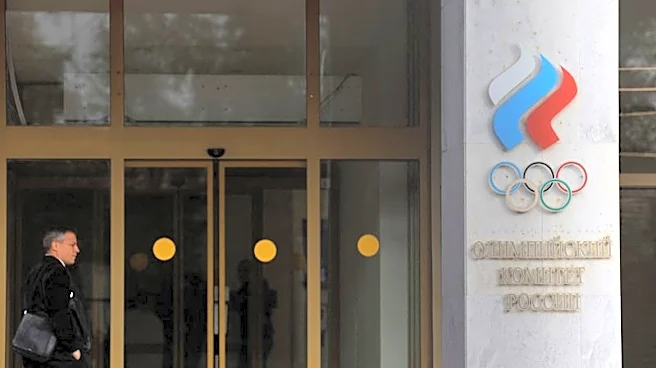
ATHENS, Nov 23 (Reuters) - Russia’s return to international sport after being excluded over its invasion of Ukraine is facing mounting opposition in Europe, drawing the world’s biggest sports organisations into a legal quagmire.
The International Olympic Committee barred Russia from Olympic and international competitions following Moscow's February 2022 full-scale invasion of Ukraine, but in July this year it lifted the suspension, and several sports federations are now allowing
Russians to compete.
With qualifiers across dozens of sports for the 2028 Olympic Games in Los Angeles kicking off in earnest next year, the IOC's recommendation to allow Russia's return to international competition is now being put to the test, with some European countries putting barriers in front of Russian athletes' renewed participation.
Spyros Capralos, president of the European Olympic Committees umbrella body, said there were concerns that the standoff with Russia could affect key LA 2028 qualifiers, including the European Games in June 2027.
The multisport event in Istanbul will offer places at the games across several sports and will likely be the biggest test of how Europe will react.
“It is a massive problem facing Europe because Europe is divided on this matter, with governments which sometimes forget the autonomy of sport,” Capralos told Reuters. “They forget that the most important thing is for all athletes to take part.”
The dispute is already before the Court of Arbitration for Sport, the sporting world's top arbitrator. CAS told Reuters that the Russian Olympic Committee had filed an appeal against the EOC over conditions on Russian athletes’ participation in the Winter European Youth Olympic Festival, to be held in Romania in February.
Russian athletes were told to compete under their national Olympic committee's logo rather than with their flag and anthem, amid strained relations between Romania and Russia.
Romania, a European Union and NATO member, shares a land border of more than 600 km (370 miles) with Ukraine. Centrist President Nicușor Dan has said his country is the target of a hybrid war waged by Russia to destabilise nations that support Kyiv. Russia denies these accusations.
CAS said both parties had agreed to an accelerated procedure, with a ruling expected by December 15 at the latest.
EUROPEAN NATIONS BLOCKING RUSSIAN ATHLETES
The IOC is eager to have Olympic powerhouse Russia fully back in the games after its athletes competed at the Paris 2024 Summer Games and the Milano Cortina 2026 Winter Olympics as neutrals, without their flag or anthem.
Some international sports federations, such as World Athletics, which oversees a showpiece Olympic discipline, still have restrictions in place.
Furthermore, with the war in Ukraine, Europe's biggest conflict since World War Two, about to enter its sixth year, many European nations are not eager to facilitate Russia’s sporting return.
Norway, Sweden and Poland have denied visas to Russian athletes, while some national teams have refused to play them.
Some have said they will not compete against Russia even in junior events, as Norway’s ice hockey team has done. Event organisers, meanwhile, are weighing the costs of hosting Russian competitors.
Next year’s ice hockey World Championships in Germany are already in focus after CAS ruled that Russia was eligible to compete, overturning an International Ice Hockey Federation decision to exclude the team. German organisers have said a Russian presence would require heightened security arrangements that could stretch budgets.
RUSSIA TO CONSIDER ALL LEGAL OPTIONS
Russia, however, is not planning to back down. After briefly considering a switch from the European to the Asian sports federation system several years ago to give its athletes better access to competitions, it is now taking cases to CAS to secure places in events.
Earlier this year, it succeeded at CAS in securing places for some of its winter sport athletes at the Milano Cortina Olympics.
Russia’s sports minister and national Olympic committee president Mikhail Degtyarev has criticised restrictions on Russian athletes, saying his country would consider all legal options.
“We are waiting for a legal statement to proceed with all our complaints to authorities. The (Russian) Hockey Federation follows its own line, and we would go through the IOC,” Degtyarev told Russian television on November 12.
The IOC, which says entry visas are a sovereign responsibility, wants Russia back in the fold.
“Athletes’ access to international competition should not be limited by the passport they hold or affected by the involvement of their governments in a war or conflict,” an IOC spokesperson told Reuters.
However, it has made clear that outside the Olympic Games, it is for international sports federations to deal with the issue of Russian participation at their events.
“The international federations have to navigate the complex and evolving reality – and concrete consequences – of the current geopolitical context, in particular for events they have already awarded and planned,” the IOC said.
Those consequences could, however, end up affecting the IOC’s own events, including the Olympic Games.
“There is, of course (concern),” Capralos, who is also a member of the IOC Executive Board, said, when asked whether the arguments could affect Olympic qualifiers.
“One of the reasons we wanted to have Russians competing was to allow them to qualify for the Games,” he said.
(Editing by Julien Pretot and Toby Chopra)